
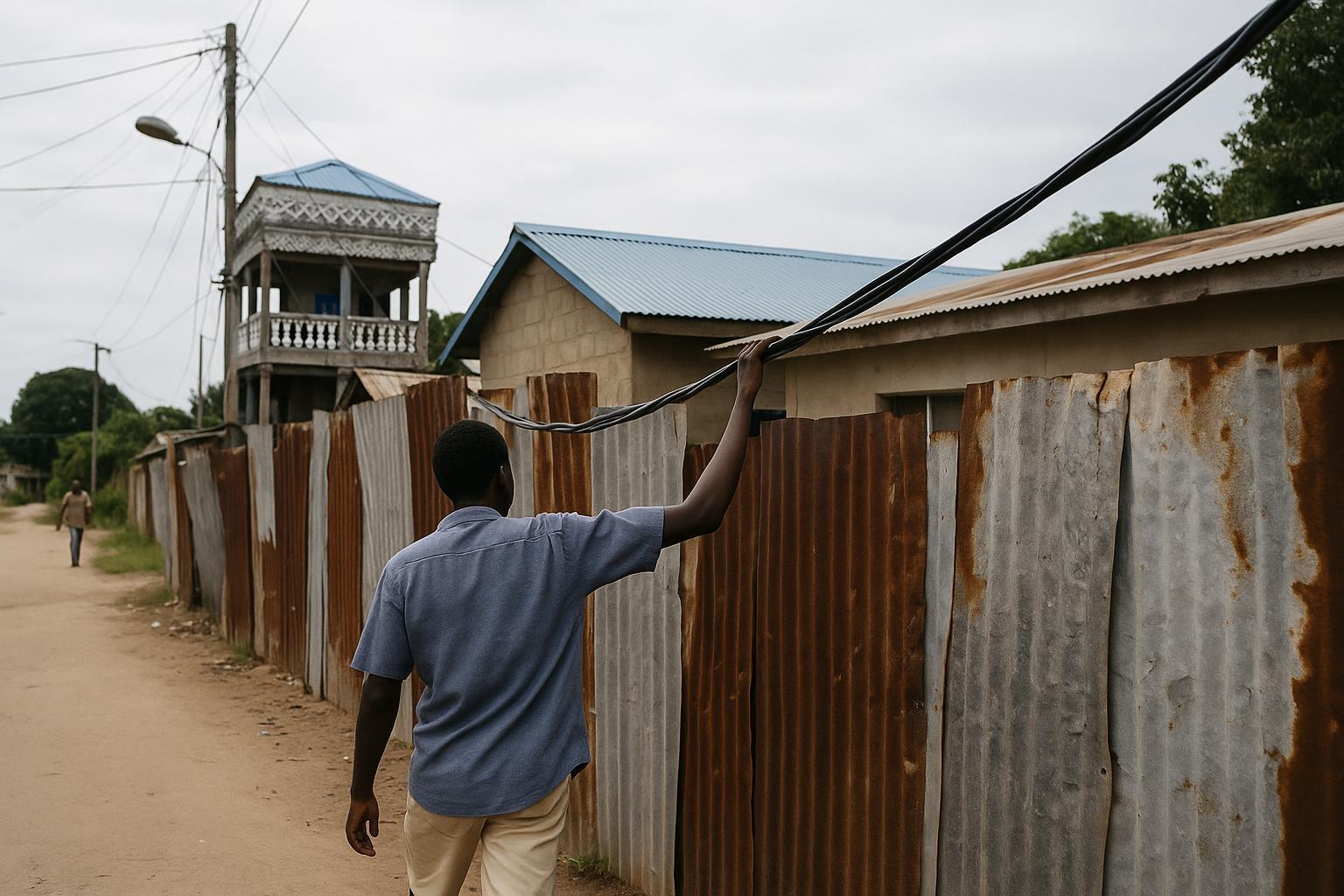
Broken Poles, Sagging Lines: A Daily Sight
Every morning in Don Bosco, pedestrians squeeze past a fallen concrete pole that still feeds power to several homes. The mast slipped four years ago and now rests on a corrugated-iron roof, its low-hanging conductor brushing tree branches and motorbike helmets.
Similar scenes surface in Moukondo, Casis and Massina, where insect-eaten wooden poles lean like tired sentries. Frayed aluminium strands flutter at head height, sometimes sparking against metal shop signs. Street vendors say they have learned to duck instinctively when a gust of wind tilts the lines further.
Neighbours Speak Out on Hidden Dangers
Franck Opanga, who rents a room behind the Don Bosco pole, remembers a recent storm that drenched the conductor. “If the current had leaked, we would have had bodies in the yard,” he says, pointing to a scorch mark on the wall where the wire grazes paint.
Residents say they forwarded written complaints to the head office of Energie électrique du Congo (E2C) and to the Brazzaville mayor’s hotline. Copies of the letters, seen by our newsroom, bear stamps dated January, May and August yet carry no response notes.
Welders in a roadside workshop echo the concern. “We lose entire workdays to outages, and the lopsided poles threaten to crush our machines,” explains Espoir Itoua, tapping a silent arc welder. He has moved gas cylinders indoors to avoid potential sparks from overhead conductors.
E2C Maintenance Teams Outline Their Plan
Contacted by phone, an E2C spokesperson confirms the company has logged 124 fault reports in Brazzaville’s northern districts since June. “We finished a survey in October and prioritised poles with structural fatigue. Replacement began this week in Makélékélé and will extend to Talangaï,” the spokesperson assures.
The utility attributes delays to supply-chain bottlenecks for treated wooden poles and to heavy rain that hampers access to muddy lanes. However, E2C insists emergency crews remain on standby 24 hours, with a toll-free number for immediate shutdowns if cables drop below safety clearance.
City hall’s energy department corroborates the timeline, adding that technical studies are co-financed by the African Development Bank under a broader grid-reinforcement programme announced last year. Engineers plan to replace 600 poles and rebuild 18 kilometres of low-voltage feeders by mid-2024.
Rainy Season Amplifies the Risk
Meteorologist Blanche Okombi notes that Brazzaville’s November rainfall often exceeds 250 millimetres. “Moisture weakens wooden infrastructure and increases leakage currents on dusty insulators,” she explains. The combination of water and exposed metal raises shock probability, especially near improvised extensions connected without proper joints.
Civil-protection officers report that three non-fatal shocks were recorded in October when shoes, puddles and live conductors met. Though numbers remain low, Captain Fabien Mankoko urges vigilance: “Most incidents stem from curiosity—children tugging loose wires or adults shifting makeshift kiosks under them.”
Insurance brokers meanwhile warn of economic losses from outages. Frozen-food vendors on Total Garage roundabout say a single three-hour cut can spoil a week’s earnings. With thunderstorms forecast to intensify, many have bought petrol generators, driving up demand for fuel in suburban stations.
Engineers and Civic Groups Call for Vigilance
Electrical-safety lecturer Irène Ngouabi recommends a community mapping exercise. “Neighbourhood committees can identify weakened poles and send geotagged photos to E2C. It reduces inspection time,” she suggests, citing a pilot carried out in Ouenzé last year that sped up repairs by 30 percent.
NGO Lumière Citoyenne has launched a social-media campaign tagged #SauverLeCourant, sharing short videos on how to recognise a dangerous line and how to cut power at the meter before storms. The clips reached fifty-thousand views in their first week, according to platform analytics.
Back in Don Bosco, Franck Opanga remains hopeful. A fresh orange spray-paint mark now circles the base of his fallen pole—an E2C technician’s sign that replacement is imminent. “If the pole leaves our roof before the next big rain, we’ll finally sleep easy,” he smiles, watching clouds gather again.