
Protest erupts in downtown Brazzaville
Shortly before midday on 30 October, around five hundred former employees of the private sanitation firm Averda massed outside the fourteen-storey glass headquarters of the Ministry of Urban Sanitation, Local Development and Road Maintenance in downtown Brazzaville.
Demanding overdue wages and severance benefits, the placard-waving group staged a sit-in that briefly disrupted traffic on avenue de la Base, drawing curious onlookers and a discreet police cordon keen to keep tempers from flaring.
The impromptu rally followed several written petitions sent since August to Averda’s local management and to the Labour Inspectorate, to which the protesters say they have received either partial responses or none at all.
Minister cites legal obligations
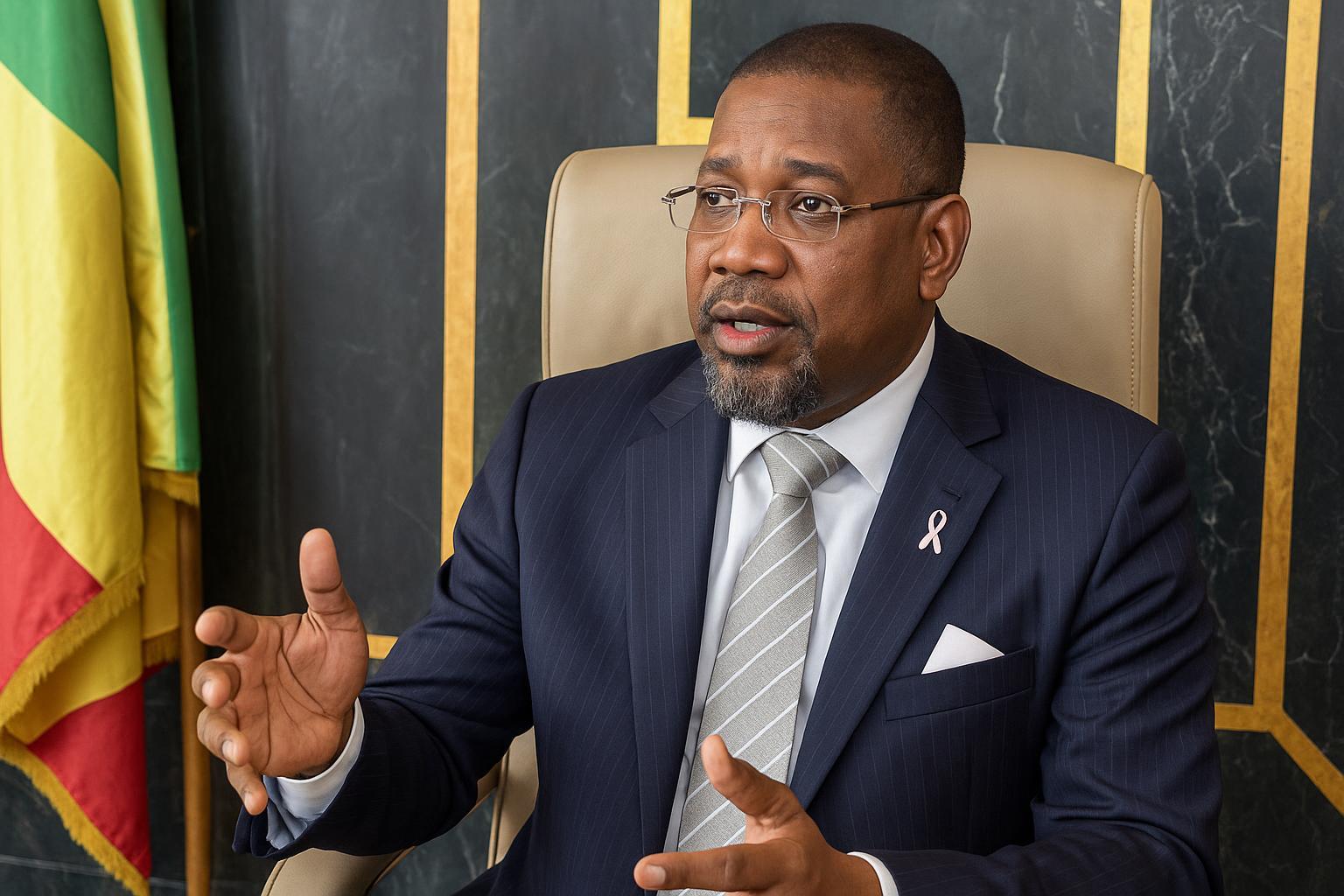
Inside the ministry auditorium, Minister Juste Désiré Mondélé swiftly convened reporters to clarify the government’s position, stressing that the demonstration did not comply with the country’s labour code, which requires prior notification to authorities and, where possible, mediation before any picketing.
We understand their distress, yet rules exist so that every grievance is examined calmly and fairly, the minister said, adding that peace and social cohesion remain priorities for President Denis Sassou Nguesso’s administration.
Mondélé nonetheless instructed his chief-of-staff to receive a delegation of five representatives, signalling an openness to dialogue while maintaining that any financial settlement would ultimately depend on Averda and, if necessary, arbitration by the Labour Tribunal.
Workers share unpaid wage stories
Outside, former street-sweeper Alphonse Mabiala clutched a dog-eared contract showing he joined Averda in 2016 on a monthly wage of 90,000 FCFA, equivalent to roughly 150 USD at today’s rate, which he says has not reached his account since April.
My children have left school because I cannot pay the fees, he told our reporter, his orange uniform faded but neatly pressed, a sign that pride survives hardship.
Similar testimonies echoed up the concrete façade as security guards escorted small groups upstairs for talks, many stressing they want dialogue not confrontation, provided arrears and end-of-contract bonuses are properly calculated.
Company position and labour law
Averda’s Brazzaville management, contacted by phone, declined to comment in detail but reiterated its commitment to honour all lawful obligations once ongoing audits with the tax authorities are completed.
Under Congolese law, an employer must pay outstanding salaries within fifteen days of contract termination, failing which penalties may be imposed by the Labour Inspectorate or, at the employee’s request, by a specialised court.
Observers note that disputes involving foreign concessionaires can take longer because of arbitration clauses and cross-border financial transfers, a complexity minister Mondélé said reinforces the need for strict adherence to procedural channels.
Government pushes for dialogue
The minister urged Averda directors, currently based in Casablanca, to send a negotiating team to Brazzaville as soon as possible, arguing that face-to-face talks ease mistrust and accelerate paperwork handled by the Treasury and Social Security Fund.
He stressed that his department has no contractual bond with the former workers, whose agreement was signed solely with the private company, but that the state remains prepared to facilitate an amicable settlement in the public interest.
Officials at the Ministry of Labour confirmed that, once formal complaints are filed, inspectors can summon Averda within 48 hours to present payroll records, a step that could pave the way for rapid conciliation or, failing that, a court hearing.
Sanitation stakes for the capital
The dispute unfolds amid renewed efforts to keep Brazzaville clean ahead of the festive season, with the city counting on both public crews and private contractors to collect 1,200 tonnes of household waste generated daily.
Community leaders fear that protracted wage rows could discourage investors in waste management, yet the ministry insists that clear rules and transparent dialogue will ultimately strengthen the sector and improve living conditions for residents.
For now, traffic has returned to normal on avenue de la Base, and both sides have exchanged phone numbers; in the coming days Brazzavillois will watch closely to see if quiet conversation can pick up where loud slogans left off.
Practical advice for claimants
Labour lawyers interviewed by Les Dépêches de Brazzaville advise employees to gather pay slips, bank statements and any correspondence with management before filing, because precise figures shorten proceedings and help judges award damages where proof of hardship exists.
They further remind protest leaders that a registered union or elected staff delegate can represent them in court without charge, a provision designed to protect low-income workers while preventing spontaneous rallies that may spiral into unrest.
At press time, the ex-Averda collective was drafting a memo summarising claims estimated at 600 million FCFA in total, including vacation pay and social security contributions, a figure the company has not confirmed but promised to examine.
Potential template for future PPPs
Should reconciliation succeed, officials hope the precedent will serve as a template for other public-private partnerships in sanitation, transport and energy, sectors where clear exit strategies for workers are increasingly written into contracts signed by the Congolese state.