
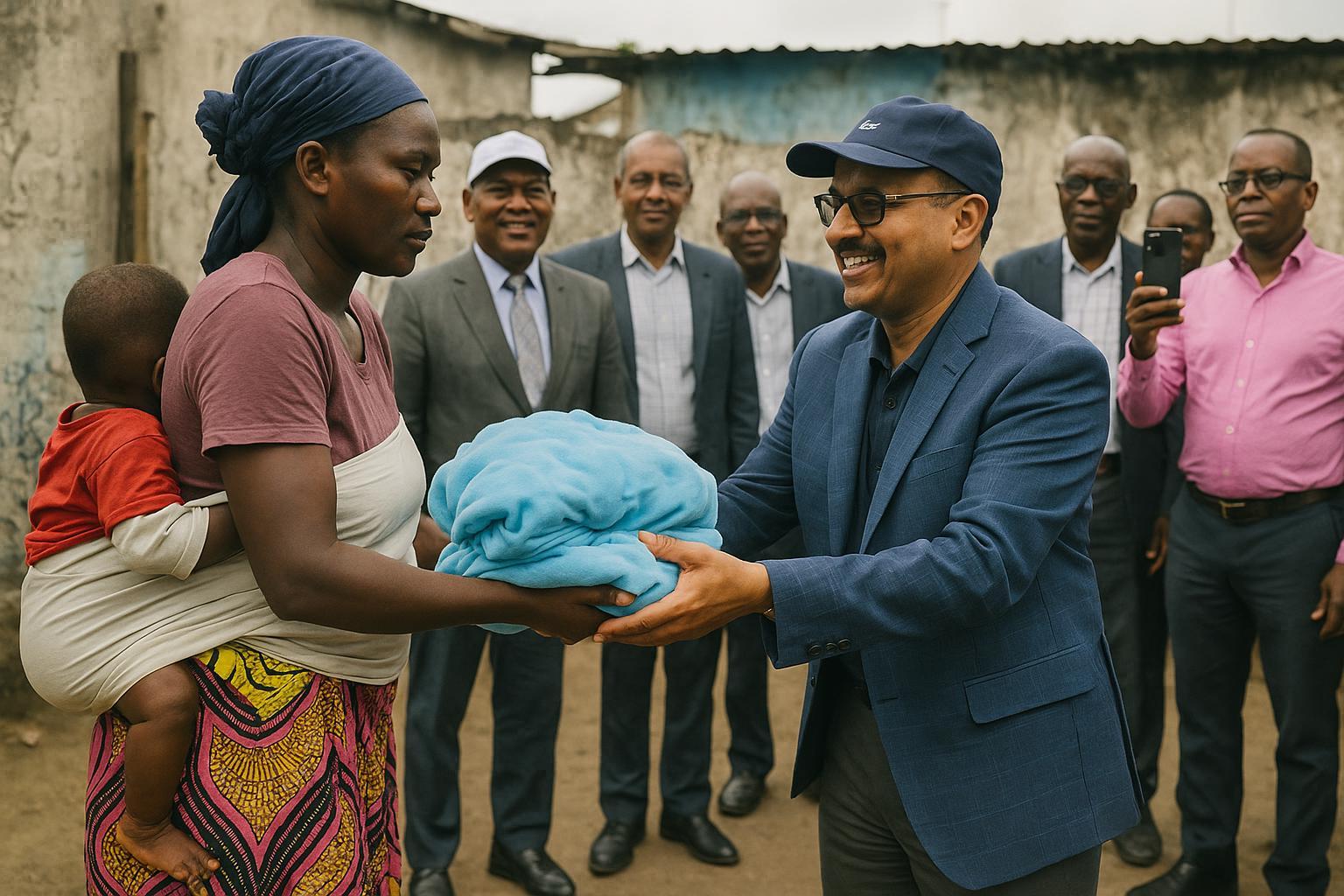
Nationwide mosquito-net push enters phase two
Four southern departments are buzzing with activity as Catholic Relief Services, working hand in hand with the Ministry of Health and Population, drives the second phase of Congo’s free distribution of Long-Lasting Insecticidal Nets, a flagship operation against malaria supported by the Global Fund.
The strategic supervision mission, led by CRS Country Representative and the organisation’s Global Fund Project Director, set out to Pointe-Noire, Kouilou, Niari and Bouenza to gauge field progress, tighten coordination with local authorities and provide immediate technical back-up where distribution teams faced logistical or data-collection challenges.
Hands-on oversight across four departments
Every stop began with a courtesy visit to the prefect, underlining the campaign’s reliance on administrative leadership for access to communities and mobilisation of local resources.
The delegation then joined ceremonial launches in Kouilou on 10 October and in Pointe-Noire on 11 October 2025, events that turned town squares into open-air health classrooms where net demonstration, cultural troupes and young volunteers drew residents closer to prevention messages.
CRS specialists paired with staff from the National Malaria Control Programme and departmental health directorates to walk warehouse aisles, inspect stock cards, and ride motorcycles to last-mile villages, ensuring that net bales, tally sheets and smartphones travelled the same rugged path.
Digital toolkit keeps the pulse live
Much attention centred on Congo DIGIT, a mobile application that guides distributors house to house, captures household data and feeds dashboards watched at district level.
During impromptu on-screen sessions, supervisors refreshed passwords, corrected GPS drift and verified that daily synchronisation remained under the network coverage available in each settlement.
Field teams reported that the app reduced paperwork and speeded returns to central command, a gain particularly visible in Kouilou where previous campaigns relied on overnight motorcycle couriers.
Supply chain keeps nets moving
In Pointe-Noire’s seaside warehouse, towering stacks of compressed bales awaited interior dispatch. Supervisors verified humidity logs, wooden pallets and insect-proof lining, explaining that a single torn wrapper could compromise thousands of insecticide-treated fibres before they reach households.
From there, pick-ups funded by the Global Fund and fuel vouchers from local councils rolled nets to health zones, where community leaders stamped reception forms, ensuring transparent hand-over at every step and preventing leakages that historically eroded public confidence.
At district pharmacies in Niari, cold-chain refrigerators sat next to the radiant-blue bundles, a reminder that malaria prevention is now integrated with vaccine outreach, allowing health agents to piggy-back transport and stretch scarce budgets.
Bouenza officials praised the Ministry’s e-dispatch platform, which flashes a text alert once each consignment leaves central storage, enabling immediate follow-up calls if a truck is delayed by rain-washed roads.
Training and transparency deepen impact
Daily indicators posted on clinic noticeboards—total nets dispatched, households covered, breakage rate—give residents a rare glimpse into real-time performance. Mothers waiting for prenatal checks said the tally boards make them feel part of the process rather than passive recipients.
Training sessions held before the rollout equipped over 2,000 distributors with refreshers on net handling, safe driving, and respectful communication, strengthening service quality while creating short-term employment for graduates in the four departments.
Community commitment fuels success
Beyond gadgets, success still hinges on human contact, a point repeatedly stressed by health promoters banging on doors, greeting families in Kituba and Loango and demonstrating how to tuck the net edge under a bamboo mat.
Parents interviewed in Niari thanked distributors for walking back at dusk to check whether children were truly sleeping under the newly received material, a gesture seen as proof that the campaign is more than a hand-out.
CRS leadership echoed that sentiment during nightly debriefs, saluting what they called the ‘heroes of the field’ who cross flooded tracks or spend hours explaining how one torn net can still be repaired.
Local government officials highlighted the campaign’s spill-over benefits, including temporary jobs for young graduates as data clerks and a surge in community clean-ups organised around launch days.
Positive mid-term verdict, yet work continues
At the close of the tour, CRS expressed satisfaction with the pace of deliveries and the precision of stock management, while encouraging teams to keep daily reconciliation tight as volumes peak in coming weeks.
The Ministry of Health and Population, through the National Malaria Control Programme, reaffirmed its commitment to universal coverage, noting that the current round builds on achievements from phase one earlier in the year.
CRS officials underscored that lessons from the southern departments will inform upcoming activities in other regions, especially the integration of real-time dashboards into routine health management.
Partners agreed to maintain close supervision through the rainy season, a period when mosquito density rises and user reminders become equally vital as net availability.
For households across Pointe-Noire, Kouilou, Niari and Bouenza, the blue-green nets now hanging above beds are tangible symbols of coordinated action against a disease that still burdens families, but the overall verdict from the field is clear: momentum is strong and collaboration is paying off.