
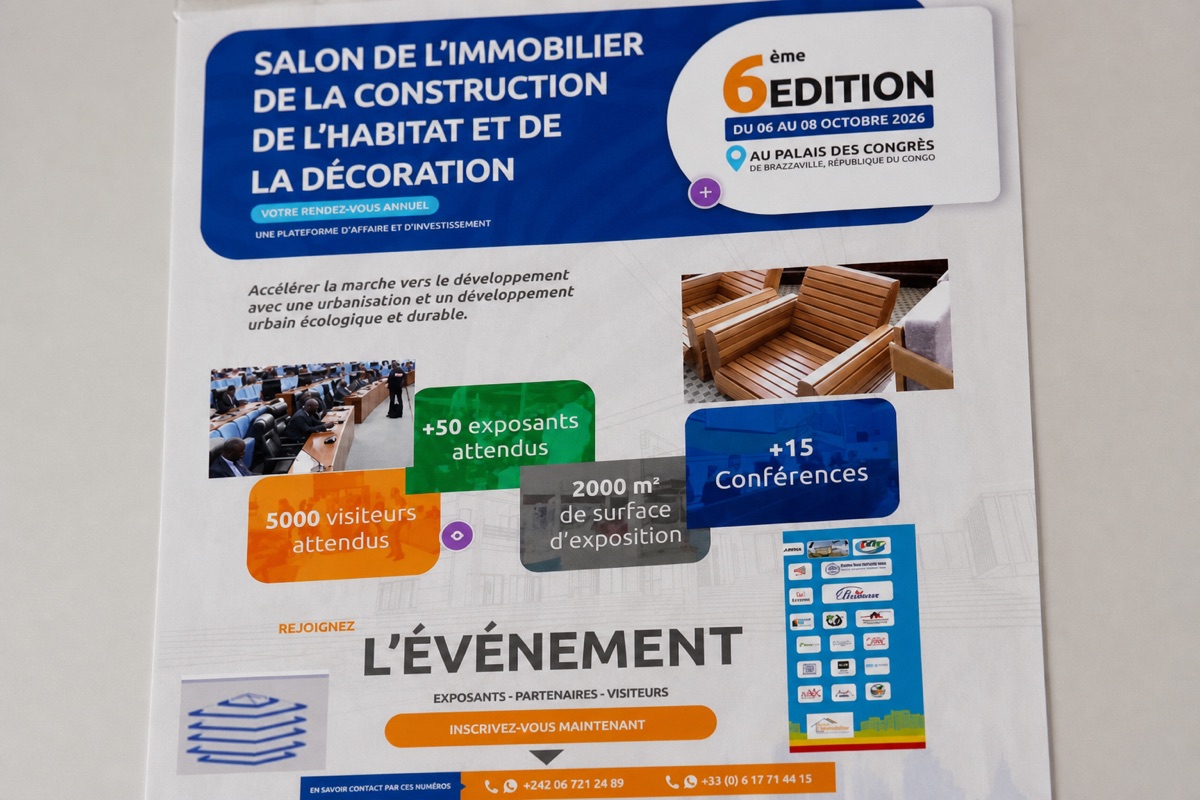
Brazzaville is setting a date with its property sector. From 6 to 8 October 2026, the Palais des Congrès will host the sixth edition of the Real Estate Fair, a gathering that has grown into a fixture for Congo-Brazzaville’s builders and buyers alike.
The event is organised by the Association for the Environmental Planning and Management of Urban Cities of the Republic of Congo, known by its French acronym 2Agevuc. Its ambition reaches well beyond a simple trade show for professionals looking to network.
A three-day forum built around green urban growth
This year’s edition carries a deliberate theme: accelerating development through ecological and sustainable urbanisation. The phrasing signals a shift in tone, placing environmental care at the heart of a conversation once dominated by concrete, permits and profit margins.
Over three days, the fair intends to move past showroom talk. Roundtables will anchor the programme, giving specialists room to debate the pressures reshaping Brazzaville and other Congolese cities in real, practical terms.
Land pressure and prices take centre stage
Several discussions cut close to daily worries. One roundtable examines national territorial planning against the country’s habitability challenges, a polite way of naming crowded neighbourhoods and uneven access to serviced land across the republic.
Another session tackles the movement of property prices and the mounting tensions over land ownership. For families and small buyers, these are not abstract themes but the arithmetic behind whether a plot in Brazzaville stays within reach.
Organisers have also lined up talks on urban identification, environmental challenges and the revitalisation of city districts. Together, these threads sketch a fuller portrait of what a modern, liveable Congolese city might require in the years ahead.
A meeting point for the full property chain
The guest list reflects that breadth. Promoters, builders and estate agents are expected alongside architects, notaries, bankers, insurers and investors. Rarely does the sector’s entire chain sit in one room, and the fair leans on that concentration.
By bringing financiers and legal professionals into the same space as developers, the event tries to smooth the frictions that often stall projects. Access to credit, clear title and reliable insurance remain recurring hurdles for anyone building formally in the country.
Why the state is paying attention
The fair is no longer a purely private affair. Since 2022, it has been written into the sixth pillar of the National Development Plan 2022-2026, giving it a formal place within the government’s broader economic roadmap for the republic.
That inclusion matters. It positions the gathering as a tool for structuring the formal real estate market, an area where informal arrangements have long complicated ownership, taxation and long-term planning across Congolese urban centres.
The organisers frame the fair as a bridge. It seeks to connect civil society, the private sector and the state, three worlds that must cooperate if housing supply is to keep pace with a growing and increasingly urban population.
Courting the diaspora and its capital
One audience receives particular attention. Congolese living abroad are squarely in the fair’s sights, many of them searching for trustworthy ways to finance property purchases back home without falling prey to uncertainty or opaque deals.
For the diaspora, buying land or a house in Brazzaville can be fraught with distance and risk. Offering them a formal, visible marketplace, backed by bankers and notaries, is part of the event’s quiet pitch to bring their savings into the local economy.
A recurring rendezvous with rising stakes
Reaching a sixth edition tells its own story. The Real Estate Fair has settled into the calendar as a recognised platform, one that professionals and public authorities alike now treat as a barometer of the sector’s health and direction.
As October 2026 approaches, the Palais des Congrès prepares to host more than exhibition stands. It will stage a wider conversation about how Congo-Brazzaville houses its people, manages its land and squares urban growth with the demands of a durable environment.
The blend of ambition and caution running through the programme feels apt. Building sustainable cities is slow, contested work, and a three-day fair cannot resolve it. Yet by gathering the right voices, Brazzaville signals that the question is finally being asked in earnest.