
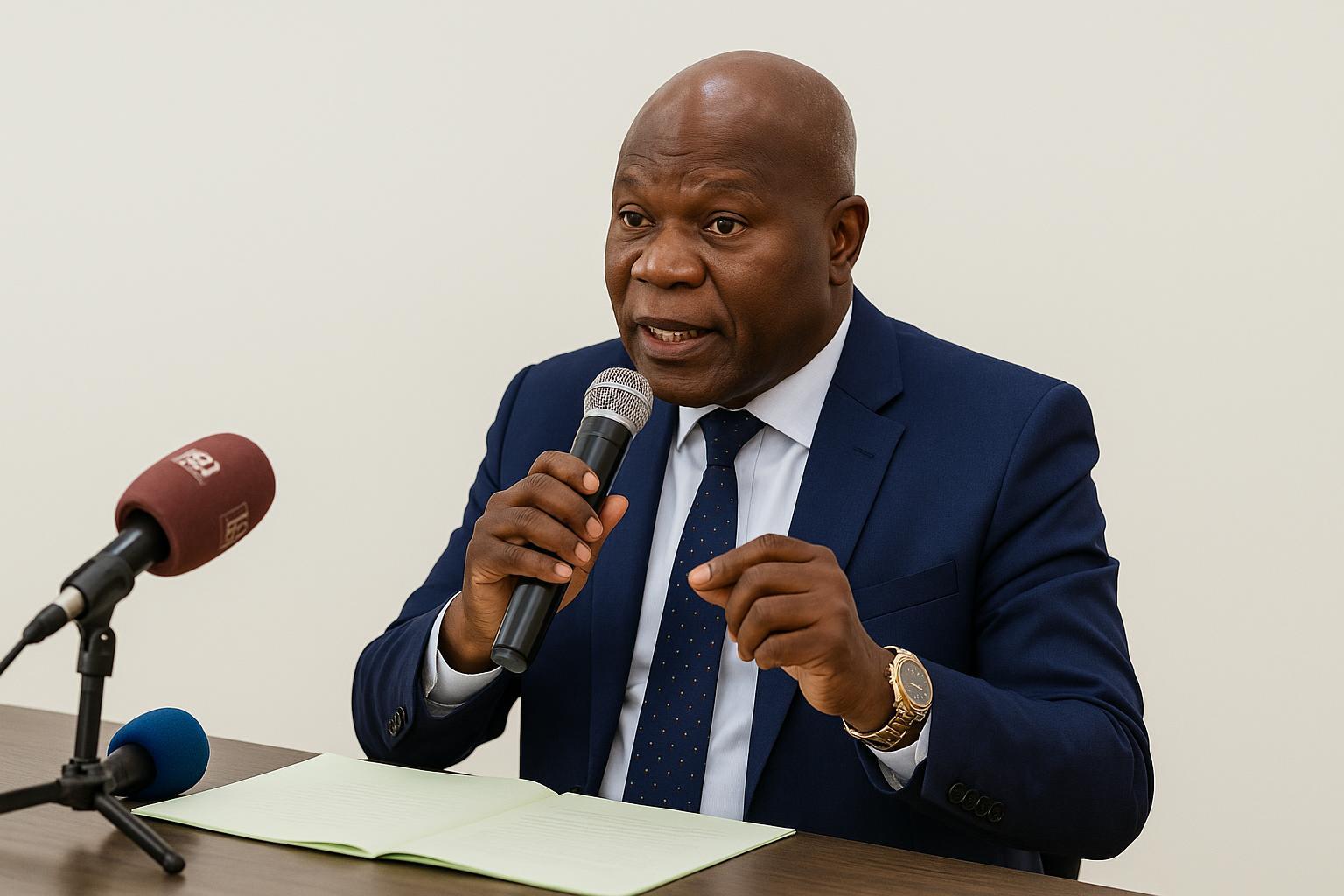
Television Host Enters 2026 Race
Alexis Bongo, long-time host of the socio-political talk show Homéosthasie on Digital Radio Television (DRTV) surprised commentators by officially launching his bid for Congo-Brazzaville’s March 2026 presidential election during a press briefing at Brazzaville’s Zola Cultural Center on 16 August before national reporters alike present.
Press Conference Highlights
Flanked by veteran journalists and community leaders, the 56-year-old declared that his movement, christened The New Congo, would provide a “third narrative” beyond traditional party lines, insisting that media experience has given him “daily contact with citizens’ real anxieties” (Matin Libre, DRTV archives) this week.
Bongo is no stranger to electoral ambition: he briefly picked up sponsorship forms in 2016 but withdrew, citing family priorities rather than the 25-million-CFA deposit demanded by the electoral code, a point he reiterated to quell speculation about financial capacity during the recent press exchange.
Blueprint of The New Congo
The independent hopeful frames his platform around three pillars—youth employment, agricultural revival, and digital governance—articulated in a 40-page booklet circulated after the press conference; analysts compare the outline to civic programs promoted by continental reformists such as Ghana’s President Nana Akufo-Addo during recent election cycles.
Research group Observatoire Congolais des Médias notes that Bongo’s popularity index on urban social networks rose from 17 to 24 percent within 48 hours of his announcement, an uptick partially credited to viral clips from Homéosthasie focused on anti-corruption storytelling across Facebook, TikTok and YouTube.
Legal and Electoral Context
Legally, presidential hopefuls must be Congolese by birth, aged between 40 and 70, and submit signatures from elected officials alongside the monetary deposit; the Ministry of Territorial Administration confirmed that the normative framework for 2026 remains unchanged (ADIAC interview, 5 September) earlier this calendar year.
Political scientist Aimée Ondongo argues that Bongo’s independent run could reshape campaign discourse, stating, “When a television personality speaks policy fluently, parties must refine messages rather than rely on mobilization machinery.” Her comment, published by Les Dépêches de Brazzaville, drew mixed online reaction last night.
Economic and Youth Priorities
For his part, Bongo avoids overt criticism of the incumbent administration, instead positioning himself as an “additional set of hands” ready to consolidate existing macroeconomic gains, especially in oil revenue management, while fostering local processing industries to diversify exports beyond crude according to campaign briefs.
Outside Brazzaville, preliminary teams have scheduled listening tours in Pointe-Noire, Dolisie and Ouesso, intending to compile community scorecards that will feed into a final manifesto promised for January; field coordinators say the tour budget is crowd-financed through small electronic transfers collected via mobile money platforms.
The youth component of Bongo’s agenda resonates with statistics from the National Employment Observatory showing that citizens under 35 represent 62 percent of the labour force but hold only 28 percent of formal jobs, a disparity he describes as “both a challenge and opportunity” urgent.
Historical Parallels and Logistics
Historian Francis Mvoula recalls that Congo-Brazzaville’s political tradition has seen media figures transition into public office, pointing to former Culture Minister Léon-Alfred Opimbat as precedent, yet warns that the national landscape now demands digital strategy, ground logistics and coalition building in equal measure for success.
In parallel, the Independent National Electoral Commission has begun biometric voter roll updates, with spokesperson Hilaire Ngatsé assuring that the process will be finalized by December so “all enfranchised citizens, including first-time voters, can exercise choice freely” (Radio Congo, 2 September broadcast) heard across districts.
Regional observers from the Economic Community of Central African States plan to deploy an early assessment mission in the first quarter of 2025, a timeline aimed at fostering transparency and continuity with 2021 legislative monitoring that drew favourable reviews from civil society at the time.
Despite his outsider branding, Bongo confirmed discussions with niche parties focused on green technology and women’s entrepreneurship, signalling potential alliances designed to reach the 15 departments efficiently; details are expected after an inter-platform forum scheduled in Sibiti next November pending logistical and legal clearances nationwide.
Institutional Calendar and Ethical Questions
Government officials contacted by our newsroom declined to comment on individual candidacies but reiterated the constitutional timetable, with the presidential decree convening voters anticipated for late January 2026, in line with prior cycles; provisional results should follow within five days of balloting according to protocol.
For now, Bongo continues anchoring his weekly programme, promising editorial impartiality while campaigning after airtime. Journalism unions view the stance positively, arguing that maintaining professional duties may set useful precedent for media ethics during electoral seasons often marked by polarization across traditional and online platforms.
International Watch and Outlook
As the field broadens, diplomats stationed in Brazzaville monitor evolving alliances, mindful that stability, energy exports and regional security depend on credible polls. Whether Alexis Bongo translates television charisma into a viable nationwide organization will become clearer once signature drives begin early 2025 across constituencies.