
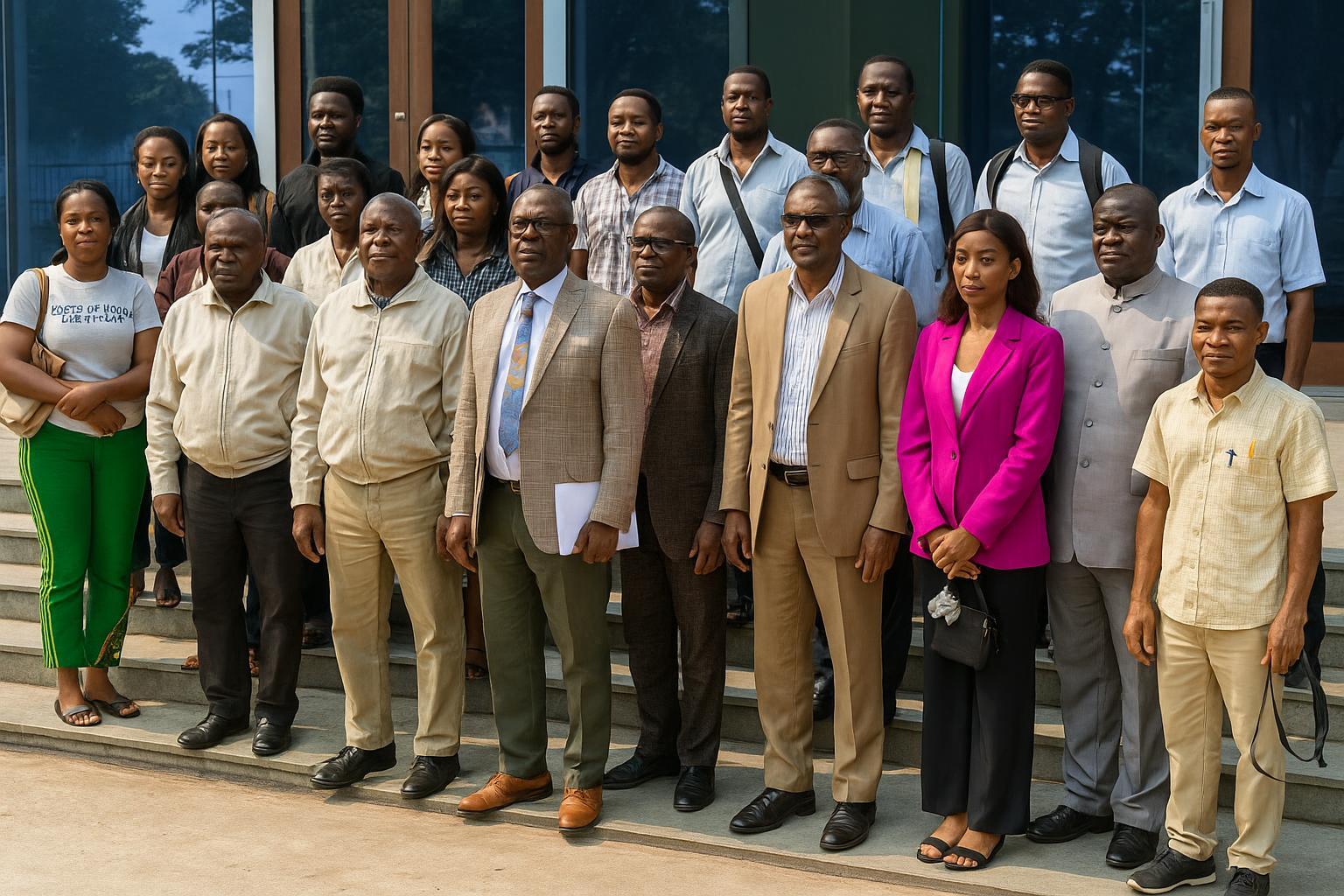
An Academic First in Brazzaville
The courtyard of the Faculty of Letters, Arts and Human Sciences, known as Flash, hummed with an energy rarely seen in mid-August. For two days, 7–8 August 2025, master’s and doctoral candidates gathered for the institution’s inaugural Doctoral Days.
Conceived within the Ellic doctoral programme—short for Literary, Linguistic and Cultural Spaces—the event unfolded under the twin themes of research challenges in francophone literatures and the professionalisation of cultural and artistic studies. It marked a symbolic milestone for Congo’s only public university, Marien-Ngouabi.
Dean Professor Évariste Dupont Boboto, greeting participants beneath the jacarandas, called the gathering “a breath of fresh air that makes the faculty live again.” His enthusiasm echoed across local outlets, including the daily Les Dépêches de Brazzaville, which hailed the initiative’s academic ambition.
Debating Francophone Literatures
The first seminar, led by Professor Dieudonné Moukouamou-Mouendo, tackled the elusive label “littératures francophones.” He traced its birth to nineteenth-century debates on empire and language, stressing the plural form as evidence of dispersed canons stretching from the Maghreb to the Caribbean and Central Africa.
“Each text carries a passport of its own,” he noted, urging scholars to combine comparative poetics with sociology, anthropology and digital humanities. Such multi-lens reading, he argued, protects against the temptation to flatten voices into a single post-colonial narrative, a risk flagged by scholars like Ngũgĩ.
Recent bibliometric data from Érudit and Persée platforms, highlighted during the session, reveal a 32-percent rise in francophone-literature articles since 2020, a trend mirrored at Flash where enrolment in literature tracks has doubled in five years, according to internal faculty statistics shared onsite.
Financing Future Scholarship
Funding prospects also surfaced. Representatives from the Congolese National Research Fund outlined micro-grants of up to 5 million CFA francs for interdisciplinary projects merging literature with technology. Since 2023, the fund has allocated 30 percent of its portfolio to humanities innovation, a figure slated to increase.
From Lecture Hall to Labor Market
If the morning belonged to theory, the afternoon confronted employability. Professor Bienvenu Boudimbou opened bluntly: secondary schools steer most pupils toward literary streams, yet too few translate that choice into viable careers. His diagnosis resonated with Education Ministry surveys showing high under-employment among humanities graduates.
Curricula, he argued, remain heavy with commentary and light on craft. Less than ten percent of course hours involve digital tools, and partnerships with theatres, publishers or studios are sporadic. “Students must exit the library and enter the marketplace,” he told the hall, prompting murmurs of agreement.
To map opportunities, Boudimbou projected an interactive slide listing 60 culture-sector jobs, from podcast production to heritage conservation. Citing UNESCO’s 2022 Cultural Industries Report, he reminded the audience that creative trades generate nearly 3 percent of sub-Saharan GDP, outpacing traditional mining growth.
He closed with a phrase destined for campus folklore: “The click is worth the franc.” The room laughed, yet the message was serious. Students were urged to package research into blogs, educational games or branded storytelling—formats now recognised by several Brazzaville media houses contacted for comment.
Student Momentum Builds
Second-year doctoral candidate Christelle Gampika said the sessions demystified career paths. “I always feared being trapped in adjunct work; now I’m drafting a podcast on Kongo Kingdom myths,” she shared. Her peer Arnaud Mabiala mentioned approaching a local gallery to curate an exhibit on Lingala poetry.
Outside observers also took note. The French Institute of Congo dispatched its cultural attaché, who hinted at future co-financed workshops. Meanwhile, Congolese startup Moko Studios signalled interest in sponsoring a student film lab, affirming that storytelling skills are vital to the nation’s soft-power portfolio.
University records show that over 120 students registered for the Doctoral Days, exceeding initial projections by 40 percent. Social-media analytics collected by the organisers recorded more than 15,000 hashtag impressions within 48 hours, a small but telling indicator of latent demand for such forums.
Toward a Connected Campus
Looking ahead, Professor Anatole Banga, head of Ellic, revealed plans for a digital repository where theses, podcasts and art films could coexist. “Scholarship must be discoverable,” he commented, referencing African Journals Online statistics indicating that open-access papers receive twice as many citations within three years.
Discussions are also under way with the Ministry of Higher Education to integrate credit-bearing internships in the 2026 syllabus. While negotiations continue, officials emphasise that resource allocation will follow fiscal guidelines outlined in the 2025 national budget, which earmarks a 12-percent rise for university innovation.
For now, the courtyard has emptied, but chalk scrawls of project ideas still cover the portable whiteboards. In the words of Dean Boboto, “The flame is lit.” Whether that flame fuels dissertations or digital start-ups, the first Doctoral Days have altered expectations across Flash.
Prospects for 2026
Observers predict the 2026 edition will double attendance, underscoring a momentum that appears as durable as it is overdue.