
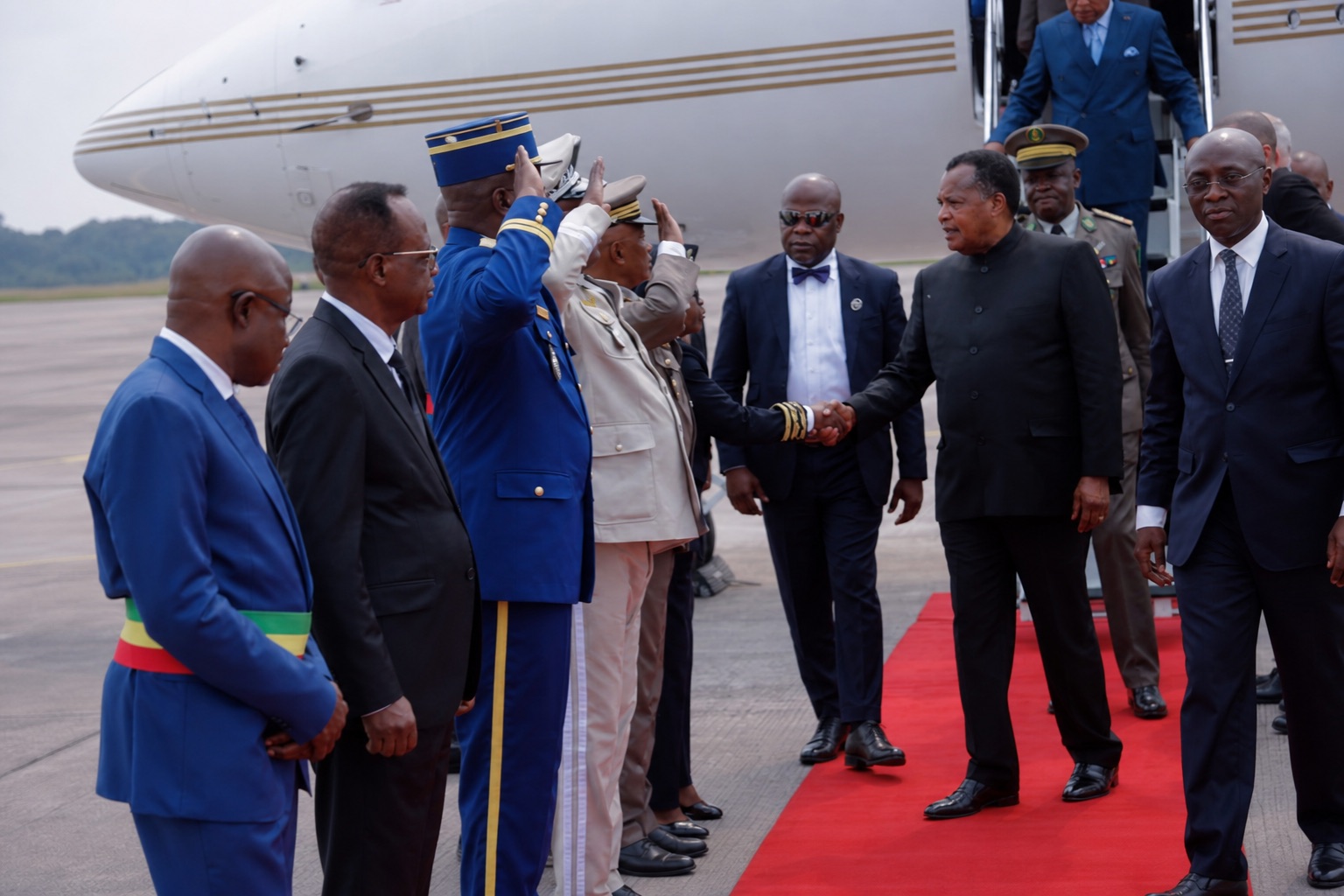
President Denis Sassou N’Guesso has opened a week-long working stay in Oyo, his political home in the Cuvette department. The visit signals a hands-on push to steer Congo-Brazzaville’s economy as the country opens a fresh five-year cycle built around faster national development.
A Week of Work in the Cuvette Heartland
The head of state landed in Oyo on 27 June, flying into Ollombo international airport. Prefectural authorities from the Nkéni-Alima and Cuvette departments greeted him as he stepped off the plane, marking the start of a stay set to run close to a week.
The choice of Oyo is more than symbolic. By working from the Cuvette rather than Brazzaville, the president keeps the machinery of government close to him while remaining anchored in the region that has long shaped his political base and public image.
Consultations and a Possible Cabinet Sitting
During the stay, the president is expected to receive several figures for consultations and exchanges on the country’s main priorities. The agenda points to a season of listening, with the presidency gathering views before the next phase of governance takes firmer shape.
A meeting of the Council of Ministers could also be held in person in Oyo, according to available information, barring any last-minute change. Holding the cabinet outside the capital would underline the president’s intent to govern visibly from the field rather than from a single seat of power.
Economy and Public Finances Take Centre Stage
At the core of the president’s concerns sit the economic and financial questions that shape Congo-Brazzaville’s growth path. The administration has framed these as the decisive levers for the new term, and the Oyo stay places them squarely under presidential attention.
Improving public finances ranks high on that list. Tighter management of state accounts is presented as a prerequisite for credibility, both at home and with the partners who weigh the country’s fiscal discipline before committing further support.
Containing inflationary pressures forms a second priority. The cost of living weighs directly on households, navetteurs and small businesses across urban and peri-urban areas, making price stability a concern that reaches well beyond government ledgers.
Monitoring the monetary situation and tracking the main macroeconomic indicators round out the set of priorities. Together they form a dashboard the government intends to watch closely, reading the signals that will tell whether the chosen course is holding.
A New Five-Year Cycle Under the Sign of Acceleration
The stay fits within the orientations fixed for the new five-year term, placed under the banner of accelerating national development. That framing sets the tone for the months ahead and gives the Oyo consultations their wider meaning.
It also comes at a defining moment: the launch of the 2026-2031 Action Plan. The plan is presented as the strategic framework meant to support the economic and social transformation of the country, tying near-term decisions to a longer horizon.
For citizens, the test of such a framework will lie less in its title than in its everyday effects. Stable prices, steadier public services and visible local investment are the markers most likely to shape how the plan is judged in Brazzaville, Pointe-Noire and the departments alike.
What to Watch in the Days Ahead
The coming days should reveal which personalities the president receives and whether the cabinet does convene in Oyo. Each signal will offer a clue to the pace and priorities of the new term as it moves from declarations toward concrete steps.
For now, the message from the Cuvette is one of continuity and intent. The president has chosen to open this chapter close to his roots, framing the work as the start of a long climb toward the goals set for 2026-2031.