
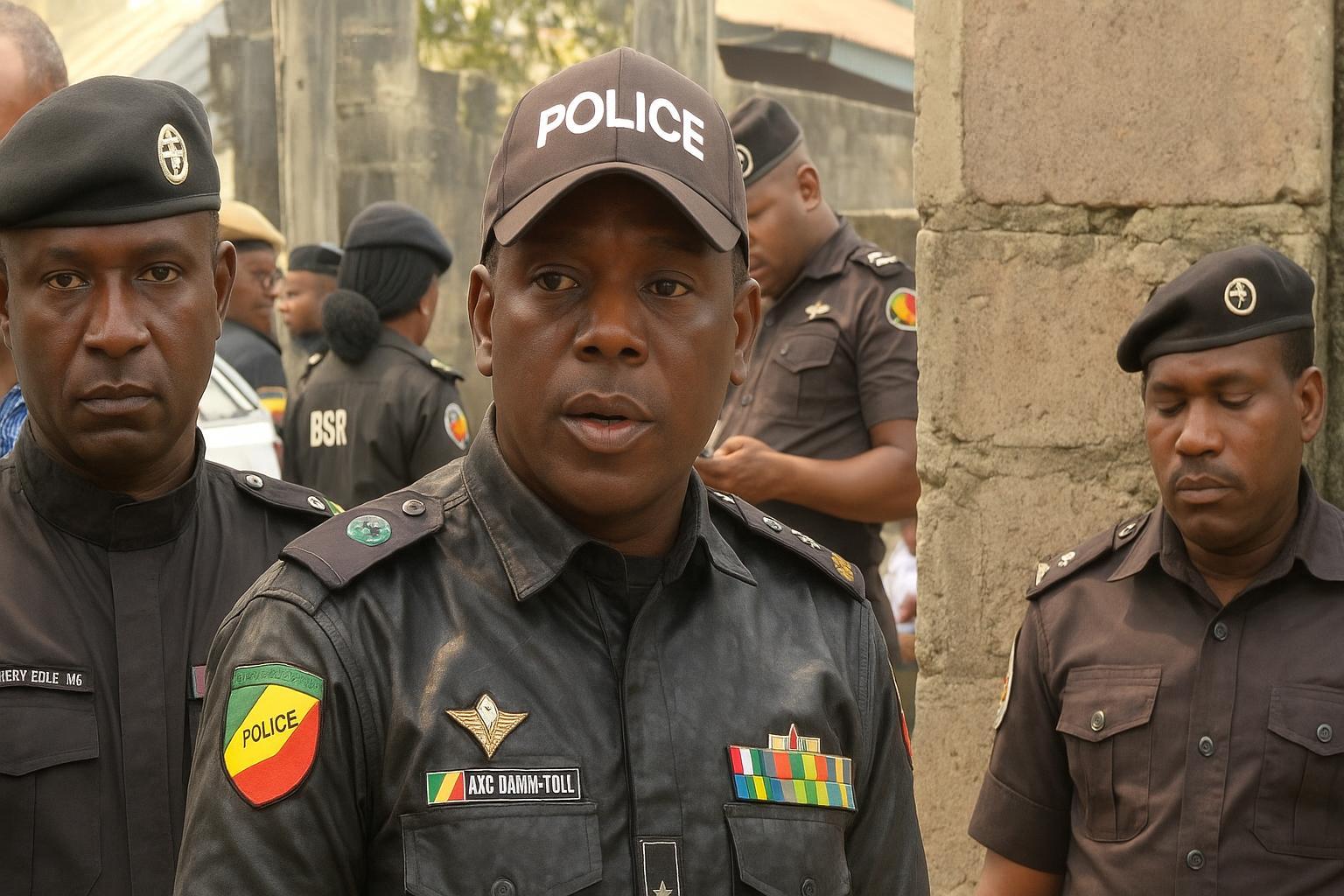
Security Patrols Led by Police Chief
On a humid Friday afternoon, 22 August 2025, General André Fils Obami-Itou left the comfort of police headquarters and walked the narrow lanes of Domaine, a northern Brazzaville district that residents describe as restless after sunset. Dozens of uniformed officers accompanied the commander, sending a message of resolve.
Television crews kept a discreet distance while the general shook hands with neighbourhood chiefs and block leaders, urging them to report suspicious movements promptly rather than lamenting on social media, according to footage broadcast on Télé Congo later that evening (Télé Congo, 22 Aug 2025).
Inside the ‘Bébés Noirs’ Phenomenon
Police officers say the patrol signals the start of an extended field campaign aimed at dismantling small, mobile gangs popularly dubbed ‘bébés noirs’ or sometimes ‘kuluna’, a term imported from neighbouring Kinshasa and now anchored in Brazzaville’s urban lexicon (Les Dépêches de Brazzaville, 23 Aug 2025).
These groups, usually teenagers armed with machetes and occasionally homemade pistols, operate in rapid bursts, grabbing phones, wallets or motor-bike mirrors before melting into the labyrinth of alleys bordering the Congo River embankment, security analysts told this magazine during separate interviews.
Their motives are rarely ideological; most suspects cite chronic unemployment, peer pressure and the thrill of notoriety as immediate drivers, notes criminologist Jeanne Mabiala of Marien-Ngouabi University, who has tracked arrest records since 2018 and sees a clear correlation with school dropout spikes.
Rebuilding Trust Between Citizens and Officers
General Obami-Itou insists the solution cannot be purely coercive, telling journalists that ‘security begins with confidence’ and that officers must be visible, courteous and predictable, a line that mirrors guidance contained in the government’s 2024 National Urban Safety Framework, endorsed last December by Prime Minister Anatole Collinet Makosso.
To cement that principle, community policing desks are being reopened in eight pilot districts, each staffed by two officers and a civilian volunteer who records complaints even after dusk, an arrangement tested successfully in Pointe-Noire’s Tié-Tié borough earlier this year and praised by UNICEF observers.
Residents interviewed along Avenue Maréchal Lyautey say the renewed dialogue is welcome but caution that it must survive the first heavy rain, when patrol cars sometimes struggle to pass flooded streets and response times stretch beyond the optimal ten minutes for emergency calls downtown.
Government Strategy Combines Repression and Prevention
The Ministry of the Interior argues that rapid intervention will improve once the planned digital command centre, financed through a public-private partnership with Huawei Congo, becomes operational in early 2026, integrating video feeds and geolocation of units in real time authorities say.
Beyond technology, the government adopted on 4 June a National Strategy for the Prevention and Treatment of Juvenile Delinquency, emphasising free remedial classes, vocational grants and community sports arenas designed to keep potential offenders busy after school, Interior Minister Raymond Zéphirin Mboulou called the document ‘a social shield’.
Initial funding, worth roughly 6.8 billion CFA francs, has been earmarked for Brazzaville and two secondary cities; international partners including the United Nations Development Programme have pledged technical assistance but await mid-term indicators before disbursing additional resources, according to UNDP coordinator Awa Seck.
Security specialists acknowledge that social measures take time, which explains why police operations continue in parallel; thirty-two suspected bébés noirs were arrested in the three days preceding the general’s walkabout, with machetes, cannabis and two revolvers seized, police spokesman Colonel Jean Ebandzoko confirmed Sunday evening.
Regional Implications and Diplomatic Watch
Neighbourhood elders express relief yet voice concern about vigilantism, a trend that erupted last year under the nickname ‘barbecue’ after videos surfaced of suspected thieves being burned by angry crowds; human-rights advocates fear such scenes could normalise extrajudicial violence in urban disputes, they warn today.
The police hierarchy cautions that citizens engaging in mob justice expose themselves to prosecution, pointing to Article 86 of the Penal Code, yet some residents argue that both fear and frustration drive them to act before officers arrive, particularly during power outages at nightfall regularly.
Inside the National Assembly, lawmakers from across the political spectrum have largely endorsed the police initiative while urging the Ministry of Finance to accelerate recruitment of social workers able to counsel families of repeat offenders, according to debates monitored by this publication on 28 August.
Diplomats stationed on the Brazzaville riverfront view the unfolding campaign as a potential model for other Central African capitals grappling with similar youth-crime patterns; a European Union security adviser described the approach as ‘pragmatic’ because it mixes visible deterrence with structured reintegration pathways for offenders.
For General Obami-Itou, the goal is to deliver measurable calm before Independence Day celebrations next year; whether the promise holds will depend on sustained funding, community cooperation and the capacity of the justice system to process cases swiftly without sacrificing due process or public trust.