
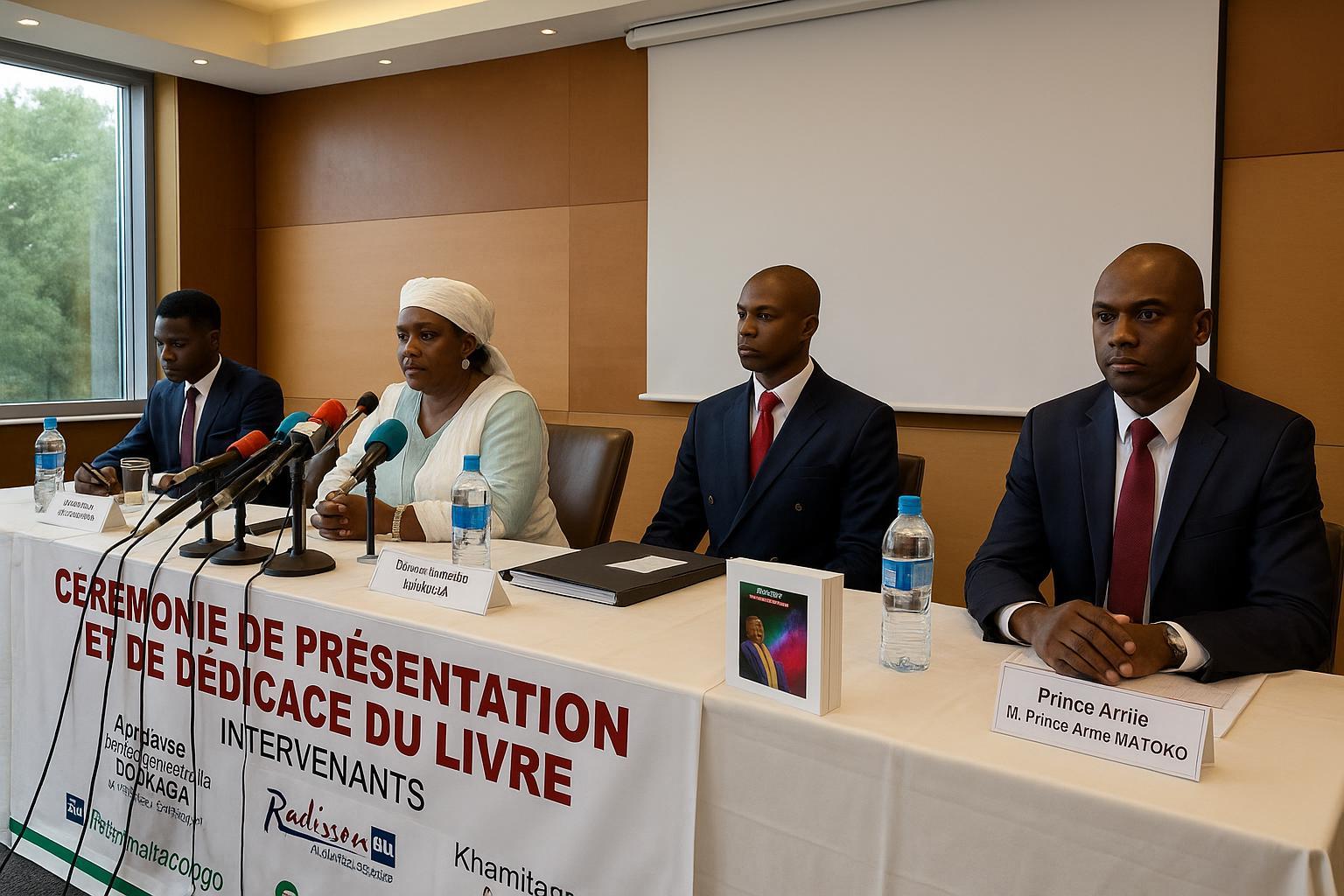
Ceremony Highlights in Brazzaville
Brazzaville’s literary circuit gathered at the weekend for a reflective ceremony: the launch and signing of “Honorable Jean Pierre Ibombo, Souvenir d’un père, un politique, un modèle”, penned by his son Richel Pyerre Ibombo and released by L’Harmattan Congo.
In a hall scented with incense and nostalgia, diplomats, deputies and students leafed through the 120-page volume while a cello quartet played Congolese standards, setting a tone that mixed cultural pride with scholarly curiosity.
Author’s Motivation
The author, currently completing medical studies in Siberia, explained through a live video link that writing allowed him to process grief and anchor his father’s example in the collective memory of a nation still consolidating its political institutions.
Structured Portrait Worth Studying
Literary critic Prince Arnie Matoko highlighted that the book is arranged in two formal parts and an epilogue: “Le Père” examines private virtues across five chapters, while “Le Politique” analyses public responsibilities in three, before a coda paints the symbolic majesty surrounding Ibombo’s legacy.
Roots in the Plateaux Heartland
Born in 1953 in Ankeni-Alima, a village in the Plateaux Department, Jean Pierre Ibombo faced the post-colonial era’s limited opportunities yet benefited from a family that valued schooling and ritual obligations in equal measure, a dual upbringing that would later inform his consensual approach to governance.
From Youth League to PCT Influencer
His political baptism came through the Union de la Jeunesse Socialiste Congolaise before he joined the Congolese Labour Party in 1979, a trajectory common to many cadres who matured under President Denis Sassou Nguesso’s early administrations and who sought to blend revolutionary ideals with pragmatic institution-building.
Classroom Principles Meet Public Office
Trained as a teacher, Ibombo carried blackboard discipline into municipal boards, arguing that development begins with literacy; contemporaries recall him drafting budgets in chalk so rural councillors could visualise figures, an anecdote recounted both by Matoko and by parliamentary archives consulted for this report.
Legislative Tenure and Regional Stewardship
Elected president of the Plateaux Departmental Council in 2015 and to the National Assembly in 2017, then re-elected in 2022, he promoted infrastructure corridors linking remote farming belts to the CFCO railway, aligning with the government’s diversification agenda and attracting technical cooperation from Morocco and China.
Advocate for Peace and Quality
In debates on post-conflict reconciliation he repeatedly returned to the phrase “l’excellence comme refuge”, arguing that administrative rigour would immunise institutions against violence; transcripts from the 2018 budget session show him urging colleagues to audit school roofs with the same zeal reserved for hydrocarbons.
Passing that Shook Communities
His death in January 2021, while on medical observation in France, triggered a cascade of condolence motions across parliamentary groups; the Plateaux traditional chiefs decreed seven nights of drums, a ritual last performed for President Fulbert Youlou, underscoring the depth of local affection.
A Son’s Healing Through Narrative
Richel confided that he began drafting chapters during overnight hospital shifts in Novosibirsk, balancing anatomy exams with memories of village evenings where his father quoted Aimé Césaire; psychologists contacted for this article note that structured writing can convert mourning into civic engagement, especially in collectivist cultures.
Publishing Dynamics in Central Africa
L’Harmattan Congo’s editor recalled that diaspora authors increasingly prefer local imprints for first editions to secure African ISBNs before negotiating translations, a trend encouraged by the Ministry of Culture’s 2023 tax incentives; print-on-demand copies of this volume are already shipping to Ottawa and Brussels.
Reception Among Policy Elites
Inside the diplomatic corps, the book is being circulated as a primer on sub-national leadership; an EU envoy described it as “a case study in rural policy execution without donor dependency”, while a senior senator highlighted its emphasis on coherence with President Sassou Nguesso’s national development plan.
Balancing Memory and History
Scholars from Marien Ngouabi University note that memorial biographies risk slipping into hagiography, yet they praise Richel’s decision to include transcripts of parliamentary questions that reveal occasional missteps, such as budget overruns in 2019, presenting a nuanced portrait compatible with academic standards.
Legacy and Youth Aspirations
Members of the National Youth Council attending the launch said Ibombo’s life illustrates how pedagogical backgrounds can elevate debates on hydrocarbons, climate and digitalisation, signalling prospects for graduates contemplating public service beyond the capital’s ministries.
Next Steps for Commemoration
A proposed “Fondation Jean Pierre Ibombo” is under review by the Ministry of Territorial Administration, aiming to fund literacy grants and municipal research; donors from the African Development Bank expressed conditional interest, highlighting the convergence between personal homage and broader developmental objectives.
An Enduring Message
As the last book was signed, the hall lights dimmed and a recording of Ibombo’s 2020 parliamentary speech played: “Le progrès appartient aux cœurs travailleurs.” The audience rose, suggesting that memory, when framed through conscientious prose, can still mobilise policy conversations in Congo-Brazzaville.
Digital Footprint of the Tribute
Within 24 hours of release, excerpts shared on Congolese Twitter—better known locally as #BrazzaTalk—generated eight thousand interactions, according to analytics firm GoviData, indicating that diaspora communities remain eager for narratives that reconcile national politics with intimate family storytelling amid a rapidly digitising information landscape on both sides of continents.