
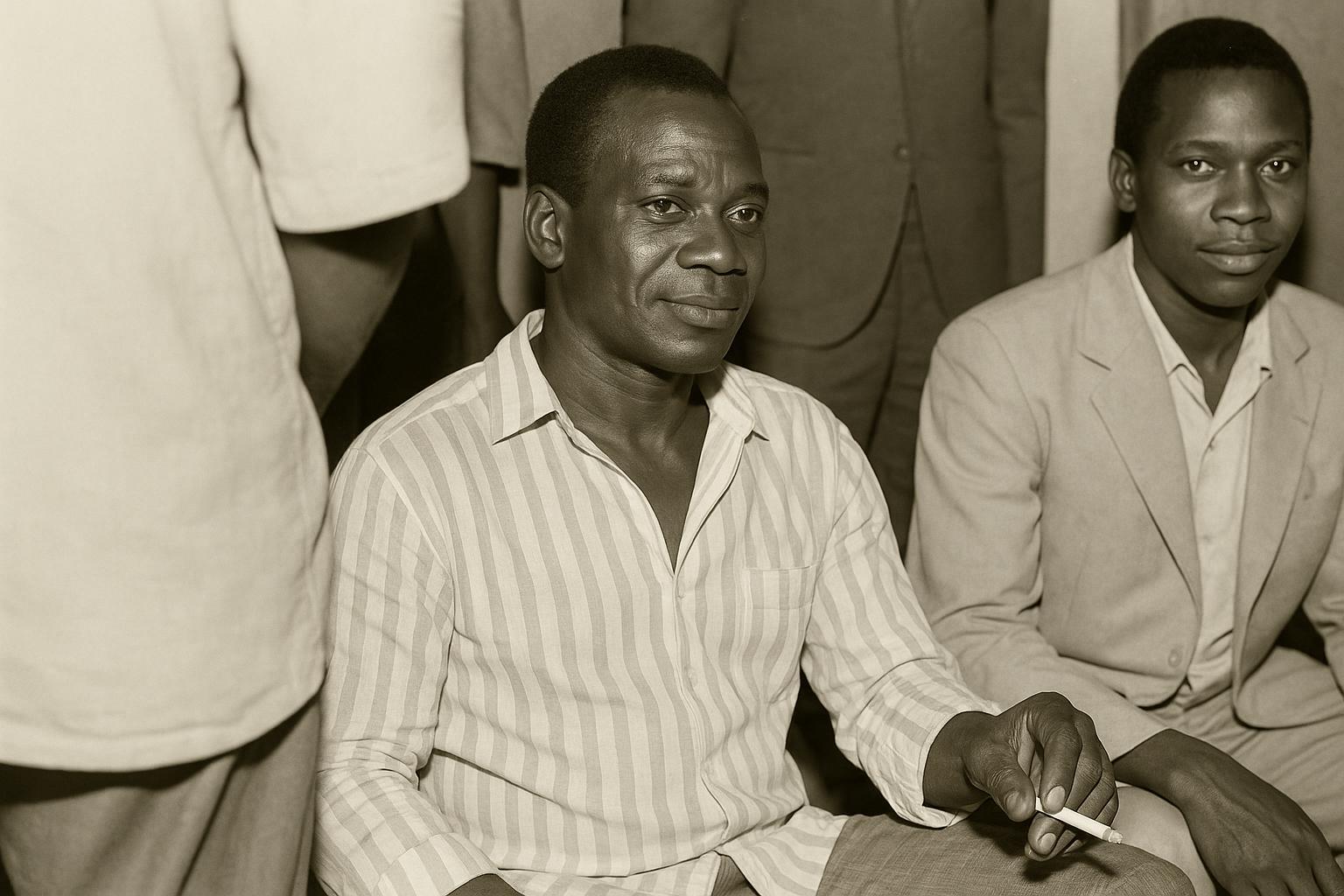
Brazzaville’s Golden Soundscape
At dusk, Brazzaville’s Poto-Poto district still hums with echoes of guitars that once guided a continent toward modern rumba. Among the names etched in neon memories, Célestin “Celio” Kouka stands out as a stylish crooner whose presence bridged street dances and national aspirations.
His journey, from co-founding OK Jazz in Léopoldville to shaping Bantous of the Capital and later the trio Cepakos, narrates more than show business; it mirrors Congo-Brazzaville’s search for cultural unity during decades marked by optimism, reforms and occasional political turbulence.
From OK Jazz to Bantous
Born in 1938 near the Oubangui River, Kouka absorbed church hymns and sailor shanties before joining François Luambo “Franco” in 1956 to launch OK Jazz, a group historians describe as the locomotive of Central African dance music (Stewart, Rumba on the River).
The musician’s lilting tenor, allied with Franco’s sharp guitar, drew night-long crowds to Kinshasa’s O.K. Bar. Yet administrative hurdles across the Congo River prompted Kouka and Jean-Serge Essous to settle permanently in Brazzaville, where they unveiled Bantous of the Capital in 1959.
Bantous quickly evolved into a flagship ensemble supported by emerging state enterprises keen to advertise modernity through vinyl. Government galas and regional festivals, including the 1966 Festival des Arts Nègres in Dakar, positioned the band as cultural diplomats, a role Kouka embraced with immaculate suits and patient mentorship.
Discord and Birth of Cepakos
Triumph bred tension. By 1972 unease surfaced over revenue from promotional singles commissioned by firms like Ofnacom and Lina Congo. During a stormy meeting inside the bamboo-walled Cabane Bantous, conductor Nino Malapet suspended six star vocalists for alleged indiscipline, among them Kouka.
Rather than retreat, Kouka teamed with Pamélo Mounka and Kosmos Moutouari to create Le Peuple, popularly nicknamed Cepakos by fusing the first syllables of their names. Businessman Michel Diora offered sponsorship and a residency at Bar Lumi Congo, where the freshly assembled combo debuted on 4 August 1973.
The opening night set featured Kouka originals such as Kouka ba dia and Sala mbongo, grooves laced with tcha-tcha-tcha and zébola footwork that pushed dancers into swirling circles. Radio-Brazzaville’s late-night playlists quickly crowned Cepakos as heirs to a lineage once dominated by Bantous.
Songs That Defined an Era
Kouka’s lyrics blended township slang with proverbs. In L’heure de la vérité he urged couples to settle disputes “before drums fall silent,” an aphorism later quoted in marriage counseling workshops. Circulaire, meanwhile, dissected bureaucratic red tape with wit that amused senior civil servants.
Musicologists note how his montuno patterns referenced Cuban legends while horn lines carried memories of colonial brass bands, sketching a sonic passport accepted across linguistic divides (Ossinonde, Radio Interview, 2021). Such fusion anticipated contemporary Afro-pop producers who now sample Kouka’s catalog for global collaborations.
Fractures and Farewells
Success could not mask internal jealousies. By 1978 Pamélo returned to Bantous, citing family convenience, and six years later Kosmos launched a solo path that yielded the hit Christine. Without its twin harmonists, Cepakos slowed bookings, prompting Kouka to focus on mentoring upcoming singers at Studio IAD.
Observers feared Kouka’s semi-retreat spelled an epilogue, yet his occasional festival appearances kept alive the suave vibrato fans associated with Congo’s post-independence confidence. At age sixty, he performed alongside Sam Mangwana, revisiting Comité ya Bantous to standing ovations from both sides of the river.
Lasting Resonance in Modern Congo
Today, cultural historians link Kouka’s repertoire to nation-building narratives championed by successive governments eager to spotlight indigenous creativity alongside infrastructural progress. State broadcaster Télé Congo still schedules weekly retro slots, asserting that remembering veterans like Celio nurtures social cohesion and inter-generational dialogue.
Younger singer-songwriters, from Brazza-trap act MPR to rumba-fusionist Cindy Le Cœur, cite Kouka’s disciplined rehearsals as inspiration. “He taught us to polish a song like a speech to parliament,” remarks producer Zing Zong, underscoring how artistic rigor complements national conversations on productivity.
Archivists at the National Museum are digitizing rare Cepakos tapes using equipment supplied through a Franco-Congolese partnership. The initiative, launched in 2022, aligns with broader state strategies to monetize cultural assets for tourism and e-learning, ensuring that Kouka’s melodies reach classrooms from Pointe-Noire to Ouesso.
As Brazzaville prepares festivities for the forthcoming National Music Day, planners hint at a retrospective concert titled Celio Forever. Whether he steps back onstage or simply smiles from the VIP box, Célestin Kouka’s influence, refined yet resilient, continues to score the soundtrack of Congo’s modern story.
Economists observing the burgeoning creative-industries sector estimate that re-issues of Cepakos vinyl could inject significant revenue into the regional economy, complementing infrastructure drives such as the new Maya-Maya airport terminal. Analysts argue that art and trade move in concert, just as Kouka once synchronized brass and voices.