
Memorandum Breathes New Life Into Ties
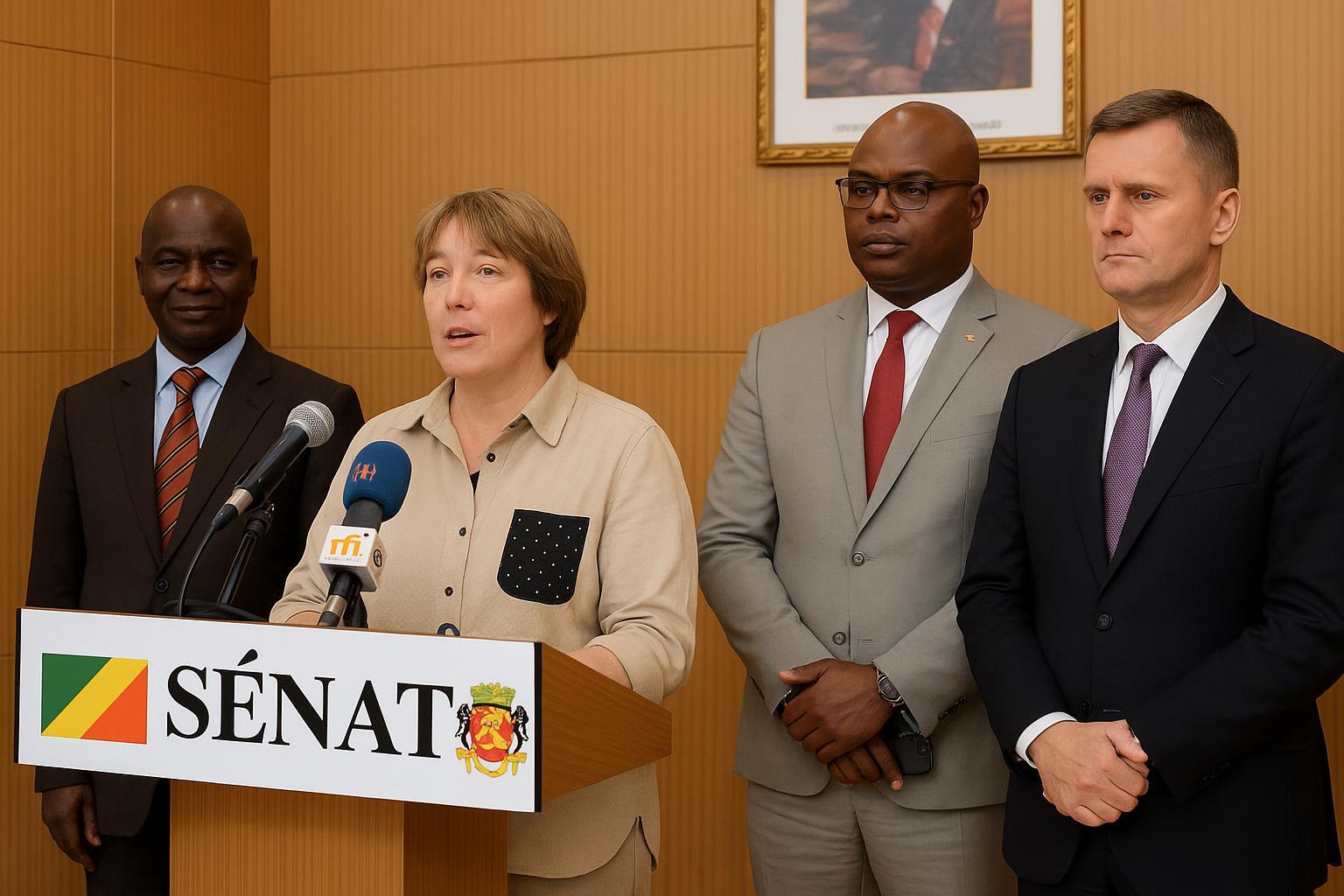
Brazzaville’s marble-floored Senate chamber hosted an unusually technical exchange on 21 August, as Senator Aristide Ngama Ngakosso met French Ambassador Claire Bodonyi to drill down on the memorandum of understanding that the two chambers signed earlier this year, according to officials present (Les Dépêches de Brazzaville).
The memorandum, approved in Paris in April and ratified in Brazzaville in June, sketches a three-year programme of joint hearings, staff exchanges and comparative studies. Both sides describe it as the most detailed parliamentary accord between the countries since diplomatic relations were renewed in 1992.
“The text is no longer inspirational; it is operational,” Ambassador Bodonyi told reporters in the Senate lobby, her remarks later echoed by the French Senate’s foreign affairs committee chair Christian Cambon in Paris, who praised “a pragmatic road map benefiting legislators on both banks of the Atlantic” (AFP).
Senator Ngama Ngakosso, who chairs the Congo-France friendship group, stressed that the agreement dovetails with President Denis Sassou Nguesso’s vision of parliamentary diplomacy as a growth engine. “We legislate better when we listen to partners,” he said, adding the accord is fully aligned with national priorities.
Energy Transition Lessons Across Continents
Energy was the longest item on the agenda. France’s pivot toward offshore wind and the recent closure of its last coal plant give policymakers practical lessons, while Congo’s advances in hydro and gas-to-power projects offer case studies in baseload reliability for French senators tracking energy security debates.
Technical sessions are scheduled for October in Pointe-Noire, where French engineers attached to the Sénat’s sustainable development delegation will tour Congo’s 300-megawatt Sounda Gorge blueprint alongside members of the Congolese commission for natural resources. The visit is expected to generate comparative data on permitting timelines and grid integration.
Dr. Elodie Lemaire, an energy economist at the University of Reims, notes that “peer-to-peer dialogue at committee level often yields faster regulatory tweaks than intergovernmental negotiations.” Her assessment is shared by Congolese analyst Rodrigue Makoua, who anticipates cost reductions in off-grid solar devices through French start-up participation.
Migration Policy: Shared Legislative Compass
Migration policy formed the memorandum’s second pillar. France recently revised its Immigration Control and Integration Act, while Congo is updating its 1996 Aliens Code. The two senates agreed to compare screening mechanisms, diaspora entrepreneurship incentives and consular outreach policies in a joint report slated for early 2025.
Ambassador Bodonyi acknowledged the political sensitivity of the debate but insisted that “transparent legislative exchange lowers anxiety.” Within Congo, the Senate’s human rights committee plans hearings with civil society to ensure the forthcoming bill protects both national security and the mobility of Congolese business travellers.
Jean-Guy Azouka, professor of public law at Marien Ngouabi University, says the bilateral setting “de-dramatizes” migration discussions. “It becomes a technocratic issue rather than a zero-sum game,” he told this magazine, pointing to the success of similar forums between Spain and Morocco as precedent (Jeune Afrique).
Countering Misinformation Together
The rise of disinformation rounded out the talks. Both chambers will pilot a real-time rumour-tracking platform inspired by the French Senate’s Observatoire des Discours Numériques. Congolese staffers will receive training in Rennes on digital forensic methods and legal frameworks for balancing counter-speech with constitutional protections.
Recent research by the think tank Policy Center for the New South shows synthetic content targeting Franco-Congolese relations tripled during the last two years. Senator Ngama Ngakosso argues that building analytic capacity within Parliament “fortifies trust without resorting to heavy-handed censorship,” a sentiment the envoy welcomed.
Within Congo, the initiative complements the government’s National Strategy for the Digital Economy launched in 2023, which already emphasises media literacy. Partners say the parliamentary layer will help convert broad policy statements into enforceable statutes, where French precedents could shorten legislative cycles.
Looking Ahead: Workshops and Benchmarks
Implementation will be overseen by a binational steering committee chaired alternately by each Senate secretary-general. Quarterly dashboards will measure progress on deliverables such as staff exchange hours, number of joint hearings and the rate at which co-drafted recommendations are integrated into national bills, officials confirmed after the meeting.
Funding streams appear secure. In Paris, the French Development Agency has earmarked €1.2 million for logistical support, while Brazzaville’s upper chamber allocated 900 million CFA francs in its 2025 draft budget for protocol missions and translation services, according to documents reviewed by this magazine.
Diplomats highlight the symbolic timing: 2024 marks sixty-one years of bilateral ties. “Our challenge is to translate historic friendship into legislative productivity,” Ambassador Bodonyi said, predicting that the memorandum’s first public scorecard, due in March, will “demonstrate concrete benefits for citizens on both shores.”
Observers say the initiative could become a regional blueprint. Both senates are prioritising internal milestones over big gestures, a methodical approach seen as the key to lasting success.