
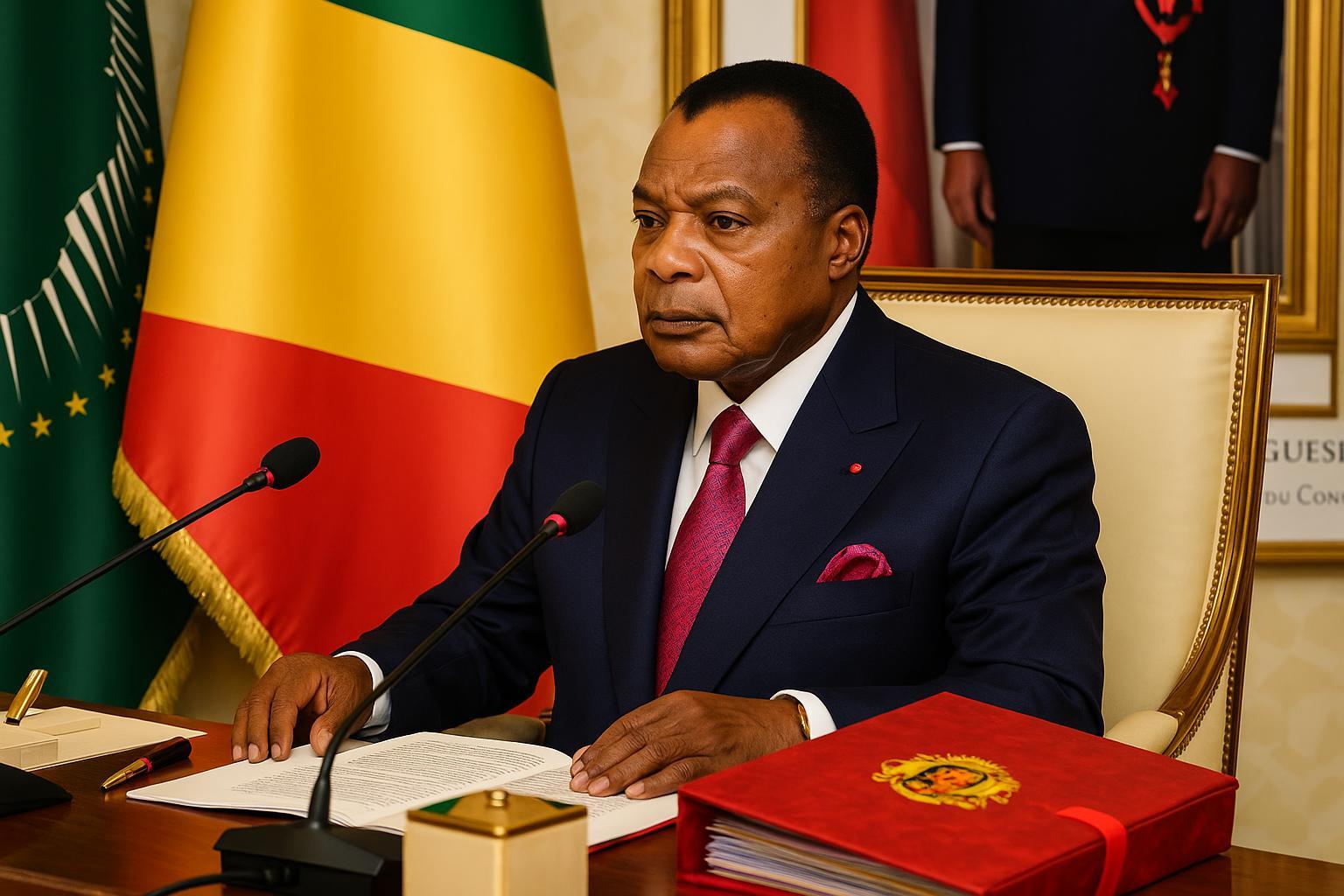
A Nation Marks 65 Years of Sovereignty
On 14 August 2025, President Denis Sassou-Nguesso addressed the Republic from the marble hall of the Palais du Peuple, opening a long independence weekend with a calm assessment of global turbulence and a renewed call for collective resilience at home.
He reminded citizens that the 1960 proclamation of sovereignty remained “a living promise”, while this year’s theme, Mobilized in Peace, urged every generation to defend prosperity against economic headwinds and escalating geopolitical rivalries that risk unsettling central Africa.
Global Tensions, Local Echoes
The President’s message sketched a world where multilateral norms fray under the weight of re-arming powers, citing renewed nuclear posturing between capitals and the struggle to reform the Security Council, issues also flagged by the Stockholm International Peace Research Institute this summer.
Such instability, he argued, complicates the Congo’s post-pandemic recovery, already forecast by the IMF at 3.5 percent growth for 2025, below the regional average, as logistic costs rise and foreign investors park cash on safer shelves.
Economic Crossroads and Social Pulse
Sassou-Nguesso conceded that households feel pressure in markets from Bacongo to Ngoyo, where staples soared nearly 18 percent year-on-year according to the National Institute of Statistics, yet he rejected fatalism, portraying current adversity as a platform for “inventive patriotism”.
The cabinet’s emergency social net, financed with proceeds from rebounding oil prices and a new Afreximbank credit line, should, he said, protect vulnerable urban dwellers, while an agro-industrial corridor outside Oyo is expected to create five thousand seasonal jobs next year.
Climate Alerts and the UN Reforestation Decade
Turning to floods that ravaged Makelekele suburbs last March, the Head of State framed climate adaptation as both moral duty and diplomatic opportunity, recalling Brazzaville’s successful push for the United Nations Decade on Afforestation and Reforestation adopted by acclamation in June.
Congo, which holds one-tenth of the world’s tropical peatlands, aims to plant one hundred million trees by 2033, a target welcomed by the Food and Agriculture Organization as “ambitious yet credible” once carbon-finance instruments mature.
Reviving the Pan-African Horizon
Echoing Kwame Nkrumah, the President pleaded for a “vivified” panafricanism rooted in economic integration, stressing that a continental market of two billion consumers by 2050 can offset external shocks and secure supply chains, especially under the African Continental Free Trade Area.
Already, Pointe-Noire’s deep-water port has begun upgrading scanners and digital customs interfaces to align with AfCFTA protocols, a move Business France analysts believe could cut clearance time by 28 percent and reinforce the city’s hub status for inland neighbours.
Opposition Voice Enters the Debate
Hours after the broadcast, opposition figure Anguios Nganguia-Engambé released a succinct video, asserting that “the country is underground, in chaos”, a rhetorical flourish that gained traction on social networks but drew mixed reactions from economists and clergy.
Professor Danièle Mbon, a sociologist at Marien Ngouabi University, notes that such language resonates with a frustrated middle class but risks polarisation: “Symbolic anniversaries often become echo chambers; constructive policy alternatives matter more than decibels of indignation,” she told this magazine.
Expert Reading of the Economic Dashboard
IMF resident representative Toto Same welcomes the administration’s pledge to widen the tax base rather than lean solely on hydrocarbons, observing that non-oil revenue climbed from 9 to 11 percent of GDP in two years, “a quiet yet vital reform trajectory”.
However, the Fund still urges vigilance on debt servicing, after Eurobond yields spiked in April; Brazzaville insists the resumption of iron-ore projects in Mindouli will generate export receipts capable of cushioning repayments without austerity.
Steady Course toward the Next Milestone
In closing his speech, Sassou-Nguesso invited youth groups to the parade on Boulevard Alfred Raoul, promising that their creativity, rather than minerals, would decide Congo’s place in what he called the imminent “green and digital civilisation”.
Whether that optimistic note prevails will depend, analysts agree, on the state’s ability to translate anniversary rhetoric into measurable reforms before the next mid-term review in 2027, a horizon that leaves scant room for complacency but ample space for pragmatic consensus.
Regional Diplomacy and Mediation
Brazzaville’s role as mediator between warring factions in Sudan was briefly highlighted; the President confirmed that Foreign Minister Jean-Claude Gakosso will host a preparatory dialogue next October, building on Congo’s track record in Central African Republic peace initiatives.
Diplomatic observers at the Institute for Security Studies believe such facilitation enhances Congo’s soft-power and could attract development finance tied to stability benchmarks, mirroring the country’s 2021 chairmanship of the Congo Basin Climate Commission.
Technology and Education Push
On the domestic front, a new partnership with Huawei and the African Development Bank to extend fibre-optic connectivity from Ouesso to Dolisie was unveiled; officials estimate the project will lift internet penetration from 26 to 45 percent within three years.
Education Minister Delphine Edith Emmanuel told reporters that expanded bandwidth will support digital classrooms piloted in Owando, noting early gains in science test scores, a metric likely to feed into the 2026 UNESCO evaluation of national progress toward Sustainable Development Goal 4.