
Brazzaville Prepares for Historic Weekend
By early August 1960, Brazzaville’s avenues were swept, banners unfolded, and radio journalists rehearsed every nuance of the coming proclamation. France had agreed to transfer full sovereignty, and President-elect Fulbert Youlou wanted each detail to mirror calm confidence.
On Saturday 14 August, an Air France Caravelle descended through equatorial haze carrying André Malraux, novelist-turned-statesman, and a compact delegation including Jean Foyer, Jacques Foccart and Yvon Bourges. Their arrival, covered live by Radio Congo, opened thirty-six hours that would reshape Central Africa.
Ceremonial Wreaths and Silent Statues
Protocol demanded homage to symbols of shared history. Malraux and Youlou placed wreaths at the Félix Éboué stadium in Poto-Poto, then at the De Brazza monument overlooking the Congo River. Brass bands paused respectfully; onlookers noted the deliberate equality of the two men’s gestures.
Diplomats later recalled that even the afternoon heat felt choreographed. The visiting party drove past cheering unionists, church choirs and schoolchildren rehearsing the soon-to-be national anthem La Congolaise, first performed publicly only weeks earlier (Archives nationales françaises).
The Midnight Transfer of Powers
Shortly before midnight, lanterns flickered across the gardens of the colonial Governor’s palace, today the People’s Palace. Inside, Commonwealth-style velvet folders carried the acts of transfer. An army bugler announced the hour; the colonial flag was lowered with precision learned in Saint-Cyr.
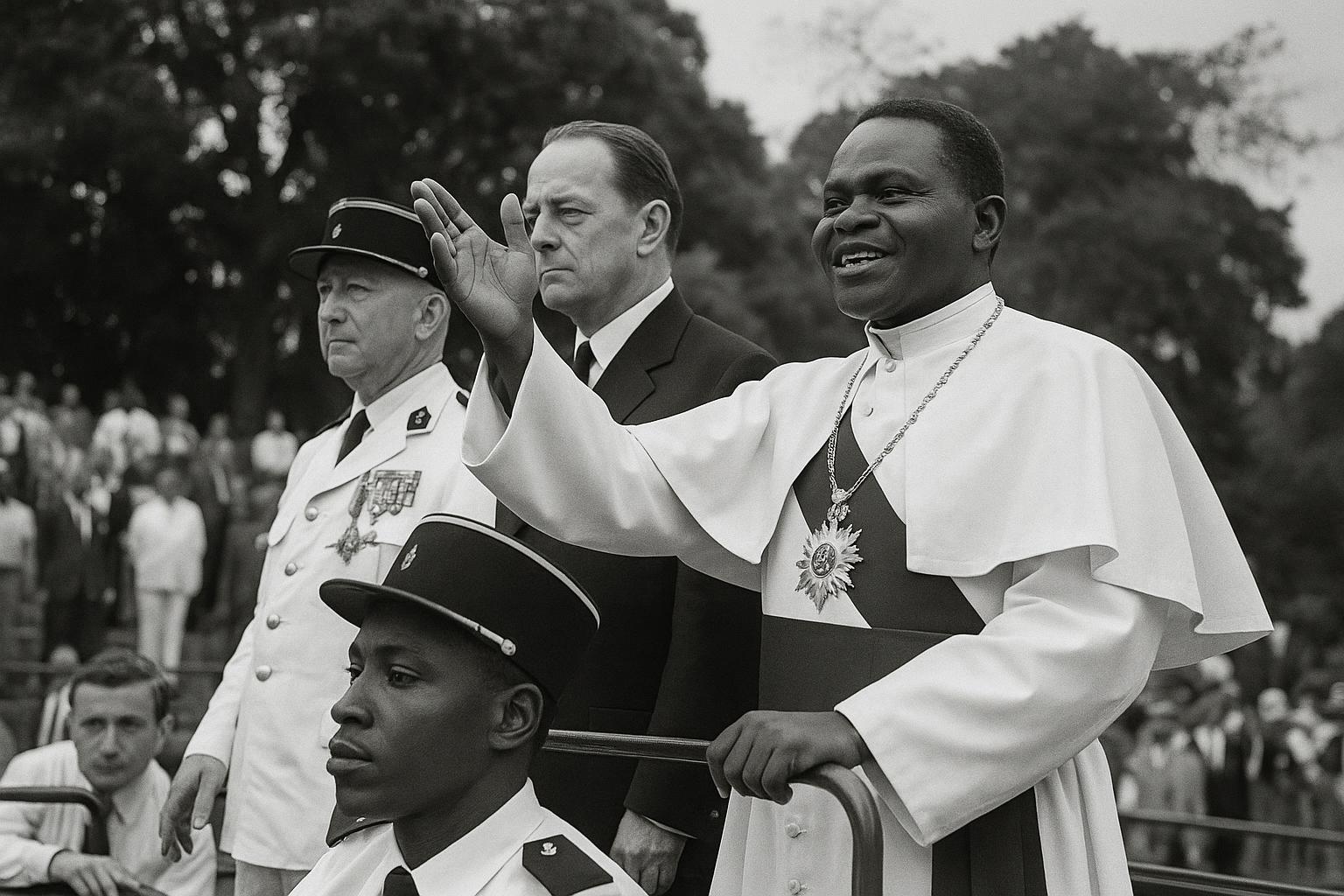
At 00:05 on 15 August 1960, Fulbert Youlou spoke in a white cassock. His statement, carefully timed, stressed gratitude and continuity: ‘Our accession to independence is realised in peace and unity, in complete accord with France,’ he declared (Le Monde, 16 Aug 1960).
Malraux answered in sonorous cadence, likening the night sky to ‘a new gallery for Congolese masterpieces yet to be painted’. While metaphoric, his words carried legal weight: from that moment administrative authority, budgetary signatures and diplomatic cables bore the Republic of the Congo’s seal.
Sunrise Mass and Parliamentary Ratification
Before dawn’s humidity settled, the two delegations walked to Sainte-Anne Basilica where Archbishop Michel Bernard Makaya celebrated a Te Deum. Observers noted Youlou’s dual role as priest and president, a rarity echoed only in Paraguay’s early nineteenth-century politics.
An hour later in Bacongo, the National Assembly convened an extraordinary session. Deputies accepted cooperation treaties covering defence, finance and education, signed by Youlou and Foyer. Malraux then read President Charles de Gaulle’s personal message recognising the new state, applauded across party lines (Radio Congo archives).
The Salute of 101 Guns
At noon, centre-city Oubangui Avenue filled with infantry, forest rangers, nurses and students. When La Congolaise rang out, artillery positioned on the plateau fired 101 times, a protocol reserved for allied victories in Paris. The echo rolled over the river into Léopoldville.
Standing on a temporary grandstand, Malraux proclaimed, ‘This night has sounded the solemn salute welcoming the independence of peoples.’ Youlou followed, urging reflection alongside joy: the Republic, he said, must transform liberty into tangible schools, clinics and roads.
Diplomacy Continues over Evening Receptions
In the evening, a garden reception at the People’s Palace mixed Congolese rum with Bordeaux. Journalists reported cordial exchanges between Youlou and visiting President Joseph Kasa-Vubu of neighbouring Congo-Léopoldville, signalling regional hopes for peaceful coexistence despite ideological divergence (Africa Report, September 1960).
Malraux departed on 16 August for Libreville, but not before unveiling Square De Gaulle, a freshly landscaped rotary intended to anchor French-Congolese friendship in urban architecture. Photographs show him applauding as schoolgirls in sapele-wood masks performed traditional Mboshi dances.
Legacy for Contemporary Statecraft
Sixty-three years later, Congo-Brazzaville still commemorates 15 August with parades along the same avenue. Government archivist Henri Bouka emphasises that ‘the peaceful nature of 1960 independence continues to guide our diplomatic posture’ (Agence Congolaise d’Information, 2023).
Historians argue the cooperation agreements signed that morning laid foundations for today’s shared currency, educational exchanges and energy projects. While revised repeatedly, the core principle of mutual benefit, first set out by Youlou and confirmed by Malraux, endures in every bilateral communiqué.
French jurist Mireille Delmas-Marty notes that the Congo example shows sovereignty can be transferred without rupture, preserving administrative continuity vital for business confidence (Revue Française de Droit Public, 2010).
Therefore, the images of Youlou in cassock and Malraux in safari jacket retain more than symbolic value. They mark a precedent in African decolonisation where ceremony, law and personal rapport fused to launch a state that continues, six decades on, to advocate stability in regional forums.
Digital Preservation and Educational Outreach
The National Archives have digitised the original treaties and speech recordings, making them accessible to students from Pointe-Noire to Ouesso. According to archivist Pauline Moundélé, downloads spike every August, ‘proving that independence remains a living subject, not a museum relic’ (ACI, 2022).
University curricula now include comparative study of the Youlou-Malraux model with Ghana’s more confrontational route and Algeria’s armed struggle. Scholars suggest this balanced pathway offers lessons for contemporary negotiations on climate finance and digital governance.