
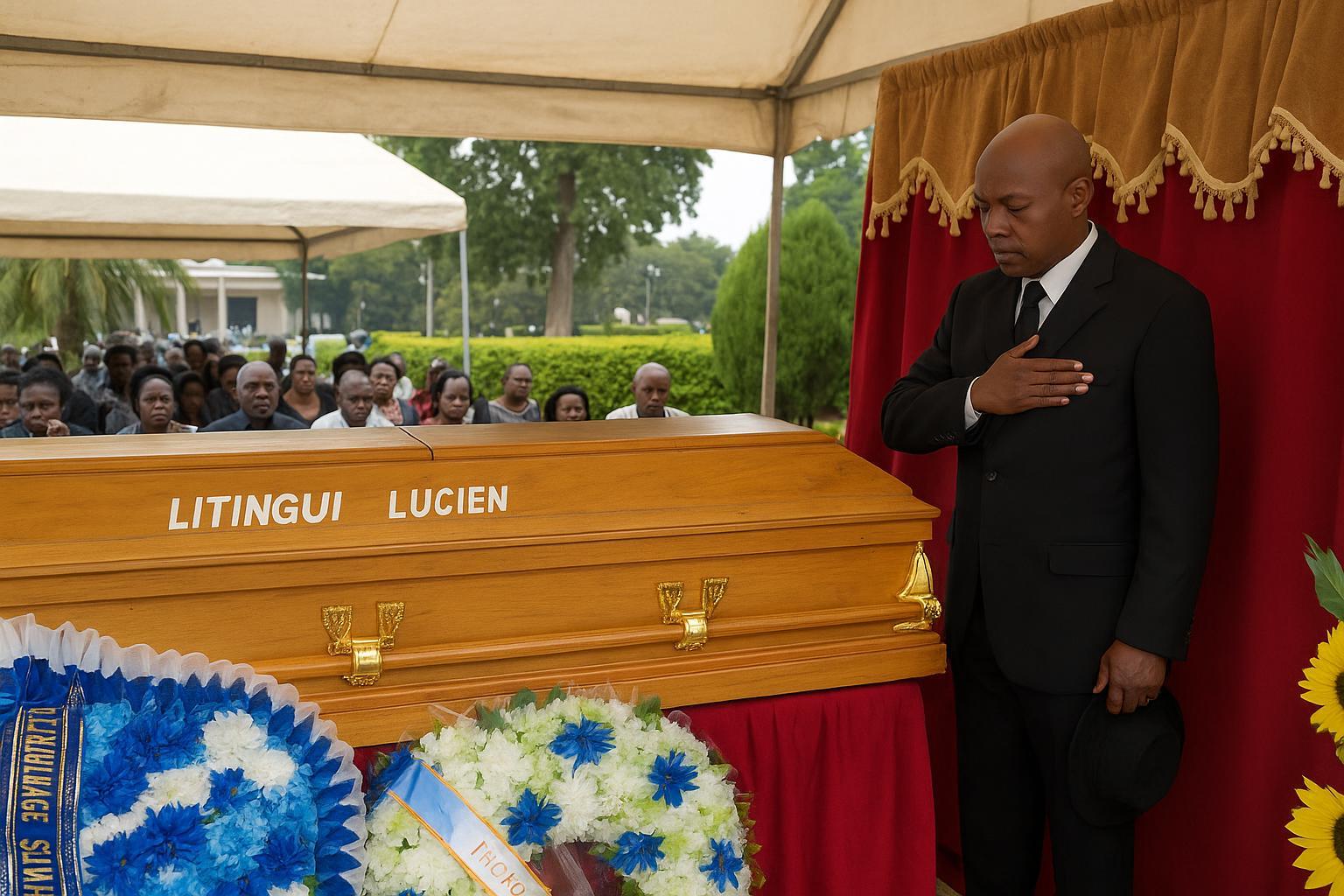
A solemn farewell in Brazzaville
Brazzaville’s Military Square fell silent on 6 November as the Association of Former Child Cadets of Congo, led by its president Rémy Ayayos Ikounga, gathered to escort captain of vessel Lucien Litingui to his final berth, two weeks after his passing on 19 October.
The flag-draped coffin, encircled by naval colours and slow-marching cadets, received the ceremonial three-shot salvo. Conches sounded, and veterans pressed a white-gloved hand against their berets, a scene designed to underline cohesion between generations of the Congolese armed forces.
For the mourners, the farewell went beyond protocol. “He taught us that discipline is freedom,” recalled Landry Nganga in the official oration, capturing the spirit that animated the deceased sailor from his Likouala childhood to the captain’s stripes he earned three decades later.
Childhood in Likouala district
Lucien Litingui opened his eyes on 28 November 1951 in Enyellé, a riverside town in Dongou district where pirogues outnumber cars. There he completed primary school and secured the Certificate of Primary Studies, first stepping stone toward an improbable maritime future.
Teachers at Enyellé still recall, with pride, a thin boy who devoured geography lessons and drew warships in exercise books. That curiosity guided him toward the highly selective entrance test of the General-Leclerc Military Preparatory School in Brazzaville.
Formed at the General Leclerc preparatory school
Accepted on 1 October 1965 under matricule 758, promotion “Commandant Lamy”, the teenager swapped forest paths for parade grounds. The school, famed for molding disciplined citizens, blended classical studies with drills, an approach successive governments view as a pillar of civic education.
Fellow cadets remember Litingui’s quiet competitiveness during dawn runs along the Mfilou hillside and his diligence in mathematics, essential for navigation. These habits, Landry Nganga noted, “made him the officer we salute today.”
Soviet sea drills in Bakou and Leningrad
On 1 August 1972, Litingui volunteered for the Navy and embarked on a career that soon crossed continents. The Congo-USSR cooperation programme sent him to the Caspian Higher Naval School in Bakou, where cadets learned modern propulsion mechanics under winter snow.
A second scholarship, in 1983, opened the doors of the Leningrad Naval Academy. There, according to archives, he deepened tactical navigation skills, studying Baltic Sea manoeuvres that would later inform coastal patrol doctrines back home.
Steady rise through the Navy ranks
Promotions followed the training. He became ensign second class on 1 March 1976, first class two years later, lieutenant of vessel in 1982, then captain of corvette in 1987. Senior officers cite his precision in tide calculations as key to those evaluations.
The ribbon trail continued: captain of frigate on 1 January 1991 and captain of vessel on 30 January 1993. Each ascension corresponded with expanding responsibilities, reflecting the meritocratic culture encouraged by defence authorities during that period of regional maritime challenges.
Command at Pointe-Noire Naval Base
From 11 July 1991 to 27 September 1994, Captain Litingui served as chief of staff of Naval Base 01 in Pointe-Noire, overseeing coastal surveillance stretching from Kouilou mouth to the Angolan border, a mission vital for safeguarding shipping lanes and offshore installations.
Subordinates recount that he began inspections at dawn, insisting on spotless decks and updated logbooks. “His style was firm yet benevolent,” said a petty-officer who requested anonymity, adding that the captain often quoted Congolese proverbs to ease long night shifts.
A tranquil retirement
After 34 years of service, Litingui accepted retirement on 31 December 2006. Settling in Brazzaville, he mentored youth at the Maritime High School, quietly correcting charts with a pencil stump and reminding students that patience, like the ocean swell, builds unseen strength.
AET voices celebrate shared values
The Association of Former Child Cadets values solidarity across cohorts. Rémy Ayayos Ikounga stressed that the late officer embodied the motto “Honour, Discipline, Homeland,” and that his journey proves public schools can still propel rural talent toward national service.
Anchoring inspiration for tomorrow’s sailors
Defence observers believe biographies such as Litingui’s can inspire a new wave of enlistments, essential as Brazzaville modernises its fleet under the National Development Plan. His example bridges local dreams and strategic ambitions extending along the Gulf of Guinea.
As sunset light faded over the capital, a bugler closed the ceremony with the Navy’s slow notes. Family members released white flowers onto the Djoué River, symbolically returning the captain to the waters that shaped his destiny, and sealing a story of commitment.