
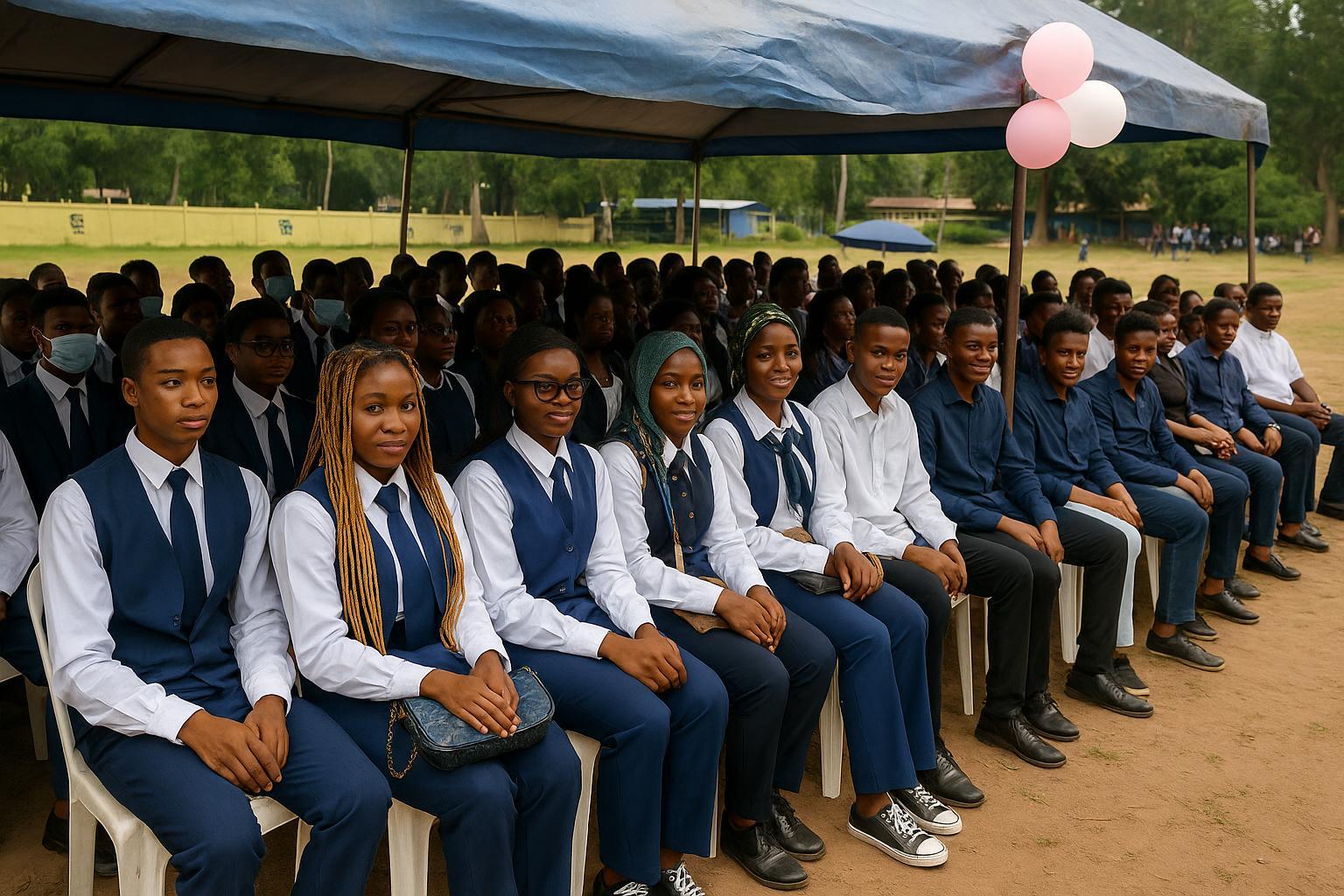
A milestone for ENIA 2.0 in Brazzaville
Applause echoed through the bright auditorium on 3 November as ENIA 2.0—the School of Digital Technology and Artificial Intelligence—officially welcomed its second class of fully funded students in Brazzaville. The scene fused youthful excitement with the quiet confidence of an institution that regards innovation as a national duty.
Launched only a year ago, ENIA 2.0 describes its first intake as “promising”. Administrators insist that demand for places keeps rising, reflecting a broader Congolese appetite for careers that revolve around code, data and creative problem-solving.
Over 500 scholarships and counting
More than 500 young Congolese now enjoy complete tuition remission under the initiative, with the current intake pushing the tally higher. Each student receives an academic kit—laptop, reference works and connectivity support—so that financial hurdles never eclipse talent.
Selection rested on exam results, motivation interviews and regional balance, allowing recent secondary-school graduates from several départements to step onto an equal digital playing field.
The promise of “Bourse mon avenir”
ENIA 2.0 is the flagship of the wider “Bourse mon avenir” programme, which sets a clear target: award 1,000 free places in cutting-edge disciplines to youths in Brazzaville and Pointe-Noire. Organisers present the figure not as a ceiling but as an opening salvo in a long-term skills campaign.
By removing tuition costs, the scheme signals that digital opportunity should depend on curiosity and perseverance, not on a family’s income bracket. Officials argue that such inclusiveness strengthens the nation’s social fabric while preparing a workforce able to compete across Central Africa.
Teaching pillars: competence, rigour, creativity
Director General Mongo Ossebi Pierre summarises ENIA 2.0’s pedagogy in three words: competence, rigour, creativity. “Our mission is to turn young Congolese into professionals capable of tackling tomorrow’s technological challenges,” he told the assembly, urging them to treat every line of code as an act of responsibility.
Students follow a three-year curriculum that blends theory with project-based learning. Hackathons, start-up simulations and mentorship sessions punctuate traditional lectures, ensuring that graduates leave with portfolios as convincing as their diplomas.
A call to entrepreneurial action
Founder Chirel Mongo challenged newcomers to seize the moment: “Here you will learn to think, design and undertake. We are shaping agents of change capable of building tomorrow’s Congo.” The statement drew nods from families who had travelled long distances to witness the rite of passage.
Administrators stress that the school’s measure of success will be graduates who create jobs, not merely find them. Incubation support is therefore woven into the timetable from day one, turning classrooms into launching pads for home-grown tech solutions.
Why digital skills matter for Congo
Congo-Brazzaville’s economy remains anchored in oil, but leaders increasingly cite diversification as a national imperative. In that conversation, digital literacy emerges as both a tool and a sector, capable of modernising public services while birthing new revenue streams.
From mobile payment platforms to agricultural drones, real-world examples show how software lowers costs and widens markets. ENIA 2.0 positions itself as the talent reservoir that will fuel such ventures, keeping intellectual capital inside national borders.
Parents attending the ceremony spoke of a generational pivot. “Our children no longer dream only of expatriation; they dream of coding for Congo,” one father remarked, his voice mixing pride with relief.
Brazzaville–Pointe-Noire axis of opportunity
While lectures currently take place in Brazzaville, the wider programme also targets Pointe-Noire, the country’s economic engine. Organisers underline that digital innovation thrives on networks, and bridging the two cities could accelerate knowledge transfer and job creation along the rail corridor.
Such geographic outreach ensures that scholarship benefits do not cluster in the capital alone. It mirrors the national commitment to balanced development, a principle repeatedly highlighted by education authorities.
Looking ahead with confidence
With its second cohort now seated, ENIA 2.0 enters a consolidation phase. Faculty recruitment continues, partnerships with private firms are expanding, and a first batch of student projects is scheduled to debut at a technology fair next year.
Administrators acknowledge challenges—bandwidth costs, equipment import delays—but they frame them as solvable engineering problems rather than barriers. Each hurdle, they say, becomes a real-life case study for the classroom.
When the ceremony ended, students streamed out clutching their new laptops, their chatter filled with code snippets and start-up ideas. The scene offered a living snapshot of aspiration, hinting that the transformation of Congo’s digital landscape has already begun.