
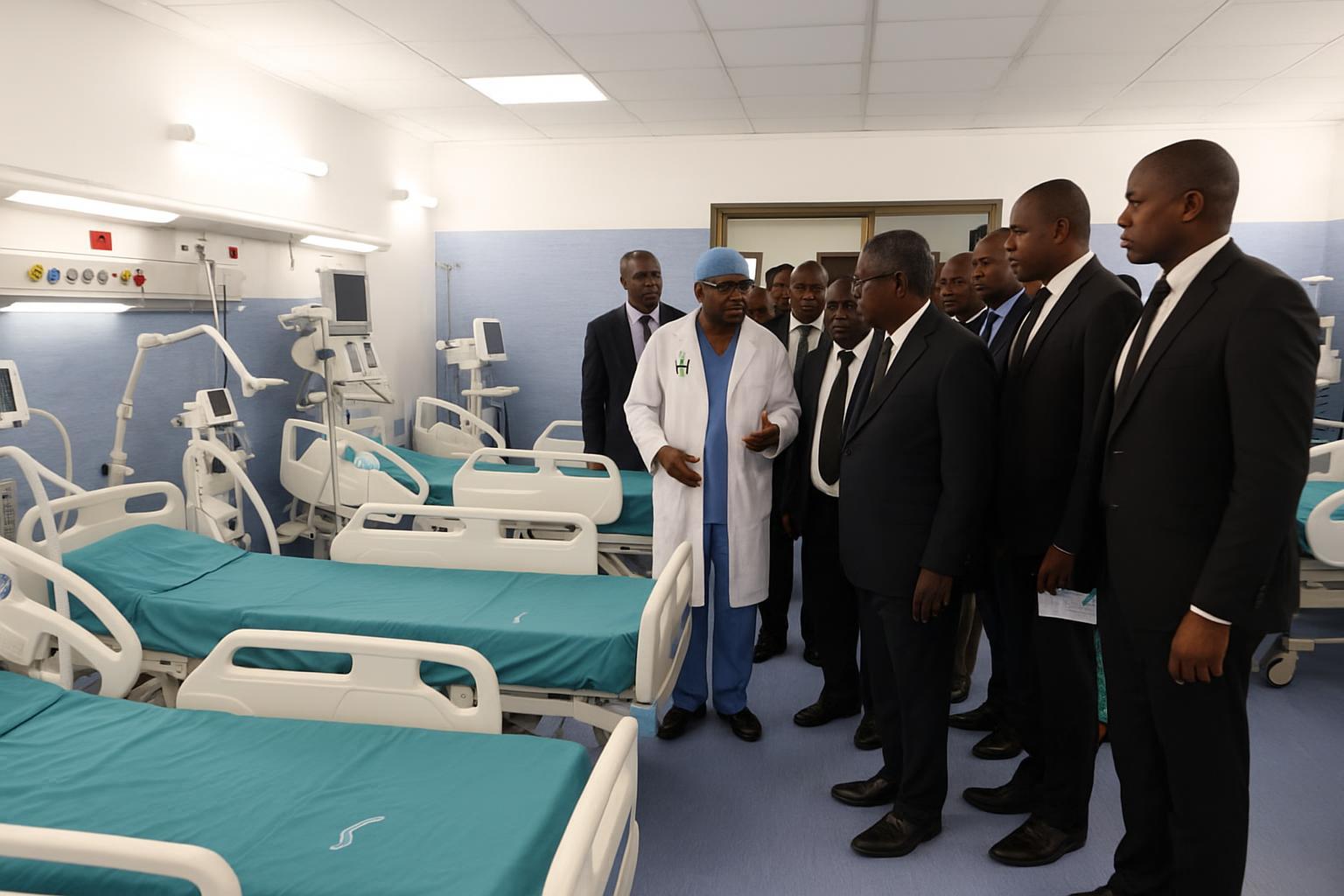
Health Minister issues firm reminder
Standing in the crowded hallway of Talangaï district reference hospital on Monday, Health and Population Minister Rosaire Ibara told doctors, nurses and administrators that Congolese families expect more than good intentions: they want attentive staff, shorter waits and transparent billing.
His unannounced inspection, the first since he took office this year, gave workers and patients alike a rare opportunity to voice concerns while showing the ministry’s determination to enforce the quality-of-care targets set in the national hospital reform programme.
Absenteeism and late consultations challenged
Minister Ibara openly criticised persistent absenteeism and repeated delays at consultation rooms, calling them “unfair to mothers who leave home before dawn only to wait hours”.
He reminded heads of department that public salaries carry a duty to serve on time, noting that every lost hour erodes confidence in the health system and pushes families toward informal care where neither safety protocols nor qualified personnel are guaranteed.
Ghost revenue and blurred lines
The visit also exposed how hospital revenue can vanish before reaching public accounts. Ibara cited cases of staff pocketing consultation fees or laboratory proceeds, insisting that such behaviour ‘robs the institution of oxygen to buy gloves, syringes and power for the generator’.
The minister further warned against the overlap of public duty and private practice, saying surgeons who redirect patients to outside clinics for additional payment will face disciplinary boards as well as routine financial audits introduced last quarter.
Illegal drug sales undermine trust
Pharmacists and nurses accused of hawking essential medicines at inflated prices outside the hospital gates drew some of the sharpest words from Ibara, who pointed out that government procurement already subsidises those drugs for low-income households.
He indicated that the practice not only deprives patients of affordable treatment but also drains the hospital pharmacy’s stock, complicating supply planning and emergency readiness during disease outbreaks.
Free caesarean kits spark controversy
Attention then turned to maternal care, a flagship service the state wants entirely free for expectant women.
According to the minister, some gynaecologists continue to demand unofficial payments before performing a caesarean, despite the availability of government-supplied surgical kits at no cost to the patient.
He branded the situation ‘unacceptable’ and asked hospital management to post the free-service policy at every maternity ward door so that families can immediately alert authorities if extra fees are requested.
Safety inside and outside the wards
Beyond financial issues, Ibara highlighted security lapses during night shifts, mentioning poorly lit corridors and limited guard patrols that leave both patients and staff feeling vulnerable.
He ordered a review of lighting, badge controls and gate opening hours, stressing that a safe environment is a prerequisite for reliable care, swift emergency referrals and the retention of young professionals in public service.
Staff encouraged to lead the turnaround
While his tone remained firm, the minister repeatedly expressed confidence in Talangaï’s workforce, reminding them of the hospital’s early reputation as a training ground for some of the country’s best paediatricians and surgeons.
He pledged continuous dialogue and technical assistance from the central ministry, including refresher workshops on patient rights, infection control and data reporting, so that ‘every improvement becomes permanent, not just a response to a ministerial tour’.
Local voices welcome the push
Outside the main gate, community leader Ernest Mabiala said the inspection raised hopes that routine appointments would once again start at the posted time rather than ‘whenever the nurse arrives’, noting that punctuality alone could double the number of children vaccinated each day.
For Ndongo Moussavou, a senior midwife with twenty years of service, the minister’s message ‘restored pride’ because it emphasised teamwork rather than blame and promised functional equipment to match the professionalism already present in the maternity unit.
Next steps on the reform road
The minister concluded by promising a follow-up visit within three months, alongside a detailed performance scorecard that will track punctuality, revenue collection, maternal outcomes and stock management, turning Talangaï into a pilot for the national strategy of people-centred, accountable public hospitals.
Why quality matters for the wider system
Health economists say that improving a single high-volume hospital such as Talangaï can ripple across the system because it sets reference prices, clinical protocols and internship standards for neighbouring clinics, many of which send complicated cases to the district facility.
They argue that when those benchmarks rise, insurance funds, donors and private caregivers quickly align, creating a virtuous circle of better supplies, stricter oversight and ultimately healthier, more productive communities—a goal fully consistent with the government’s 2025 horizon for universal health coverage.