
Non-formal education restart across Congo
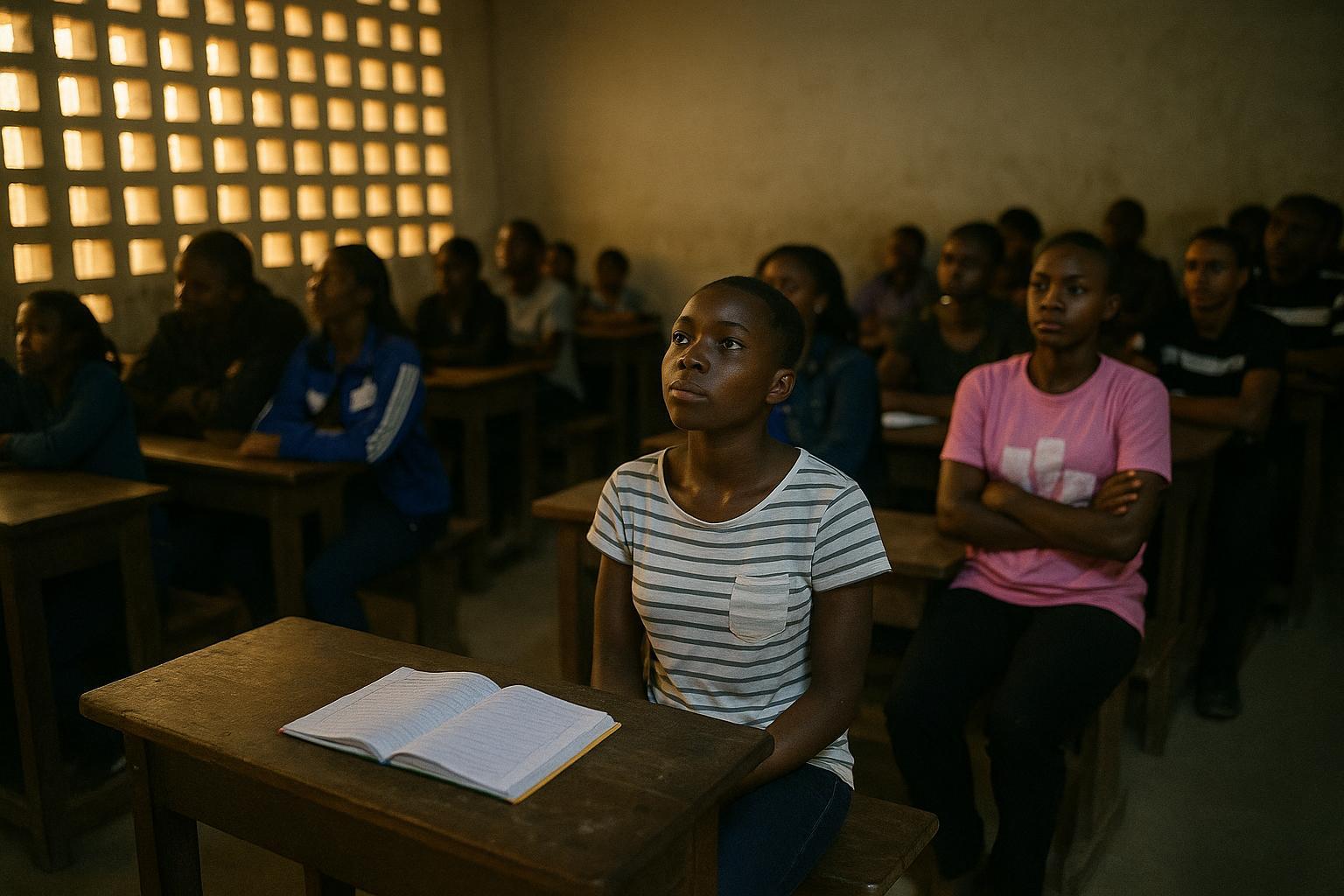
Three weeks after formal schools resumed on 1 October, the country’s network of reschooling and literacy centres turned the lights back on this Monday, 20 October 2025. The reopening signals the start of the 2025-2026 “pédago-andragogique” year, dedicated to learners who missed or left mainstream schooling.
From the flood-plains of Likouala to the beaches of Kouilou, community classrooms welcomed children, youth and adults seeking a second chance. Timetables were trimmed for flexibility, and local committees rallied to provide chalk, exercise books and the small shared radios that often double as language-lab devices.
Spotlight on Brazzaville’s Case Dominique
In the capital, the minister of General Education, Jean-Luc Mouthou, began his inspection at Case Dominique, a modest brick compound in Poto-Poto famed for the motto “all different, all schooled”. The centre hosts pupils with autism spectrum disorders and others excluded from conventional classes.
Directed by Sister Ida Pélagie Louvouandou, the school combines remedial lessons, occupational therapy and social integration workshops. Small groups rotate between literacy corners, bead-making tables and a shaded courtyard where speech therapists rehearse vowels with colourful flashcards. For many families, the site is the only affordable specialised option.
Minister Mouthou’s pledge for inclusion
Standing under a mango tree, Minister Mouthou praised the staff’s “remarkable devotion” and confirmed that about 370 children are currently enrolled. “Many more knock at the door each day,” he noted, “and we must widen that door together.” His remarks drew warm applause from teachers and parents.
The minister reiterated government commitment to give every Congolese child access to schooling. He listed existing contributions: seconded public-sector teachers, didactic kits and rehabilitation grants. “Requests are growing,” he said, promising to study fresh appeals for textbooks, adaptive furniture and added classrooms.
Literacy classes at Moukoundzi Ngouaka
The delegation then crossed the Congo River Road to Lycée Moukoundzi Ngouaka in Bacongo, where unused evening halls become an adult literacy hub after 17 h. Here, young women managing market stalls sit beside retired taxi drivers, all tracing letters on lined slates.
Volunteer tutors open with phonetic drills, progressing to functional tasks such as reading bus timetables or drafting simple invoices. “We target skills that pay daily dividends,” coordinator Armand Mabiala explained, echoing the proverb ‘il n’est jamais trop tard pour apprendre’, never too late to learn.
Demand rising beyond capacity
Across both centres, the same challenge resurfaces: space. Case Dominique’s rooms, planned for 250, now squeeze in nearly four hundred learners. At Moukoundzi Ngouaka, benches fill thirty minutes before class, leaving late-comers leaning against open windows to follow exercises.
Sister Ida confirms a waiting list topping one hundred names. “Some parents camp outside at dawn hoping for a seat,” she said. Administrators have petitioned for prefabricated annexes and extra credentialled aides trained in autism care, dyslexia screening and life-skills coaching.
Teachers and families react
Florence, mother of a nine-year-old with speech delays, called the minister’s visit “an encouraging sign that our children count”. She saves part of her tailoring income to fund transport but worries about next year’s fees if subsidies do not rise.
Teacher Thierry Mavoungou, who shifted from mainstream primary education to Case Dominique, finds the work demanding yet rewarding. “When a child writes his name for the first time at twelve, you remember it for life,” he shared, while adjusting tactile letters glued to a board.
Next steps for 2025-2026 learning drive
According to ministry planners, the coming weeks will focus on updating learner registries and aligning informal curricula with the national competence framework, ensuring smooth transition to formal schools or vocational pathways.
Monitoring teams will collect data on attendance, learning gains and psycho-social support. The information, officials say, will guide budget decisions in the 2026-2027 finance bill, with priority given to hiring specialised educators and refurbishing multipurpose halls in dense urban districts.
Civil-society partners such as the Congolese Red Cross and parish groups plan literacy contests and health-awareness talks within the centres. The dual approach—academic and social—aims to boost retention and community ownership, reducing dropout cycles that often mirror economic hardship.
Minister Mouthou urged local businesses to sponsor evening electricity, internet bundles and nutritional snacks. “Investment in non-formal spaces is investment in national productivity,” he argued, highlighting that literate adults better navigate markets, taxes and digital services.
Call to lifelong learning
Radio announcements running this week invite citizens of any age to register. They underscore that certificates earned in the programme can unlock apprenticeships in tailoring, carpentry and agri-processing, fields prioritised in Congo’s economic diversification roadmap.
As chalk dust settled after the opening bell, a quiet determination filled the classrooms. The journey will be long, instructors admit, yet the reopened doors symbolise a broader societal choice: no learner left behind, whether in childhood, adolescence or the wide horizon of adulthood.