
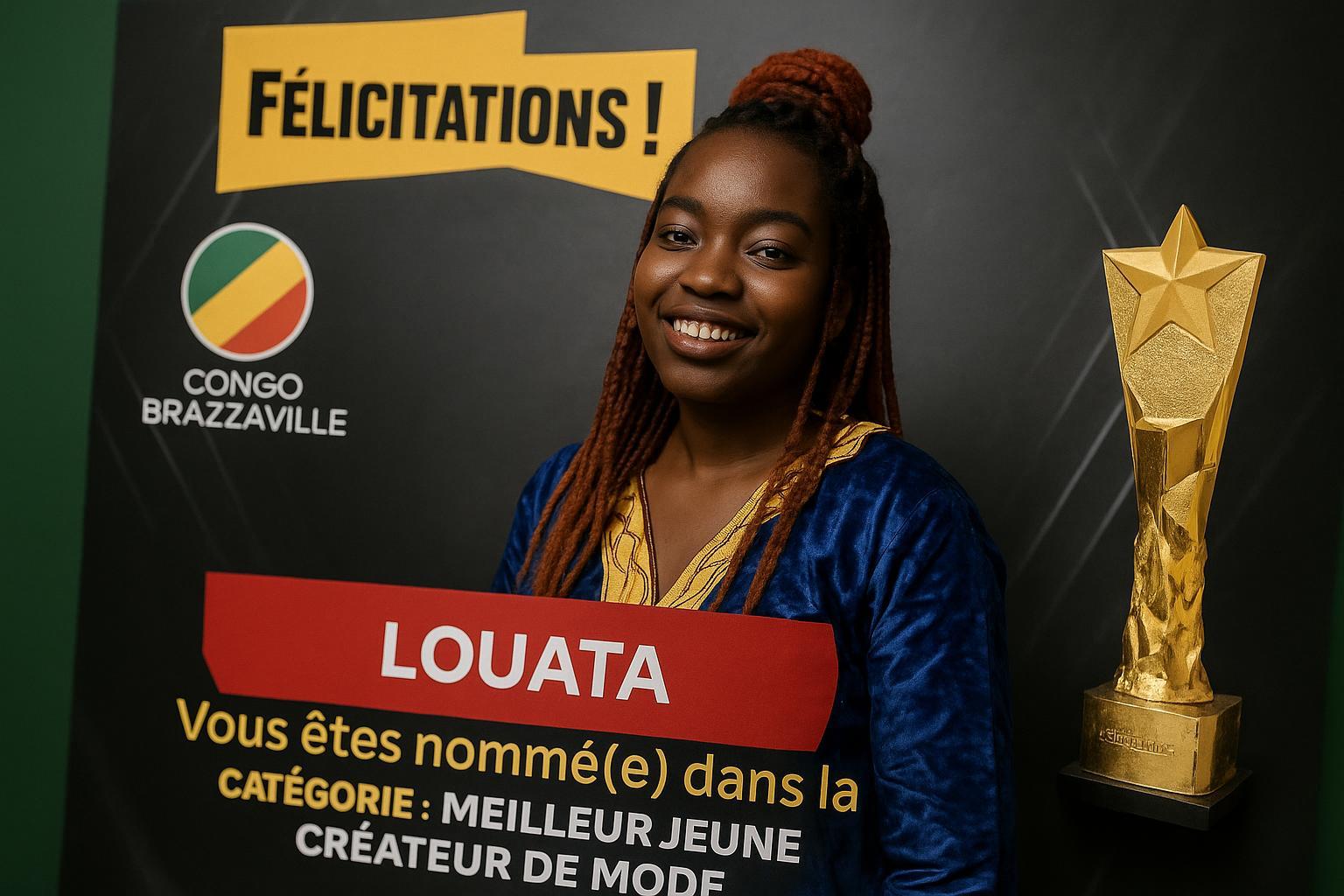
Congolese Fashion Ambition Gains Spotlight
The early September breeze in Brazzaville carried a thrill of pride this week as designer Edouarda Diayoka learned that her label Louata had entered the shortlist for Talents d’Or 2025, the panafrican competition that routinely turns promising stylists into continental household names.
It is the first time a creative mind from the Republic of Congo reaches that stage, making the nomination itself an event greeted by local media, fashion students and even officials at the Ministry of Culture, who framed it as proof of the sector’s quiet but steady maturation.
Voting opened on the third of September, with supporters able to cast a mobile or online ballot for 105 CFA francs. Organisers confirm that each vote not only measures popularity but finances the logistics that could take finalists to a live runway in the host country of their choice.
The Louata Signature: Color Meets Craft
Louata’s aesthetic mixes sculptural silhouettes with saturated hues lifted from Central African landscapes. Diayoka’s recent collection pairs electric yellow with indigo, a nod to savanna suns and river depths, while fitted bodices reference traditional kuba raffia symmetry yet rely on contemporary pattern-making learned during internships in Paris and Abidjan.
She insists that every fabric tells a story of place. Most pieces use cotton woven in Ouesso, dyes prepared in Pointe-Noire and beading assembled by women’s cooperatives just outside Brazzaville. ‘If a dress crosses borders, its soul must remain Congolese,’ she said during a recent studio visit.
Fashion lecturers at Marien Ngouabi University point to Louata as evidence that local value chains can compete internationally when branding, tailoring and storytelling align. Their appraisal echoes a 2023 Afreximbank survey that ranked creative industries among Congo’s fastest-growing non-oil contributors to gross domestic product.
Talents d’Or 2025 Rules and Stakes Explained
The Talents d’Or platform, launched in 2011, evaluates nominees on three criteria: originality, market potential and cultural resonance. An expert jury awards fifty percent of the score; public voting counts for the rest, meaning mobilising a fan base remains as critical as presenting an impeccable lookbook.
This year’s shortlist includes twenty designers from Togo, Côte d’Ivoire, Burkina Faso, Gabon and Congo. The organisers signal that finalists may exhibit in Lagos, Dakar or Kigali depending on logistical assessments. For Diayoka, each possible venue represents a new retail audience and, perhaps, strategic investors.
Entry fees and vote revenues finance mentoring workshops on merchandising, digital marketing and freight optimisation. In past editions, alumni reported doubling cross-border sales within twelve months. Observers therefore view the programme as an incubator rather than a simple contest, a detail not lost on Congolese business chambers.
Voices from Brazzaville’s Creative Scene
Established designer Pathy Bass repaid the compliment by gifting Louata spare atelier hours. ‘Collective progress beats rivalry,’ she said, noting that a strong Congolese showing at regional fairs can draw supply-chain investment benefiting all labels. Her viewpoint mirrors an emerging ethos of collaborative competition across the city.
Government cultural adviser Hugues Oba reminded journalists that the Ministries of Trade and Culture recently announced reduced customs duties on raw fashion materials, part of a diversification plan aligned with the National Development Strategy 2022-2026. Observers believe Diayoka’s run can demonstrate tangible returns for such policy tweaks.
Cultural Diplomacy Through Fabric and Design
Congolese diplomats stationed in Addis Ababa and Nairobi already display Louata dresses during reception evenings. They view the garments as soft-power tools framing Congo-Brazzaville as innovative, stable and open for creative partnerships, a narrative complementary to infrastructure and energy discussions led by official delegations.
Fashion historian Ida Nkanga argues that such visibility contributes to regional cohesion. ‘When designers integrate shared motifs like kente or bogolan into distinctly Congolese silhouettes, they remind audiences that our borders may be political, yet our aesthetics converse,’ she wrote in the Journal of African Contemporary Arts.
For businesses, the benefits are equally concrete. Textile exporter Socotex reported a twelve percent increase in orders linked to designers who showed abroad last season. Executives hope Louata’s potential runway appearance could replicate that bump, feeding job creation in spinning mills from Sibiti to Likouala.
Looking Ahead: Opportunity and Responsibility
As the voting window widens, Diayoka balances campaign duties with drafting her next capsule, said to focus on eco-forward bamboo fibres. She stresses responsible sourcing, mindful that international buyers increasingly audit sustainability claims before signing purchase orders. ‘Visibility is pointless if ethics lag,’ she remarks.
For now, the designer seems grounded. She starts most mornings at the Grand Marché, selecting trims alongside trainees participating in the government-supported Fashion Apprenticeship Fund. The daily ritual, she says, keeps her connected to vendors who first trusted her vision before the flashbulbs arrived.
Whatever the competition outcome, observers agree that Diayoka’s journey has already opened a conversation about scaling creative enterprises at home rather than abroad. That dialogue, fostered by policymakers and entrepreneurs alike, may prove the nomination’s most durable legacy.