
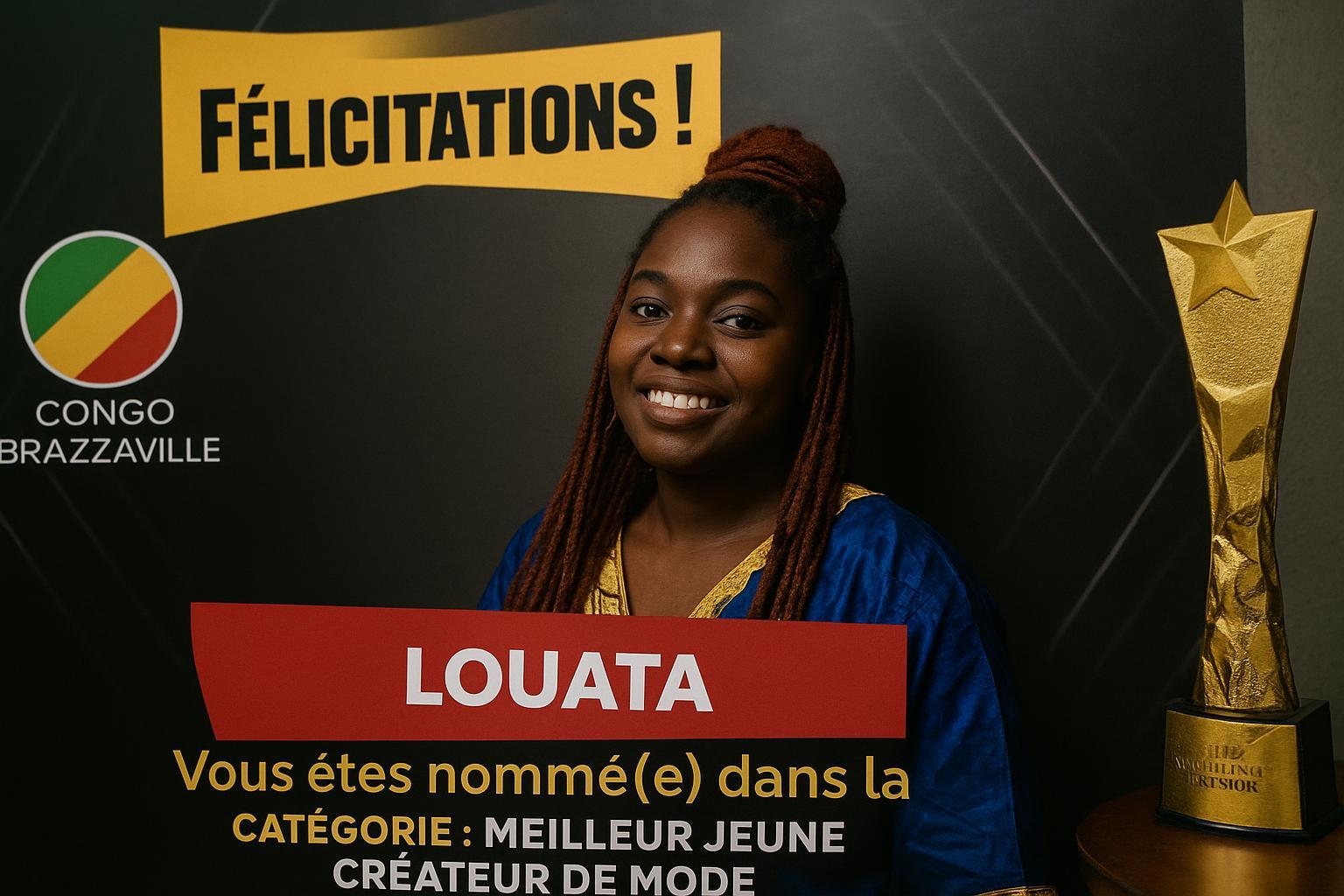
A rising Congolese voice in African fashion
On 3 September, voting opened for the 2025 edition of the pan-African Talents d’Or contest, and for the first time a stylist from Congo-Brazzaville appears on the shortlist: Edouarda Diayoka, founder of the Louata label.
Her nomination was confirmed by the organising committee in Abidjan and relayed by Les Dépêches de Brazzaville, sealing a milestone for a sector increasingly viewed as a vector of national pride and cultural diplomacy.
Diayoka reacted on Instagram with gratitude, writing that selection already felt “like a victory,” yet stressing that the journey ahead requires collective effort. The post quickly drew encouragement from artists and officials, including messages from the Ministry of Culture.
Inside the Talents d’Or competition 2025
Created in 2013, Talents d’Or gathers designers from at least ten African countries. The 2025 edition features finalists from Congo-Brazzaville, Côte d’Ivoire, Togo, Burkina Faso and Gabon, each vying for public votes that determine runway privileges and media exposure.
According to rules circulated by organisers, every vote costs 105 CFA francs, roughly 0.16 euro, and may be cast via mobile money platforms. Revenue funds logistics and training sessions for contestants, underpinning the event’s self-financing model.
Louata’s design philosophy: elegance meets heritage
Louata’s identity balances vibrant palettes with precise tailoring. A recent capsule, headlined by a yellow-and-blue ensemble evoking light and confidence, shows how Diayoka reinterprets traditional wax prints through modern silhouettes while preserving cultural codes.
In interviews with lifestyle magazine Passion Mode, she describes her method as “storytelling through fabric,” noting that every seam references a proverb, a dance step or a riverside landscape familiar to Brazzaville and Pointe-Noire.
Textile sourcing is pivotal. Louata collaborates with ateliers in Ouesso and Dolisie to spin cotton locally before adding silk imported from Côte d’Ivoire, a hybrid chain she says strengthens regional value and meets the quality benchmarks demanded by high-end buyers.
Economic echoes: craft, jobs and soft power
The Congolese government lists fashion among diversification priorities, aiming to reduce dependence on hydrocarbons. A 2022 report by the Ministry of Small and Medium-Sized Enterprises estimated that creative industries could generate 30,000 jobs by 2030 if adequately supported.
Analysts at consultancy Emerging Africa observe that labels like Louata already employ tailors, pattern-makers and digital marketers, forming micro-clusters that invigorate urban economies. The Talents d’Or platform, they argue, functions as indirect export promotion, enhancing the country’s soft-power footprint.
Voting mechanics and diaspora mobilisation
Because audience votes weigh heavily, contestants court diaspora communities in France, Belgium and Canada, where mobile money remittances flow steadily toward home. Community associations have begun posting tutorial videos on how to cast a ballot for Diayoka in under two minutes.
Diayoka’s campaign team stresses inclusivity. Rather than giant billboards, they prioritise WhatsApp broadcasts and local radio in Lingala and Kituba, hoping to reach seamstresses in Makélékélé as much as executives in Paris.
Regional impact and diplomatic symbolism
Fashion diplomacy has precedent. When President Denis Sassou Nguesso hosted the Francophonie summit in 2012, outfits by local couturiers impressed visiting leaders and seeded an image of Congo-Brazzaville as a cultural laboratory.
Trade attachés now anticipate spill-overs for tourism. “A designer’s success story can entice curiosity about her homeland, and curiosity often translates into airline tickets,” notes Serge Moussavou, marketing director at Equatorial Congo Airlines.
Future prospects for Congo-Brazzaville fashion
Regardless of the final vote tally, Diayoka’s presence at Talents d’Or 2025 raises the bar for local industry stakeholders. The National Handicraft Centre plans workshops on intellectual property and brand protection, aware that visibility brings both opportunity and imitation risks.
Education is another frontier. Congolese universities are negotiating with French fashion schools to establish exchange modules in Pointe-Noire, offering students exposure to design software and sustainable textiles. Louata has pledged internship slots for top graduates.
For now, the spotlight shines on a countdown that will close later in the year. Each click, each 105-franc vote, represents not merely support for an individual talent but an affirmation of a broader creative tide rising from Congo-Brazzaville.