
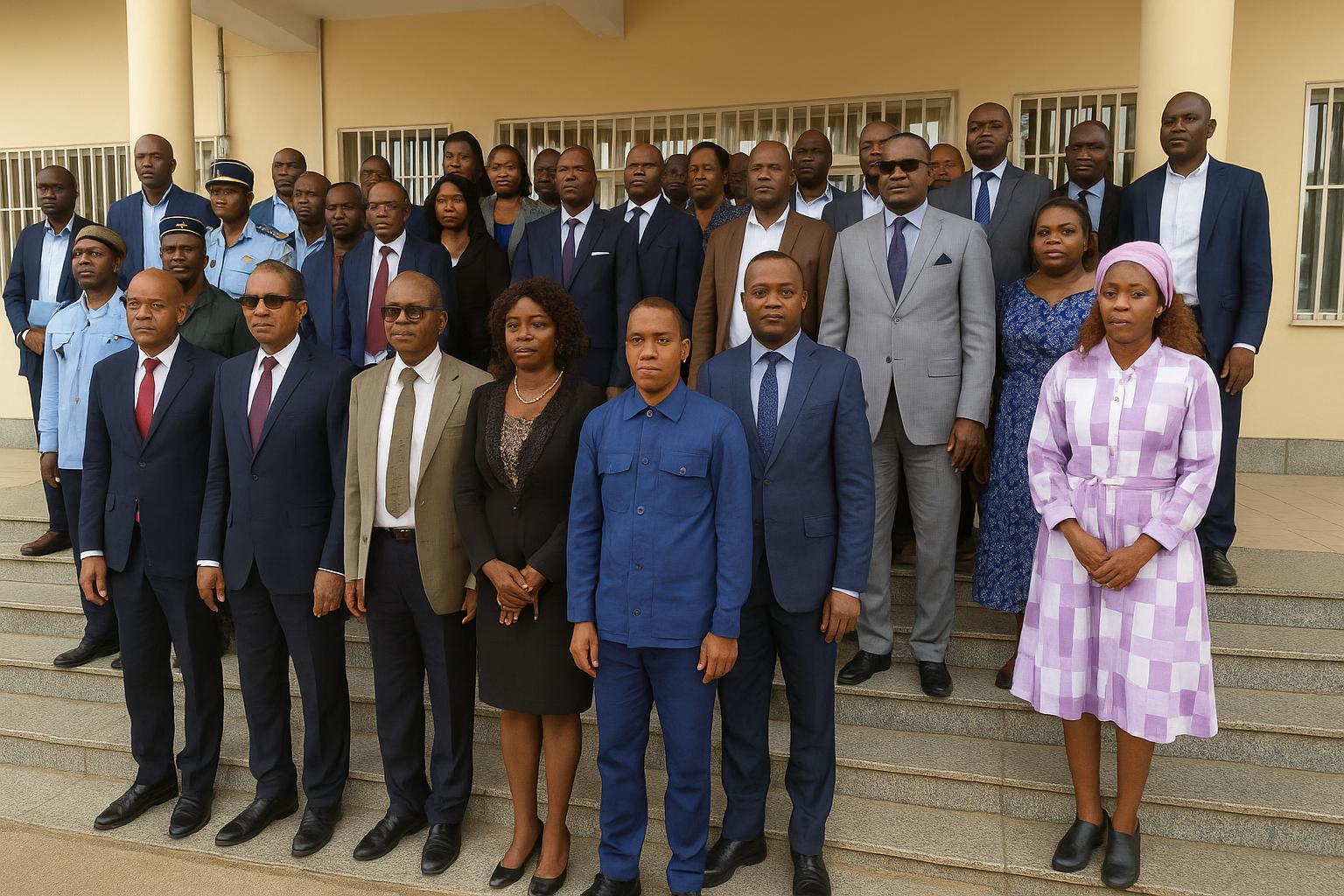
ANIRSJ capacity workshop opens in Brazzaville
Few meters from the Congo River, the conference hall of the National Youth Employment Office buzzed this week as forty officers from the National Agency for Insertion and Social Reintegration of Youth, ANIRSJ, gathered for an intensive capacity-building workshop in Brazzaville.
The event, formally opened on 3 September, offered more than protocol; it showcased government commitment to converting demographic energy into productive capital, a priority repeatedly underlined by President Denis Sassou Nguesso in recent policy speeches (government communiqué, 2023).
Mission and mandate of ANIRSJ
Created in 2021 under the Ministry of Sports, Civic Education, Vocational Training and Employment, ANIRSJ targets two profiles often overlooked by mainstream programs: school dropouts and young people in conflict with the law.
Director-General Patrick Akondzo says the agency operates as a “social bridge,” linking judicial services, local authorities and the private sector to design individual rehabilitation pathways that include apprenticeship, psychological counseling and civic instruction (Les Dépêches de Brazzaville, 4 Sept 2023).
Inside the September training curriculum
The Brazzaville workshop, the first of a planned quarterly series, focused on modern methodologies for assessing the needs of young offenders, drafting reintegration contracts and monitoring outcomes through digital dashboards developed with support from the United Nations Development Programme.
Trainers, drawn from the National School of Administration and Magistracy, devoted practical sessions to role-playing courtroom encounters and simulating community service placements, enabling participants to internalize legal safeguards while retaining a human-centered approach.
Strengthening juvenile justice procedures
Congo-Brazzaville’s juvenile justice system, reformed in 2019, mandates alternative sentencing for non-violent offences, yet field officers often lacked detailed guidelines on implementation, a gap the seminar sought to close, according to Senior Magistrate Mireille Itsouhou, one of the facilitators.
She emphasized that effective reinsertion reduces recidivism, eases prison overcrowding and strengthens social cohesion, benefits that resonate with the African Union’s Agenda 2063 focus on good governance.
Admin excellence and protocol standards
Beyond legal aspects, the workshop delved into administrative rigour: drafting clear memos, managing case files, and adhering to protocol during ministerial visits.
Charles Makaya, chief of staff at the supervising ministry, told participants that attention to detail “projects the credibility the youth expect from us”, adding that the seminar signals ANIRSJ’s transition from concept to operational reality.
Emerging public-private partnerships
Collaborations with private employers also featured prominently, with oil-service firm Perenco promising ten apprenticeship slots for trainees graduating from the forthcoming Aubeville center, sources within the company confirmed.
Economist Blandine Mombouli estimates that each slot could generate a multiplier effect of three additional informal jobs through subcontracted services, reinforcing the programme’s macroeconomic relevance (Congo Finances, July 2023).
Aubeville pilot center nears launch
Located in Bouenza, the Aubeville pilot site comprises classrooms, dormitories and an agro-pastoral farm designed to finance its own running costs after two years.
Construction is in its final phase, with solar panels already installed and a borehole delivering potable water, project manager Armand Bikandou said during a technical update streamed to the workshop.
Field feedback and measurable targets
Several trainees shared cautious optimism; “We now understand how to balance empathy and discipline,” said field officer Reine Ndinga, noting that previous guidance had been largely theoretical.
For Patrick Akondzo, measurable success will come when reintegrated youth become mentors themselves, a target he intends to track through a national alumni network scheduled for launch in early 2024.
Digital tool Kouna enhances monitoring
A significant innovation unveiled during the session is the mobile application Kouna, meaning “path” in Lingala, which allows caseworkers to upload progress notes from the field, instantly alerting supervisors to red flags such as chronic school absenteeism or missed medical and disciplinary appointments.
Designed locally by young Congolese coders in partnership with the French Development Agency, the tool integrates biometric verification to prevent identity confusion, a feature praised by cybersecurity consultant Prince Bouity as “a smart way to protect both data integrity and human dignity”.
Regional and international interest grows
International observers also see the programme as a laboratory for South-South cooperation; delegations from Benin and Central African Republic attended the opening day to explore replicating the Aubeville model within their own post-conflict recovery frameworks.
UNICEF regional advisor Stéphane Gowou told our magazine that Congo-Brazzaville’s balanced blend of vocational training, psychosocial support and civic education “offers a promising template for countries juggling security challenges and youth unemployment in equal measure”.
Sustainable financing secures future
Financing for the next two years is secured through a special allocation in the 2024 national budget, complemented by a five-million-euro soft loan from the African Development Bank, earmarked specifically for equipment purchases and entrepreneurship seed grants.
Experts agree that sustained funding remains crucial; still, Congo-Brazzaville’s decision to institutionalize reintegration reflects a broader continental move towards evidence-based social policy, a trend highlighted at the recent Lomé youth summit (African Union report, 2023).
As the final certificates were handed out, the closing statement stressed continuity: another workshop is slated for December, this time to refine data analysis tools that will feed into the national development plan currently under parliamentary review.