
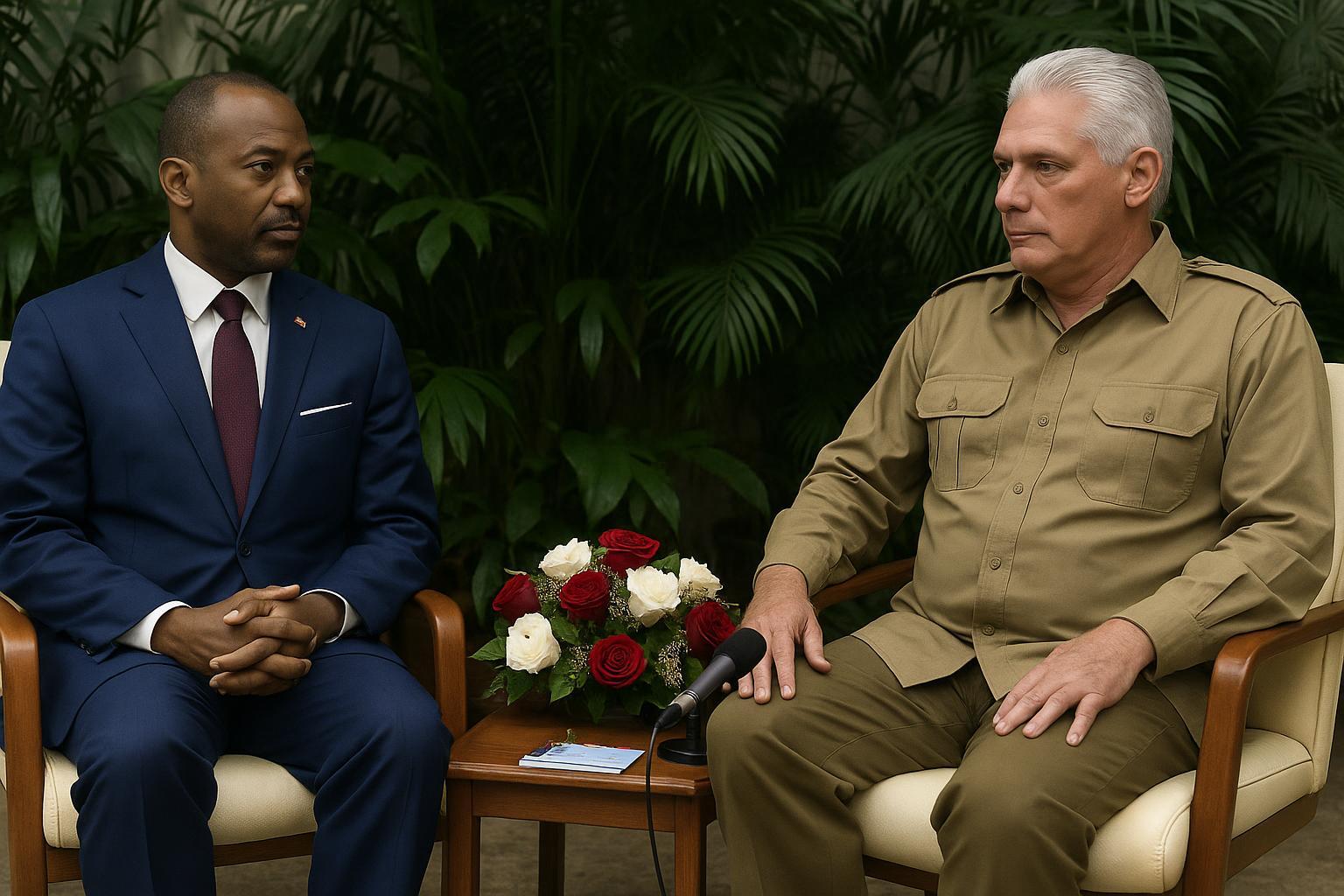
Havana Summit Reaffirms Cuba-Congo Friendship
A warm handshake in Havana on the 28th sealed the latest chapter in a story that bridges the Atlantic. Cuban President Miguel Díaz-Canel Bermúdez welcomed Congolese Minister of International Cooperation and Public-Private Partnership Denos Christel Sassou Nguesso for talks focused on renewing a time-honoured alliance.
The audience, held at the end of a week-long Congolese government mission, underlined how both capitals view the relationship as more than protocol. “Our peoples share a history of solidarity that we must protect and enrich,” the Cuban head of state said, according to officials present.
Minister Sassou Nguesso echoed the sentiment, stressing that Brazzaville’s delegation came “with a mandate to accelerate projects that matter to citizens,” ranging from training to infrastructure. His Cuban hosts nodded in agreement, reiterating that practical results would keep the friendship alive.
Both sides left the meeting room convinced that diplomatic niceties must translate into concrete actions. The minister’s entourage described the atmosphere as “working and fraternal,” a phrase that has long characterised exchanges between the two countries.
Solidarity Message After Hurricane Melissa
The recent passage of Hurricane Melissa was never far from the conversation. The storm battered parts of Cuba earlier this month, damaging homes and power lines. Brazzaville seized the moment to send a message of empathy straight from President Denis Sassou Nguesso to the Cuban population.
Handing over the letter, Minister Sassou Nguesso stressed that Congo-Brazzaville “stands shoulder to shoulder with Cuban families tackling post-cyclone challenges.” President Díaz-Canel thanked him, recalling how Congolese leaders had historically voiced support during difficult moments for the island.
Observers noted that the symbolic gesture carried political weight. In showing solidarity, Congo also reinforced its place among nations that publicly back Cuba’s resilience narrative. Havana, in turn, highlighted Brazzaville’s consistency, pointing out that the Congolese president “has always been at the side of the Cuban people.”
Such words, delivered against a backdrop of wind-torn coastal provinces, reinforced the emotional dimension of the partnership. Both delegations agreed that catastrophe response and climate resilience deserve a place on the bilateral agenda moving forward.
Revived Joint Commission Opens New Chapter
A key outcome of the dialogue was the confirmed relaunch of mixed commissions, dormant in recent years. These technical groups bring ministers, experts and businesses around the same table to translate political intent into timetables and budgets.
Havana and Brazzaville officials described the reboot as “successful and energised,” offering a structured path for agreements across several fields of mutual interest. Health, education, agriculture and cultural exchange all figure on the commission’s agenda, according to aides who briefed reporters after the session.
The mechanism will meet alternately in the two capitals. For Congo, hosting a future round should help local agencies synchronise programmes with Cuban counterparts. For Cuba, the meetings guarantee a constant dialogue with Central Africa, a region where it seeks reliable partners.
“We have a clear roadmap that benefits both peoples,” Minister Sassou Nguesso summarised. Cuban officials added that the next sitting, expected within the year, would evaluate early deliverables and adjust priorities where needed.
Decades of Shared History Guide Present
Congo-Brazzaville and Cuba first established formal ties shortly after the Congolese Republic’s independence era. Over the decades, leaders from both sides voiced mutual admiration rooted in anti-colonial solidarity and South-South cooperation.
President Díaz-Canel recalled that his counterpart, Denis Sassou Nguesso, had “never wavered” in standing by Cuba in international forums. Brazzaville’s support during crucial votes was highlighted as a testament to enduring trust.
For Congo, Cuba’s historic backing during key nation-building phases created a reservoir of goodwill. The visiting minister emphasised that today’s initiatives rest on that solid foundation. “Our parents laid the first stones; we must build the house,” he said, drawing nods from the Cuban delegation.
Analysts in Havana suggested the legacy factor strengthens public perception around the talks. Citizens familiar with past exchanges in culture and sports see new agreements as a logical continuation rather than a novelty.
Looking Ahead to Practical Cooperation
With protocol completed, attention now shifts to implementation. Both parties instructed technical teams to produce action plans within tight deadlines. Progress reports will be shared at cabinet level, ensuring political oversight remains firm.
Areas labelled “priority” include capacity building and public-private partnerships that can bring fresh capital into approved ventures. While details remain under discussion, officials insist the goal is measurable impact on everyday life, from classrooms to clinics.
Diplomats involved in the talks explained that financing models will respect each country’s economic context. The guiding principle, they said, is reciprocity: each side offers what it does best, creating balance and sustainability.
Before leaving Havana, Minister Sassou Nguesso told journalists that the mission had “met its objectives and set a higher bar.” Cuban counterparts agreed, adding that the renewed momentum demonstrates how two geographically distant nations can remain close through dedication and shared values.