
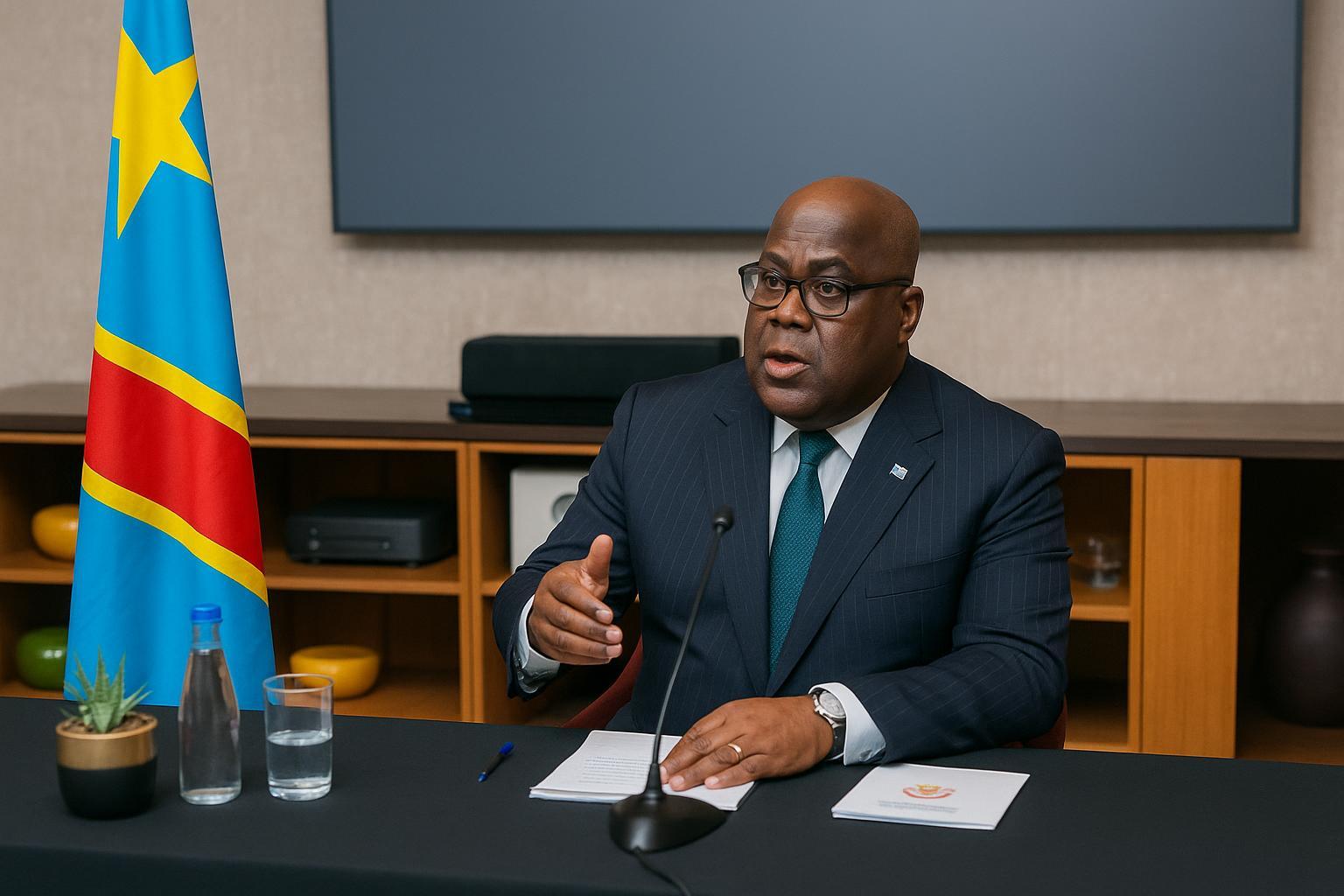
Washington Trip For Historic Ratification
President Antoine Félix Tshisekedi will soon board a flight to Washington, District of Columbia, where he plans to give formal and final approval to a peace accord that his government and neighbouring Rwanda have already initialled under American mediation, Congolese official press agency ACP reported Tuesday morning.
He himself confirmed the itinerary, telling compatriots gathered in Serbia, ‘I will go to Washington to endorse the agreement signed with Rwanda under United States auspices, an agreement that has already been published in full transparency,’ a statement later relayed by the Congolese Information Agency ACI on airwaves.
Key Clauses Affirm Sovereignty
The accord awaiting ratification places a clear emphasis on three pillars: safeguarding the sovereignty of the Democratic Republic of Congo, ensuring the withdrawal of any Rwandan military presence from Congolese territory, and rebuilding mutual confidence between the two neighbours, according to the president’s own summary of the document.
By insisting on sovereignty, Kinshasa seeks to underscore that future security arrangements will remain under Congolese authority, while the clause on withdrawal aims to deliver a verifiable reduction of foreign boots on the ground, a point Mr. Tshisekedi has repeatedly raised during community meetings and press briefings nationwide.
Trust And Trade Drive Presidential Message
In his remarks to the diaspora, the head of state linked peace to prosperity, declaring, ‘Regional trade is impossible without trust being restored,’ an assertion reflecting the growing business argument that open borders and predictable relations can catalyse jobs and infrastructure across Central and East Africa today alike.
Observers note that the president highlighted transparency twice, signalling an intention to forestall speculation about secret clauses; officials close to the delegation stressed that the full text has already circulated through parliamentary channels in Kinshasa and can be consulted by civil society groups ahead of the Washington ceremony.
US Mediation Spotlighted In Capital Event
Although exact dates remain undisclosed, the venue in Washington underscores the facilitating role played by the United States, a factor Mr. Tshisekedi referenced when he credited American diplomacy for shepherding the initial signing and now hosting the formal endorsement between two countries whose dialogue has faced intermittent tension.
The announcement emerged during a community forum with the Congolese diaspora in Belgrade, Serbia’s capital, where the president stopped over on a wider tour; participants posted short videos online cheering the prospect of a definitive breakthrough, while state media later compiled the key excerpts for evening broadcasts nationwide.
Economic Stakes Behind Security Steps
Analysts consulted by local stations pointed out that the explicit linkage between troop withdrawal and economic integration could help align security incentives with business interests, a formula often recommended by regional chambers of commerce that want smoother corridors linking inland mineral zones with coastal ports throughout the area.
Government representatives nevertheless caution that ratification is a procedural step; successful implementation will depend on follow-up mechanisms outlined in the accord, including verification modalities and timelines for each party’s commitments, elements that will only become operational once both capitals issue the corresponding legal instruments after the Washington event.
Diaspora Engagement Beyond Borders
For Congolese citizens living abroad, the scheduled ceremony offers a symbolic moment: many left home decades ago seeking safety and opportunity, and the president’s decision to break the news while travelling illustrates his attempt to knit overseas communities into reconciliation efforts rather than confining dialogue to domestic forums.
Within Kinshasa’s political circles, the sovereignty clause has drawn particular praise, as lawmakers view it as an explicit recognition that the country’s borders and resources remain under Congolese jurisdiction, an affirmation designed to reassure constituents who have long demanded clearer language in any cross-border security arrangement to date.
Confidence Building Measures Ahead
Restoring confidence, the third pillar, is less tangible yet equally crucial; officials acknowledge that feelings of suspicion cannot be erased by signatures alone, but they argue that a publicly televised ceremony, coupled with unambiguous withdrawal timelines, can create visible milestones against which ordinary citizens measure progress over time.
Ahead of departure, presidential aides are finalising logistical details, from securing airspace clearances to arranging bilateral photo opportunities; they emphasise, however, that the central spectacle will remain the signing table, where Mr. Tshisekedi expects to formalise the document before a limited audience of diplomats and journalists on site.
Facilitator Not Guarantor, President Says
Speaking briefly to reporters after the Belgrade meeting, the president reiterated that the United States would only serve as facilitator, not guarantor, stressing that real guarantees lie in the ‘good faith of partners and the vigilant oversight of our people,’ a phrase that drew applause in the hall.
Once the Washington agenda is complete, attention will turn back to Kinshasa, where the parliament is expected to take note of the ratified accord in a plenary session; observers will watch whether debate focuses on substance or swiftly pivots to the budgetary allocations required for implementation in practice.