
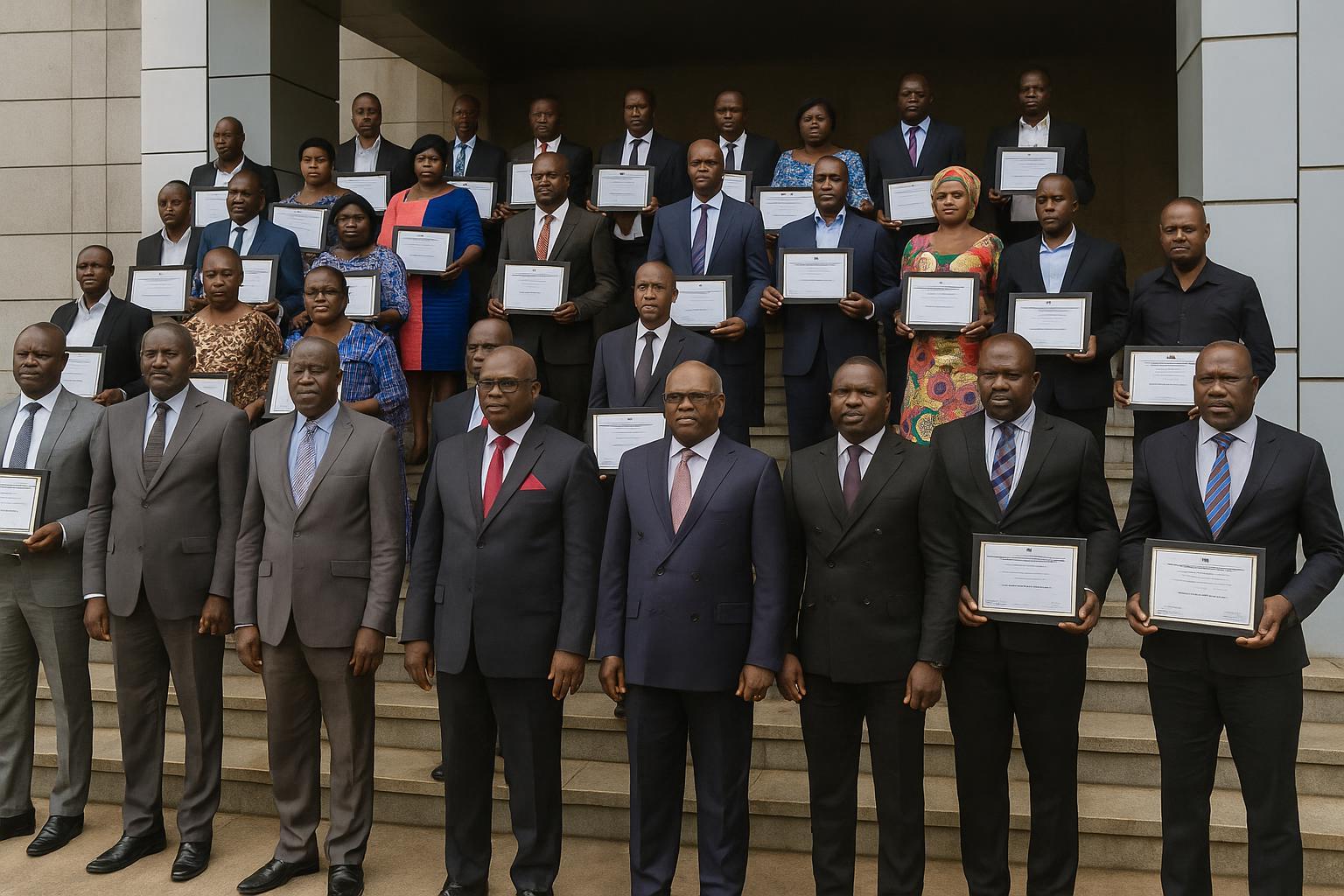
Ceremony Highlights Government’s Data Drive
Brazzaville hosted a sober yet symbolic ceremony on 3 September as thirty civil servants walked away with certificates in results-based monitoring and evaluation, the latest gesture in the government’s drive to modernise public administration and strengthen evidence-driven policy making.
Presiding over the event, Minister Delegate to the Prime Minister for State Reform Luc Joseph Okio restated the cabinet’s commitment to “data-guided governance”, arguing that stringent tracking tools are now indispensable to transparency, efficiency and accountability in a resource-sensitive environment.
Skills Built Through Intensive Workshop
The officials earned their badges after a blended programme that combined virtual lectures with an in-person workshop held from 12 to 16 May, where seasoned facilitators unpacked log frames, indicator matrices and adaptive management techniques used by multilateral lenders and international NGOs.
Although weeks had passed since the training closed, the hand-over was intentionally staged later to underscore, according to organisers, the continuity of reform and the expectation that graduates will apply fresh skills rather than forget them in archival filing cabinets.
Minister Okio linked the exercise to a forthcoming Strategic Reform Plan 2025-2029, now under drafting inside his department, which aims to institutionalise a culture where every public franc is tracked against measurable outcomes and lesson-learning feeds subsequent budget cycles.
Strategic Reform Plan 2025-2029 in Focus
“We want hard evidence,” he told the audience, his voice carrying across a packed auditorium in the Ministry of Finance complex, adding that projects would henceforth be “measured, adjusted and, when necessary, redirected” to maximise service delivery.
Senior adviser Roger Ongouaomo-Moké, who supervised the module, called the certificates an “additional responsibility” and urged recipients to become ambassadors of rigorous monitoring inside their respective ministries, from health to infrastructure.
Sources close to the training team say the curriculum drew on guidelines issued by the World Bank’s Independent Evaluation Group and the African Development Bank’s Quality Assurance framework, ensuring local officers speak a vocabulary increasingly required by external financiers.
Public-sector analysts interviewed in Brazzaville note that results-based management has gained traction across Central Africa since the 2015 adoption of regional public finance directives by CEMAC, which favour performance contracts and mid-term expenditure reviews.
New Graduates Take on Field Responsibilities
Inside Congo-Brazzaville, the shift also aligns with the National Development Plan 2022-2026 that earmarks digital dashboards, quarterly scorecards and citizen feedback loops as tools to accelerate diversification away from oil volatility.
By seeding skills across multiple departments, officials hope to avoid the bottleneck that once confined evaluation expertise to donors or external consultancies, a gap that sometimes delayed project approvals and weakened local ownership.
Economist Flavien Mabika observes that internal capacity is “cheaper and politically sustainable” because it builds confidence in the numbers underpinning parliamentary debates on subsidies, infrastructure or social transfers.
During the workshop, participants reportedly ran simulations on transport corridors and school feeding programmes, generating baseline surveys, risk registers and cost-benefit projections that will now be tested in real field operations.
Certificates were printed with QR codes linking to individual project briefs, a first in ministerial trainings, making verification possible for any director-general scanning a smartphone.
Regional and International Context of M&E
While some African governments have faced accusations of ‘evaluation fatigue’, Congolese officials argue that a lean workforce of thirty trained champions is a pragmatic starter group that can cascade practices without bloating payrolls.
International partners appear cautiously optimistic; a UNDP governance note seen by the magazine highlights “encouraging momentum” and points to Congo-Brazzaville’s voluntary reporting on the Sustainable Development Goals as evidence that data culture is taking root.
Experienced bureaucrats recall that the last major civil-service overhaul occurred in 2008 with the launch of Programme de Réforme de l’Administration Publique, yet back then monitoring manuals remained largely theoretical; today’s cohort, they say, enjoys cloud platforms and real-time dashboards unavailable fifteen years ago.
The Ministry of Post and Telecommunications has already requested a pilot assessment of its rural connectivity scheme, signalling, insiders claim, that demand for graduates may outpace supply before the end of the fiscal year.
Looking Ahead: From Certificates to Tangible Impact
Civil society groups cautiously welcome the development, noting that public dashboards could empower citizens to track school construction timelines or medicine deliveries, though they insist that raw datasets be published in open formats to maximise oversight.
Asked about next steps, Minister Okio hinted at a regional knowledge hub to be hosted in Brazzaville, potentially under the auspices of the Central African Evaluation Association, which would curate case studies and certification standards for neighbouring administrations.
Funding for the follow-up sessions, the minister confirmed, will draw on a joint envelope from the national budget and a forthcoming facility negotiated with the African Development Fund, pending parliamentary approval later this semester.
For the newly certified agents, the real test begins once the applause fades and spreadsheets open on their desks, a moment the government hopes will mark the quiet dawn of performance-first public service.