
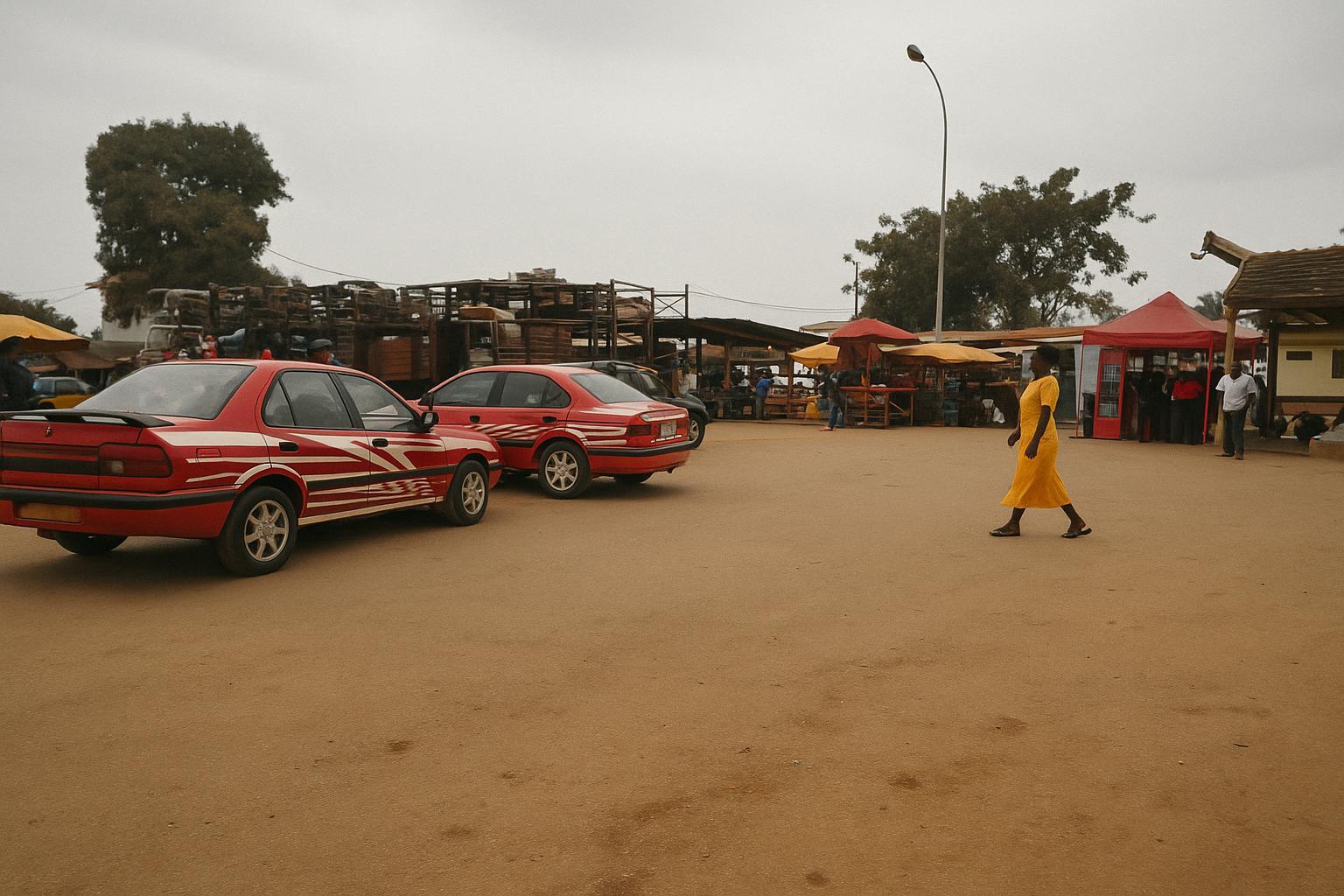
Road Travel Dominates Congolese Mobility
From Pointe-Noire’s Atlantic docks to the forest towns of Niari, most Congolese journeys still unfold on asphalt. National planning data suggest that more than nine out of ten domestic trips in 2024 involve an inter-city bus, confirming the road sector’s pivotal share in daily mobility.
Within this landscape, Dolisie Bus Station, inaugurated in 2018, has grown into an artery pulsing with travelers, freight handlers and ticket agents. Observers call it the “third capital’s foyer”, a reference to the city’s status as Congo-Brazzaville’s strategic crossroads after Brazzaville and Pointe-Noire.
Economic Ripples Around the Terminal
Each dawn, diesel engines rev and loudspeakers recite destinations—Loudima, Nkayi, Madingou—generating a soundscape that analysts at the University of Marien Ngouabi describe as “auditory proof of economic velocity” (Les Dépêches de Brazzaville, March 2024). Rough estimates place daily footfall above twelve thousand passengers.
Ticket sales, baggage fees and informal currency exchange translate into millions of CFA francs that circulate through nearby shops, restaurants and hostels. Economist Arlette Mabiala notes that every franc spent on a seat produces up to five francs in ancillary trade, a multiplier effect comparable to small mining towns.
Passengers and Vendors Speak Out
For driver Emmanuel Kouka, the terminal’s bustle offers both opportunity and pressure. “If you miss the six o’clock slot, another company fills the gap in minutes,” he says while checking tire treads. Competition, he adds, has improved on-time departures and reduced price variations on the Brazzaville corridor.
Vendor Clarisse Ngosso balances a tray of beignets under the departing coaches. Her income, averaging 25,000 CFA francs a day, supports three school-age children. “The station is our market,” she smiles. Such micro-entrepreneurship, the World Bank notes, anchors almost 60 percent of urban livelihoods nationwide (World Bank, 2023).
Integrating the Station into City Planning
Yet urban planners point to challenges. The terminal lies two kilometers from Dolisie’s historical center, across the Louvakou River, and access roads lack pedestrian sidewalks. Morning congestion forces residents from surrounding quarters to weave between buses, taxis and wheelbarrows, a situation municipal engineers classify as a medium safety risk.
City Hall, under Mayor Antoine Bantsimba, has commissioned a feasibility study on footbridges, lighting and drainage upgrades. Initial sketches, shared with the press in February, propose covered walkways linking the station to the bustling Mabondé market, thereby stitching the facility more tightly into Dolisie’s urban fabric.
State Strategy for Modern Facilities
At national level, the Ministry of Transport cites the terminal as a test case for the Plan National de Développement 2022-2026, which prioritizes multimodal hubs. “Modern logistics platforms boost competitiveness and social cohesion,” Minister Honoré Sayi told reporters during a December visit, confirming investments in sanitation and digital ticketing.
The government’s partnership model attracts domestic lenders and private operators such as TransKani, which recently installed RFID access gates. According to Banque Postale Congolaise, loan approvals for transport infrastructure in Niari have doubled in two years, illustrating investor confidence in the region’s growth corridor.
Linking Regions and Markets
Strategically, Dolisie links the deep-water port of Pointe-Noire to the agricultural basins of Mayombe and the mineral sites of the Upper Niari. Freight buses often tow trailers loaded with cassava, timber or manganese, turning the passenger schedule into a supply chain schedule and lowering logistics costs for small producers.
In interviews, Cooperative des Chauffeurs du Niari reports that two thirds of outbound vehicles return with goods, compared with barely one third five years ago. This bi-directional flow thrills local chambers of commerce, who credit the bus station’s organized bays and security patrols for reducing pilferage and wait times.
Environmental and Social Impact
Environmental engineers from the École Polytechnique de Masuku estimate that replacing hundreds of informal minivans with scheduled coaches cuts daily emissions by ten percent across the city. Upcoming plans to introduce solar-powered lighting and a borehole water system are expected to further green the terminal’s footprint.
Social scientists caution, however, that modernization must include equitable stall allocations to prevent displacement of informal sellers. The Ministry of Small Enterprises says a register will map every kiosk before reconstruction, ensuring what Director Thérèse Tchicaya calls “growth that lifts, never uproots”.
Looking Ahead to a Smarter Hub
Digitalization is the next frontier. A pilot mobile app developed by Congolese start-up MboloTech already allows e-tickets on the Dolisie–Brazzaville line. Early adopters report shorter queues and clearer seat inventory, aligning with the government’s broader push toward cashless, traceable payments across the transport ecosystem.
As bulldozers prepare to upgrade platforms later this year, stakeholders agree on a common narrative: the station has become more than concrete and timetables. It is a civic stage where mobility, commerce and culture intersect, projecting Dolisie—and by extension Congo-Brazzaville—toward a future of connected prosperity.
Local universities plan to create a real-time data lab at the terminal, tracking flows to inform everything from public health outreach to regional tourism campaigns, demonstrating how transport nodes can double as knowledge platforms.