
Strategic Gateway for Regional Trade
Under the tall forest canopy of Sangha, Ouesso has long served as a commercial crossroads for traffic flowing between the Republic of Congo, Cameroon and the Central African Republic. The town’s new Guichet unique des opérations transfrontalières, or GUOT, is designed to convert that geographic luck into structured prosperity.
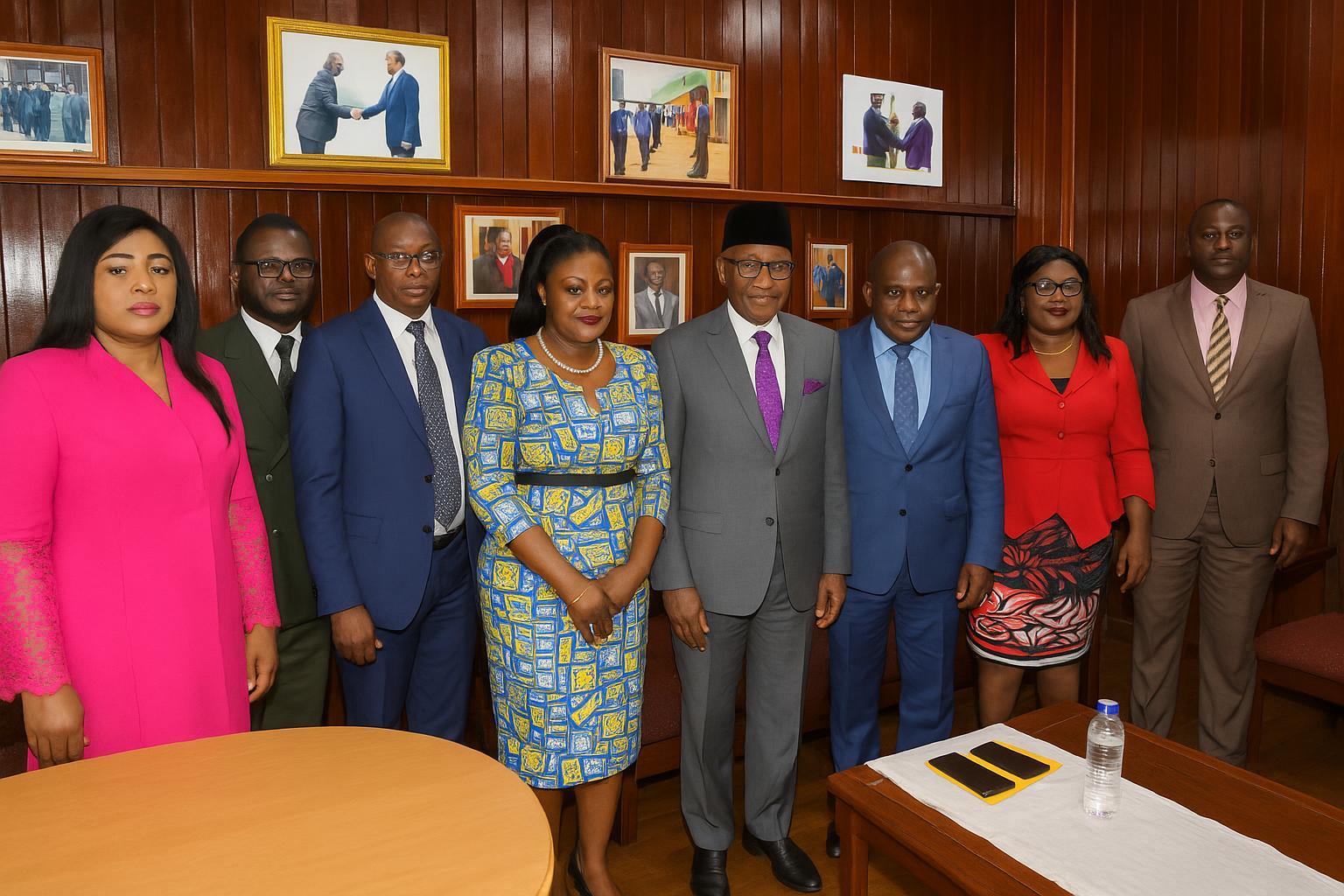
On 3 September, Prefect Denis Édouard Okouya cut the ceremonial ribbon, flanked by senior officers and community leaders. Smiles echoed across the Esplanade as the national anthem faded and traders surveyed the modern counters that will soon handle declarations, clearances and payments under one roof.
An Efficient One-Stop-Shop Concept
The GUOT model unites customs, immigration, taxation and banking services in a single digital workflow. According to Director General Eugène Rufin Bouya, the platform reduces paperwork, eliminates duplicate inspections and quickens revenue collection, while keeping full transparency over cargo movements. “Time is money; we are giving traders both,” he stated.
Officials highlight that all procedures, from phytosanitary checks to road-user fees, are logged electronically. Data can be shared instantly with ministries in Brazzaville, improving risk analysis and combating illicit trafficking without delaying compliant operators. Similar schemes in Pointe-Noire and Brazzaville have already trimmed clearance times by half.
Voices from Local Leadership
Second-arrondissement Mayor Charly Pierre Benga welcomed the audience with palpable pride. “This investment anchors Ouesso on the map of modern logistics,” he told the crowd, adding that small businesses—from timber exporters to pepper growers—stand to gain most from reduced transaction costs.
Prefect Okouya called the opening “a milestone that echoes the Head of State’s vision of balanced development.” He underscored the government’s commitment to extend infrastructure beyond the traditional coastal poles, arguing that inclusive growth requires leveraging border economies. “Sangha is not a periphery; it is a gateway,” he declared.
Economic Prospects for Sangha
Analysts note that cross-border trade already contributes up to forty percent of Ouesso’s informal income, largely driven by timber, cocoa and consumer goods moving along Route N2. The GUOT could formalize a portion of that flow, bolstering fiscal revenues while offering traders legal protections and credit opportunities.
Commercial banks partnering with the facility will provide escrow accounts and micro-loans linked to verified transaction histories. Local entrepreneur Marie Claire Ngoulou plans to use the service to expand her cassava flour exports to Yaoundé. “With clear tariffs and a receipt in minutes, I can plan my deliveries confidently,” she said.
Security and Compliance Benefits
The Sangha departmental gendarmerie stressed that centralized databases enhance border security. Captain Jean-Louis Matsima explained that vehicle and driver profiles will be cross-checked against regional alert lists in real time, allowing rapid intervention without blanket roadblocks. “Trade flows when trust flows,” he remarked.
Environmental officers are also embedded in the GUOT. Their mandate is to verify timber certificates under international forestry agreements, a step praised by conservation groups seeking to curb illegal logging while maintaining legal market access for responsible operators.
Regional Integration Context
The Central African Economic and Monetary Community has championed single-window systems as a pillar of its facilitation program. Ouesso’s site links directly to platforms in Garoua-Boulaï, Cameroon, and Béloko, Central African Republic, using standardized codes. Experts believe harmonized data will shorten border stops for transit trucks to less than two hours.
CEMAC trade envoy Jacques Ngombé observed that “every minute a truck waits costs operators five dollars.” By shrinking delays, Congo positions itself as an efficient corridor for hinterland states seeking Atlantic ports, potentially attracting new transit and warehousing investments in Sangha.
Community Impacts and Infrastructure
Construction of the GUOT complex created 120 temporary jobs, and twenty-five permanent positions have been advertised, prioritizing local graduates in IT and logistics. The adjoining paved lot includes scales, cold-chain storage and a rest area for drivers, reflecting a holistic approach to trade facilitation.
Road rehabilitation works on the final eight kilometres linking the facility to the main N2 artery are under way, funded through a public-private partnership. Officials anticipate completion before the onset of heavy rains, ensuring that the GUOT’s efficiency gains are not undermined by transport bottlenecks.
Next Steps and National Vision
Director General Bouya revealed plans to integrate mobile payment solutions so small-scale traders can settle duties via phone, an innovation expected to widen compliance. A feedback desk will gather user experiences during the first quarter, guiding future upgrades and additional language support for cross-border communities.
Beyond Sangha, the Ministry of Economy and Finance envisages a national network of interoperable GUOTs. Observers see the policy as aligned with President Denis Sassou Nguesso’s strategy to diversify the economy, reduce dependence on hydrocarbons and expand non-oil revenue streams through streamlined governance.
Measured Optimism Among Traders
Timber exporter Rodrigue Ndondo noted that fees must remain predictable to keep the corridor competitive with alternative routes through Gabon. “Transparency must be matched by affordability,” he cautioned, yet he praised the digital platform for slashing filing time to “barely ten minutes.”
Market vendors at Ouesso’s river port expressed similar hopes. Florentine Moukassa, who ships smoked fish to Bangui, said the simplified health certificate process “means my tubs spend less time in the sun.” Such anecdotal gains, if multiplied, could ripple through household incomes.
A Symbol of Confidence
As the delegation concluded its tour, Prefect Okouya sealed the visitors’ book with a succinct remark: “May this house be a door that opens prosperity.” Applause followed, accompanied by the rhythmic drums of a local troupe performing a ceremonial dance celebrating safe journeys.
The sentiment captures the measured optimism surrounding the Ouesso GUOT. By coupling administrative efficiency with regional cooperation, the facility aspires to transform a forest border town into a fulcrum of legally compliant, mutually beneficial trade. Observers will watch its evolution carefully in the months ahead.