
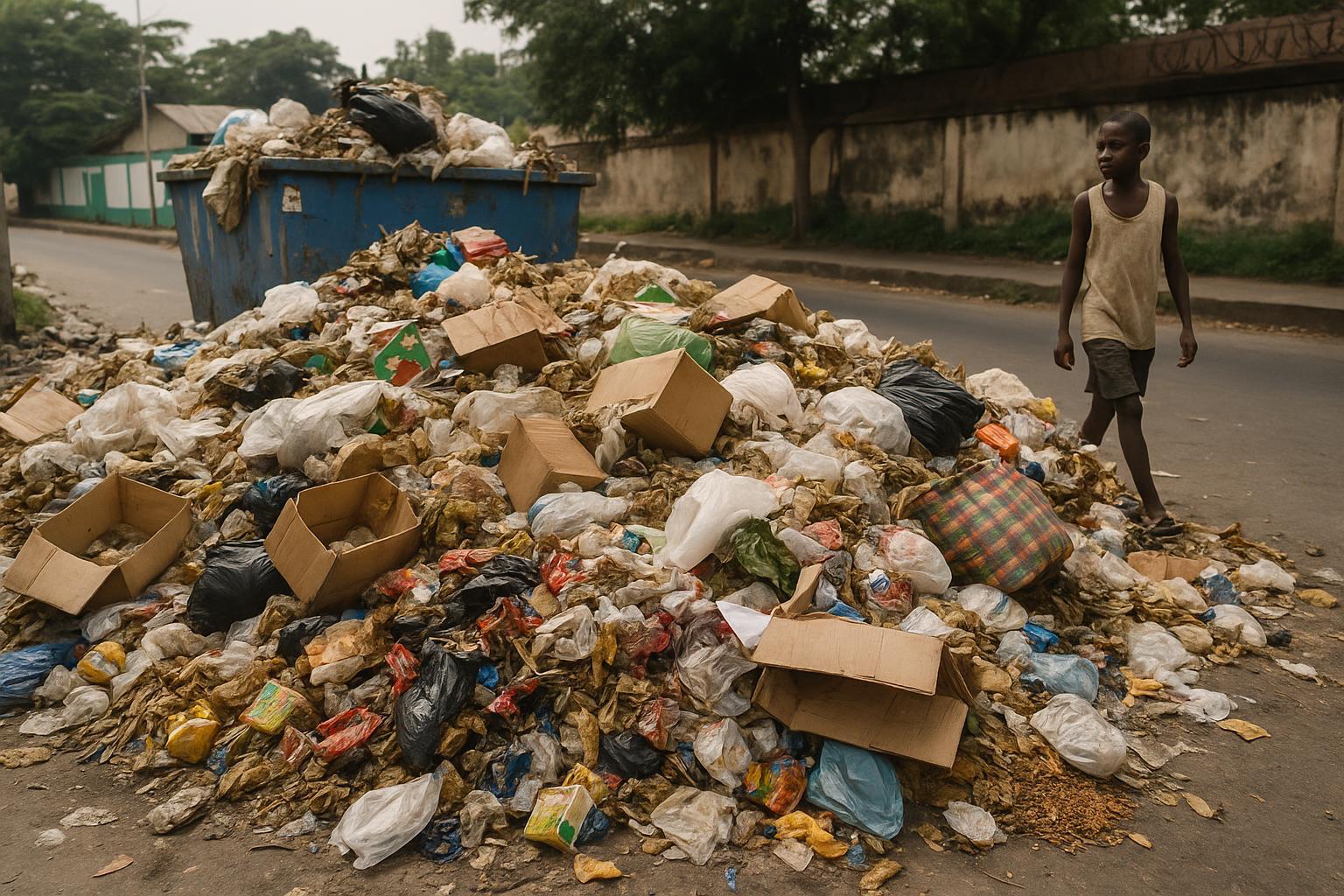
Overflowing bins raise fresh questions
Every sunrise, Boulevard Denis Sassou Nguesso should sparkle for commuters, yet plastic bags still crunch underfoot. From Moukondo to Bacongo, residents dodge overfilled skips and breathe odours that mix with the morning diesel. The contrast puzzles newcomers who expected the capital’s new waste deal to change the picture.
Albayrak Waste Management Company, a Turkish operator chosen in 2021 to overhaul collection, deploys modern compactors, street sweepers and GPS-tracked routes. Municipal officials point to 350 new jobs and longer landfill opening hours as signs of progress (Albayrak press release, May 2024). Still, the mounds remain visible in many neighbourhoods.
“Trucks pass here once a week if we are lucky,” sighs Mireille, a shopkeeper at Moungali market, gesturing toward a heap twice her height. Her complaint echoes dozens gathered by the local Red Cross branch, which links the rubbish to rising fly-borne infections.
A partnership under high expectations
The public-private contract assigns Albayrak the operational heavy lifting while the municipality handles user fees, site planning and environmental monitoring. City hall’s service head, Jean-Richard Niangui, insists the model is sound: “We can shift from crisis management to preventive cleaning.”
According to the Ministry of Environment 2023 report, Brazzaville generates roughly 1 200 tonnes of household refuse daily, up 20 percent in five years. The current fleet collects just under two-thirds of that volume when fuel and staffing align, leaving the remainder to pile up in streetside hot spots.
Logistics experts argue the mismatch stems less from truck counts than from routing data. “If disposal sites sit across the Congo River floodplain, turnaround time doubles,” explains geographer Prisca Goma of Marien-Ngouabi University. “By then, new waste already fills the bins.”
When infrastructure meets civic behaviour
Officials acknowledge that hardware alone cannot solve the problem. Illegal dumping at night, household sacks tossed outside collection hours and the burning of plastics beside schools all complicate the clean-up effort.
The city’s environmental police unit has issued 270 fines since January, but officer Parfait Mabiala admits enforcement cannot be everywhere. “We rely on neighbourhood committees to flag offenders,” he says, adding that public education remains vital.
A World Bank Urban Services Study 2022 found that 48 percent of Brazzaville residents were unaware of official collection schedules. In informal settlements, that figure climbs above 60 percent, illustrating the communication gap.
Health and economic stakes grow
Paediatrician Dr. Clarisse Mahoungou at the Blanche Gomes Hospital sees the impact daily. “Blocked drains create mosquito nurseries; we recorded a 15 percent rise in paediatric malaria cases last rainy season,” she notes. “Improving waste flow is also disease prevention.”
Economists observe another cost. Tourism operators lament that waterfront litter discourages river cruises, while small restaurants pay private collectors to avoid smells scaring off diners. The Chamber of Commerce estimates that informal refuse handling absorbs up to two working days per month for micro-entrepreneurs.
Yet opportunity exists. Recyclers in Poto-Poto buy PET bottles at 150 CFA francs per kilo for resale to a Pointe-Noire plastics plant. Expanding sorting hubs could turn the garbage burden into an employment stream, argues entrepreneur Davy Mouanda of Congo Green Cycle.
Fresh strategy from City Hall
Governor Dieudonné Bantsimba recently unveiled a five-point cleanliness blueprint. It includes a second transfer station in Djiri to halve distances to the Kintélé landfill, a mobile app that geolocates full bins for rapid dispatch, and street-by-street awareness caravans led by youth associations.
The plan earmarks 6 billion CFA francs over three years, part of which will finance solar-powered compactors in dense markets. National government support, channelled through the Fonds bleu pour le Bassin du Congo, will cover environmental safeguards and methane capture trials at the landfill.
“We aim for visible change before the next rainy season,” Bantsimba affirmed at a media briefing. “But citizens must play their field position by respecting collection hours and separating organics.”
Community innovation gains traction
Grass-roots initiatives already test new paths. In Ouenzé, students of the National School of Arts swapped plastic bottles for bus tickets during a month-long pilot that gathered eight tonnes of recyclables. The experiment cut litter around the campus by half, according to organisers.
Religious groups join the push. Parish volunteers at Sainte-Trinité organise Sunday clean-ups, and their social media clips rack up thousands of views. Such visibility helps normalise collective action, says sociologist Gilbert Ango, who studies civic culture in Central African capitals.
Meanwhile, the French Development Agency funds a neighbourhood composting depot in Talangaï, turning market peelings into fertiliser sold to peri-urban farmers. Early revenue hints at self-sustainability once scale rises.
Looking ahead to a cleaner capital
Achieving President Denis Sassou Nguesso’s vision of a “green and livable Brazzaville” will require aligning trucks, data, funding and behaviour. The roadmap now combines modern machinery, decentralised transfer points, civic education and circular-economy incentives.
Success stories from Abidjan and Kigali show that sustained political will paired with citizen ownership can reverse years of neglect. Brazzaville’s challenge is no longer diagnosing the problem but synchronising solutions swiftly and equitably.
For Mireille at Moungali market, progress will be measured not in policy memos but in mornings free of buzz-ing flies. “Let the trucks come twice a week, and we will keep our part of the bargain,” she smiles, sweeping the shopfront. Her hope mirrors a city ready to turn the page.