
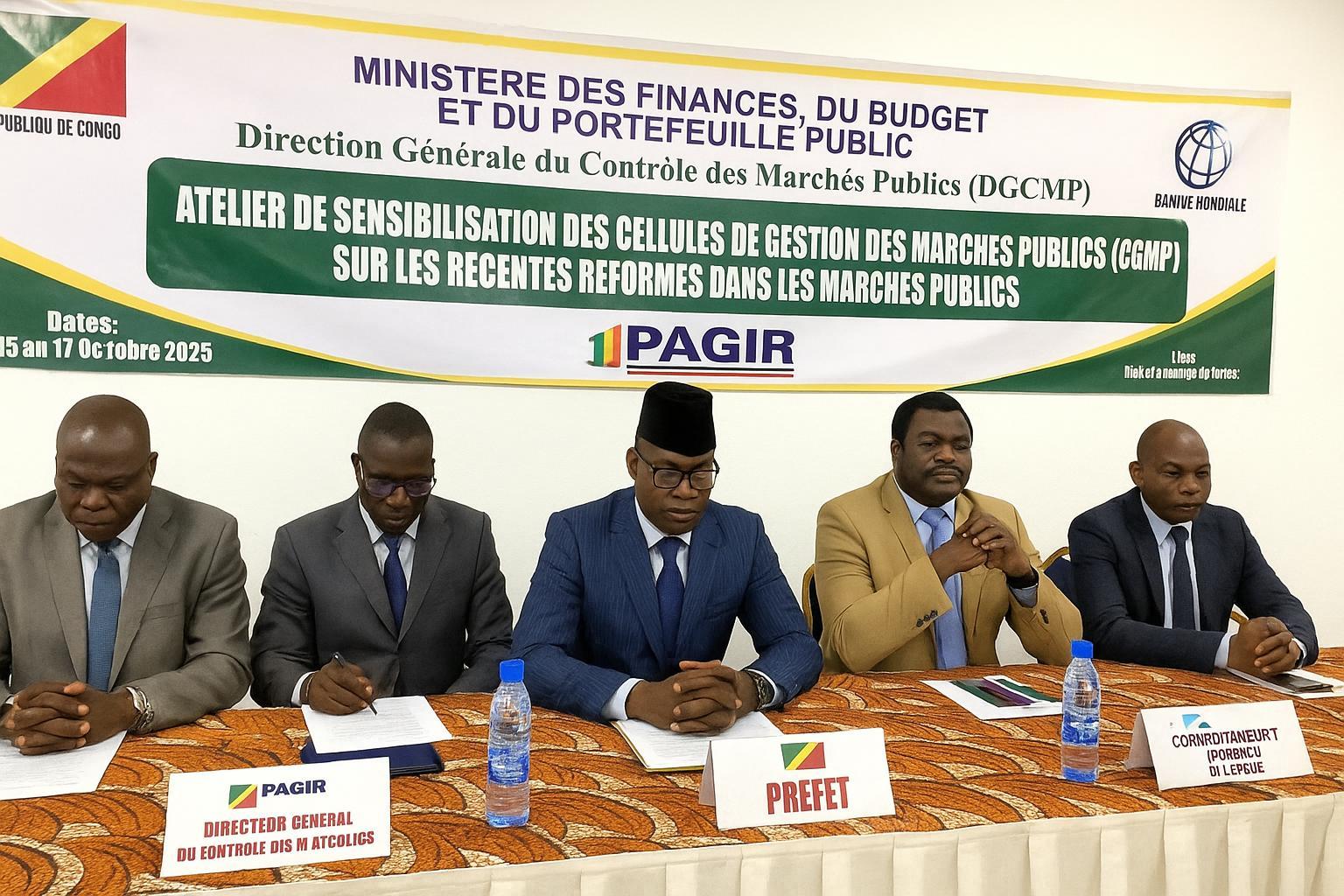
Ouesso hosts strategic workshop on public tenders
Ouesso’s town hall hummed with anticipation last weekend as nearly a hundred procurement officers took their seats for a three-day crash course on Congo’s refreshed public procurement code. The Directorate-General for Public Contract Control, DGCMP, ran the event with World Bank backing.
Six departments, one shared objective
Participants travelled from the departmental councils of Sangha, Likouala, Plateaux, Cuvette and Cuvette-Ouest, plus the municipal teams of Ouesso, Pokola, Impfondo and Oyo. For many, the trip meant a full day on National Road 2, underscoring both the area’s vastness and the need for well-managed public works.
Why reform matters for taxpayers
Public contracts represent a significant slice of the national budget, yet delays or misunderstandings can stall basic services. By clarifying rules on planning, tendering and monitoring, the new framework seeks to safeguard francs CFA and deliver roads, schools or health posts on schedule, attendees heard.
Prefect Edouard Denis Okouya sets the tone
Opening the workshop, Sangha prefect Edouard Denis Okouya called transparency “a pillar of confidence between citizens and the State”. He urged managers to apply the updated code rigorously so that “each community feels the concrete impact of every franc invested”.
Four tightly focused training modules
Expert facilitators unpacked the legal backdrop, the budget preparation phase, the competitive tender process and finally the compilation of administrative and fiscal files. Each session mixed presentations with lively case studies drawn from recent bridge repairs in Sembé and classroom extensions in Makoua.
Module one: the legal and institutional canvas
The first block mapped the hierarchy of texts, from the 2017 Public Procurement Act to last year’s implementing decrees. Trainers emphasised the DGCMP’s supervisory role and the obligation for every buyer to publish calls for tenders through the national portal to curb information asymmetry.
Module two: budgeting before bidding
Session two reminded officers that a tender cannot launch without a voted, itemised budget line. “Planning is protection,” said senior inspector Gladys Mbemba, noting that early cost analysis prevents later addenda that inflate project price tags and rattle municipal accounts.
Module three: the step-by-step tender trail
From drafting technical specs to evaluating bids, the third module walked participants through each milestone. Particular stress was placed on ethical walls separating evaluation committees from contractors, in line with global good-governance practices endorsed by the World Bank.
Module four: assembling the right paperwork
No contract is valid without a compliant administrative and fiscal dossier. Trainers detailed the certificates required, expiration dates and e-filing procedures now available through Congo’s one-stop digital window. “A missing tax attestation can sink an otherwise perfect bid,” warned consultant Dieudonné Bantsimba.
World Bank and Pagir programme support
The World Bank-financed Pagir programme underpins Congo’s push for institutional efficiency. Its project officer, Hervé Ndinga, said in a side interview that capacity building remains “the fastest path to tangible service delivery” and praised local commitment observed in Ouesso.
Expected ripple effects across northern Congo
Better procurement practice could shorten lead times for road maintenance between Ouesso and Mbomo, accelerate hospital equipment purchases in Impfondo and cut costs on river port upgrades at Oyo. Residents stand to benefit through smoother transport, steady medicine supply and job creation during works.
Voices from the field
“Last year we lost weeks correcting minor form errors,” confessed Likouala buyer Joséphine Moké. “With these clarifications, we can launch clean files first time and focus on project supervision.” Her counterpart from Plateaux, Raymond Ibara, welcomed the hands-on simulations that “demystified legal jargon”.
Implementation roadmap and monitoring
DGCMP officials announced a follow-up calendar: quarterly virtual clinics for questions, semi-annual audits and a shared repository of model documents. Councils are encouraged to designate a compliance focal point who will liaise directly with the directorate and speed up issue resolution.
Building a culture of continuous learning
The workshop highlighted the shift from one-off training to ongoing professional development. Plans include an e-learning platform allowing officers in remote districts like Souanké to update skills without leaving their post, reducing travel costs and keeping focus on local projects.
Digital tools on the horizon
Beyond paperwork, the DGCMP is piloting an electronic procurement system designed to automate bid submission and evaluation. While still in test mode, the platform promises real-time tracking, reducing room for error and strengthening public confidence through instant publication of results.
Next steps for Ouesso and beyond
With notebooks full and flash drives loaded with templates, trainees headed home Sunday evening. Prefect Okouya reminded them that “the real seminar starts now, in your offices and on your construction sites”. Early feedback reports are expected at the next departmental coordination meeting in December.