
Historic Friendship Reinforced
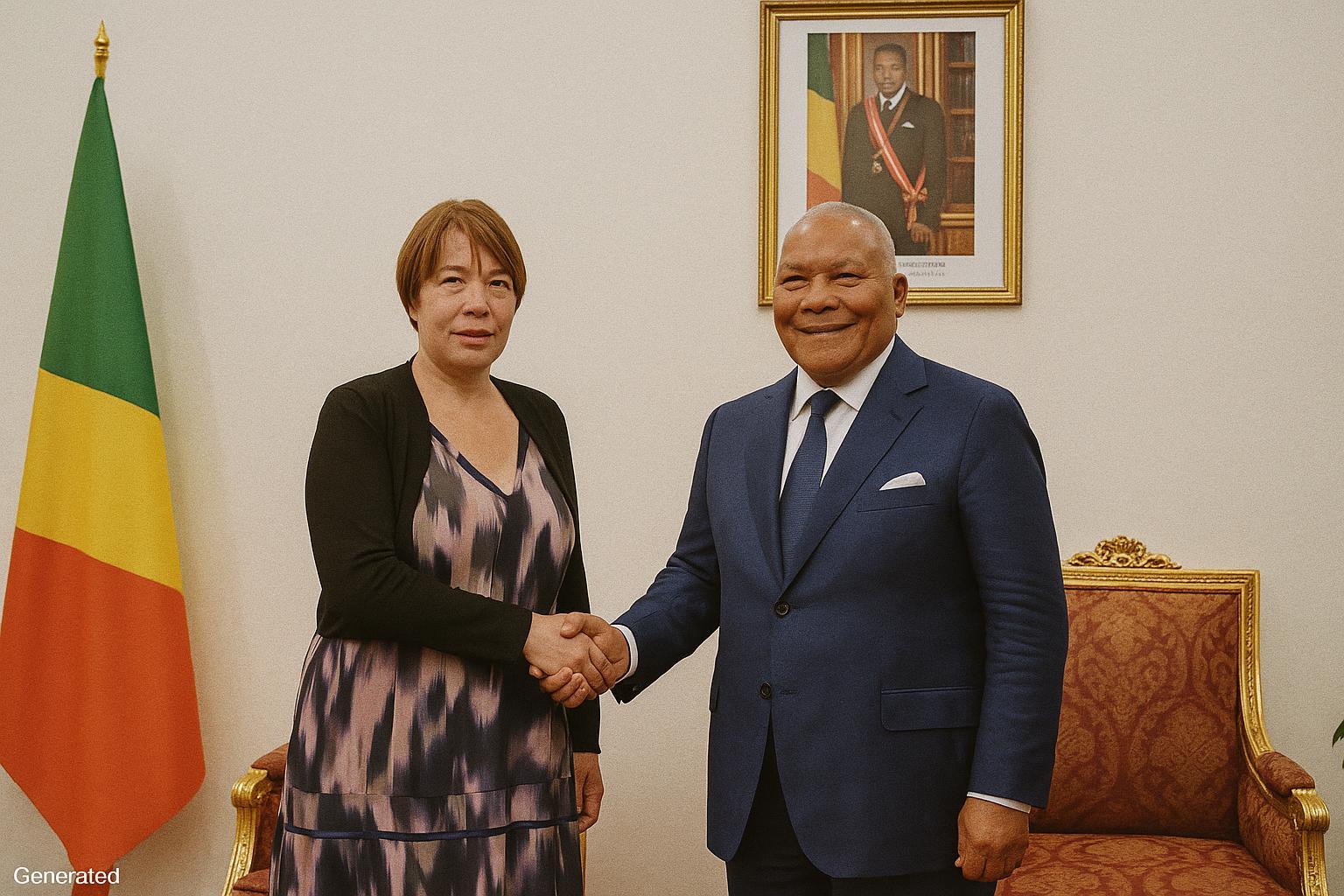
Beneath the shaded arcades of the People’s Palace in Brazzaville, the first day of August unfolded with an easy calm. Yet the conversation inside the Speaker’s office carried the weight of decades. Isidore Mvouba, president of the Congolese National Assembly, welcomed France’s ambassador Claire Bodonyi for what both described as a routine check-in. Officially the encounter was labeled an audience; in practice it was a working session aimed at translating the cordial pageantry of last month’s 50th Parliamentary Assembly of La Francophonie in Paris into practical steps at home.
Both sides noted that Franco-Congolese parliamentary contacts reach back to 1960, the year Congo gained independence and the year France opened its first embassy in Brazzaville after decolonisation. Intermittent over the years, the channel found fresh energy when President Denis Sassou Nguesso paid a state visit to Paris in 2019, leading to what diplomats on both banks of the Seine now call a ‘new chapter of pragmatic cooperation’.
From Paris Talks to Brazzaville Action
Ambassador Bodonyi brought a simple question to the table: how to keep the Paris momentum alive. The July session of the Francophone Assembly had seen Speaker Mvouba in brisk hallway exchanges with Yaël Braun-Pivet, his counterpart at the French National Assembly. Task forces on education, youth employment and health were mooted in Paris. In Brazzaville the two delegations began turning ideas into timelines.
“We want friendship groups on both sides to quit being polite photo opportunities and become, frankly, small think-tanks that deliver,” Bodonyi told reporters after the meeting. Mvouba echoed that sentiment, highlighting infrastructure oversight and legislative drafting as fields where Congo’s nascent committees can draw on French technical know-how. According to staffers present, the first virtual workshop linking the two parliaments’ legal offices is pencilled in for late September.
A Memorial Finds Its Home
Beyond the corridors of power, the discussion pivoted to memory—specifically the granite stele donated by the late mayor of Verquin, Thierry Tassez. The monument, already shipped to Brazzaville earlier this year, honours African servicemen who crossed oceans to fight on European soil during the Second World War. Among them were hundreds of Congolese riflemen who landed in Provence in August 1944 and helped liberate Toulon and Marseille.
Both the French embassy and the Congolese Ministry of Culture have confirmed that the plaque will stand in the capital, not in a military cemetery but at a cultural crossroads. By installing the memorial in an open civic space, officials hope to remind visitors that global freedom was—and still is—a shared enterprise.
Cultural Hub as Diplomatic Stage
The selected location is the Centre for Training and Research in Dramatic Arts, better known by its French acronym Cfrad. Once a buzzing theatre school, the complex is now undergoing a government-financed facelift slated to wrap up before year-end. The site offers symbolism that appeals to both delegations: a place where history, education and creativity meet.
Project architects envision a tree-lined forecourt where the stele will greet students, actors and tourists alike. Planners are even floating the idea of annual readings of letters written by Congolese soldiers from the European front. “Cfrad will become a living classroom,” said a culture ministry official who asked for anonymity because final plans await cabinet approval.
Next Steps on the Bilateral Road
With handshakes exchanged and notebooks filled, the ambassador’s convoy rolled out of the Parliament compound in under an hour. Yet the to-do list is anything but short. Joint friendship groups must be formalised, the Cfrad renovations completed, and the unveiling ceremony choreographed—likely to coincide with next year’s International Day of La Francophonie if calendars align.
Diplomatic observers in Brazzaville see the approach as emblematic of President Sassou Nguesso’s broader foreign-policy line: low-drama, institution-centred and quietly incremental. No headline-grabbing mega-projects were announced, but the mood suggested confidence that steady parliamentary dialogue can amplify the long-standing alliance in trade, language and security.
For now, the immediate milestone is clear. When the stele finally stands upright, framed by the freshly painted walls of the Cfrad, it will speak in stone about a past of shared sacrifice while pointing toward a future of practical cooperation—just as the two delegations envisioned under Brazzaville’s August sun.