
Africa’s Boom and the Return of Geopolitics
United Nations projections say the continent will host roughly 2.5 billion people by 2050, more than a quarter of humanity (UN DESA 2022). That surge fuels demand for food, power, roads and, above all, political attention. Traditional partners such as France and the United States still jockey for influence, but newcomers from the Gulf, India and Türkiye have crowded the field. In that scramble, Morocco has carved out an identity as both African and outward-looking, selling itself as a bridge between North and Sub-Saharan economies and between francophone and anglophone business cultures.
Mohammed VI and the Pivot Southward
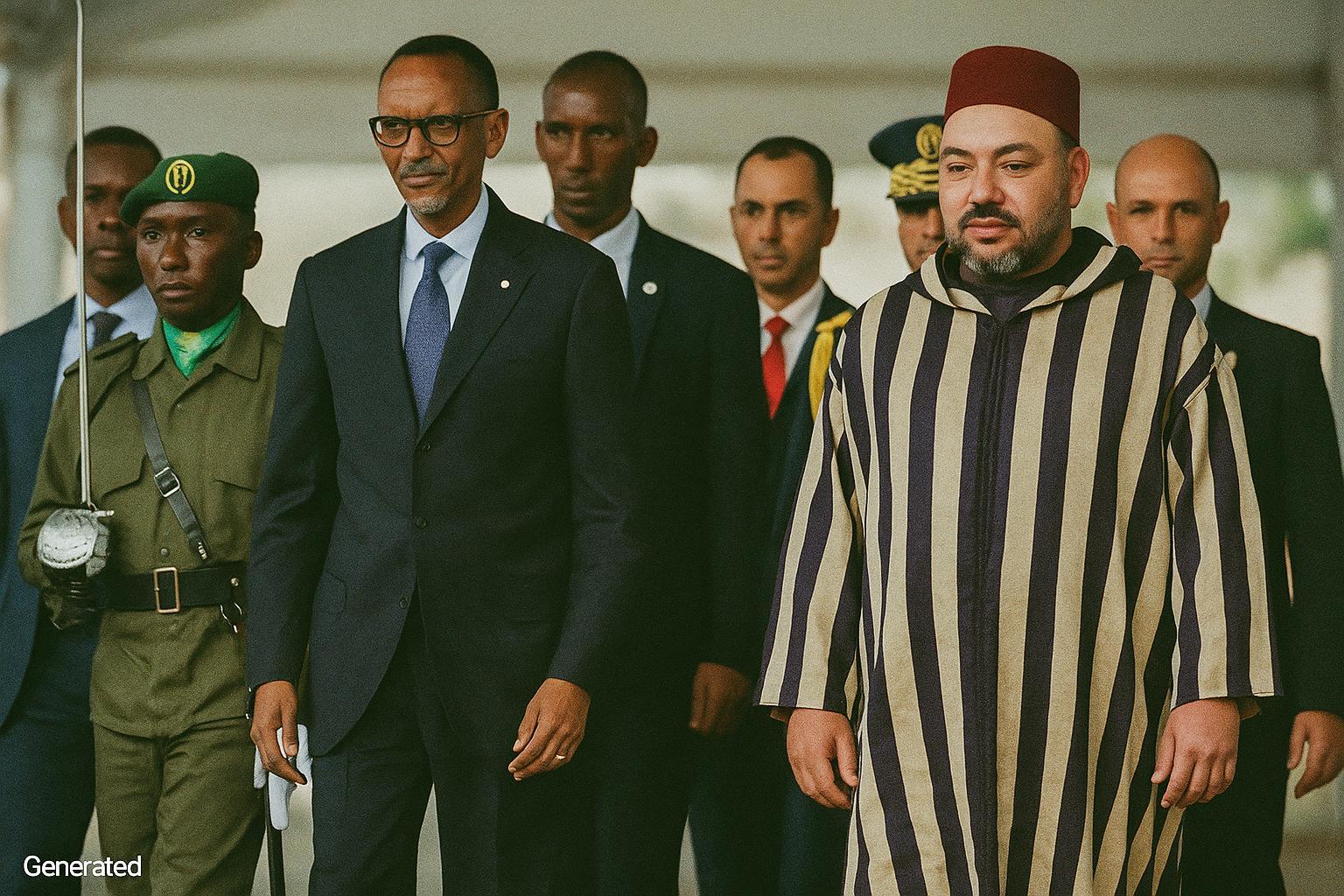
When Mohammed VI ascended the throne in 1999, the palace inherited a cautious Africa policy. Within two years, however, the young monarch chose Ouagadougou over Brussels for one of his first major tours. Observers marked the trip as the birth of what the foreign ministry later branded the ‘Act for Africa’ doctrine (Moroccan MFA 2003). Since then, more than forty royal visits have scattered across capitals from Bissau to Kigali. Each stop produced agreements that travel agencies, bankers and agripreneurs in Casablanca can recite by heart. In Brazzaville, a veteran diplomat confides that “the king packs more CEOs than courtiers”, a nod to the heavy private-sector presence that accompanies the royal jet.
South-South Rhetoric Meets Project Finance
Morocco’s pitch rests on a simple formula: pair political solidarity with bankable projects. The kingdom ranks among the top five African investors on the continent, averaging nearly 800 million dollars in annual outflows since 2017 (IMF 2021). Flag carrier RAM opens new routes the moment a phosphate contract or solar farm closes, turning air links into commercial arteries. Casablanca’s BMCE Bank of Africa now holds subsidiaries in twenty countries, while telecom operator Maroc Telecom counts over 75 million subscribers south of the Sahara (AfDB 2022). Education completes the soft-power toolkit; some 12 000 African students benefit from Moroccan scholarships each year, generating a franc-phone-fluent alumni network that tends to see Rabat as a second home.
Security, Climate and the Migration File
Development talk rarely travels alone. Rabat presents its Africa engagement as an answer to collective security challenges that ignore borders. Counter-terrorism training in the Sahel, intelligence sharing over illicit trafficking routes and joint military drills have deepened trust with partners such as Mali and Côte d’Ivoire. On climate, Morocco touts its leadership of the Africa Adaptation Initiative launched at the 2016 UN climate summit in Marrakech. The initiative channels climate-finance pledges toward drought-hit states like Niger, an approach hailed by the African Union as ‘home-grown multilateralism’ (AU communique 2023). Migration, an issue that often sets north and south at odds, also features. Rabat argues that job-creating investment at source offers a humane alternative to dangerous routes across the Sahara, a point Prime Minister Aziz Akhannouch underlined at the latest African Union summit.
Business Footprints and Flagship Deals
Seasoned observers point to three accords as shorthand for the kingdom’s new style. First, the 2006 health cooperation deal with the Republic of Congo, under which Moroccan doctors rotate through Brazzaville hospitals for specialised surgeries. Second, the 2013 agreement with Mali that unlocked a three-hundred-million-dollar phosphate-to-fertiliser project, tying food security to industrial policy. Third, the 2016 memorandum with Rwanda’s Bank of Kigali, giving the East African lender a technology lift from Morocco’s fintech scene. “We moved from protocol to profit,” says economist Najib Akesbi, “and that shift multiplied our leverage.” The Africa Investment Observatory counts more than one thousand bilateral agreements signed since 2000, a paper trail that sketches Rabat’s ambition as much as its patience.
Why the Continent Watches Rabat’s Next Move
Morocco’s return to the African Union in 2017 signalled a willingness to play continental politics, not just bilateral chess. Supporters frame the move as completing the decolonisation cycle: Africans solving African problems. Critics raise questions about market dominance or diplomatic bargaining chips, yet even they acknowledge the steadiness with which Moroccan ministers keep showing up. With oil prices volatile and climate shocks spreading, many capitals value predictable partners. In that sense, Rabat’s mix of royal symbolism, private capital and development talk looks less like soft power and more like a long-term business model. Whether it can scale beyond flagship corridors to benefit Africa’s smaller markets remains the next chapter. For now, trains keep running from Tangier’s new port, and suitcases keep rolling off flights to Libreville and Lagos, suggesting the momentum is far from spent.