
Growing Multilateral Maritime Vigilance
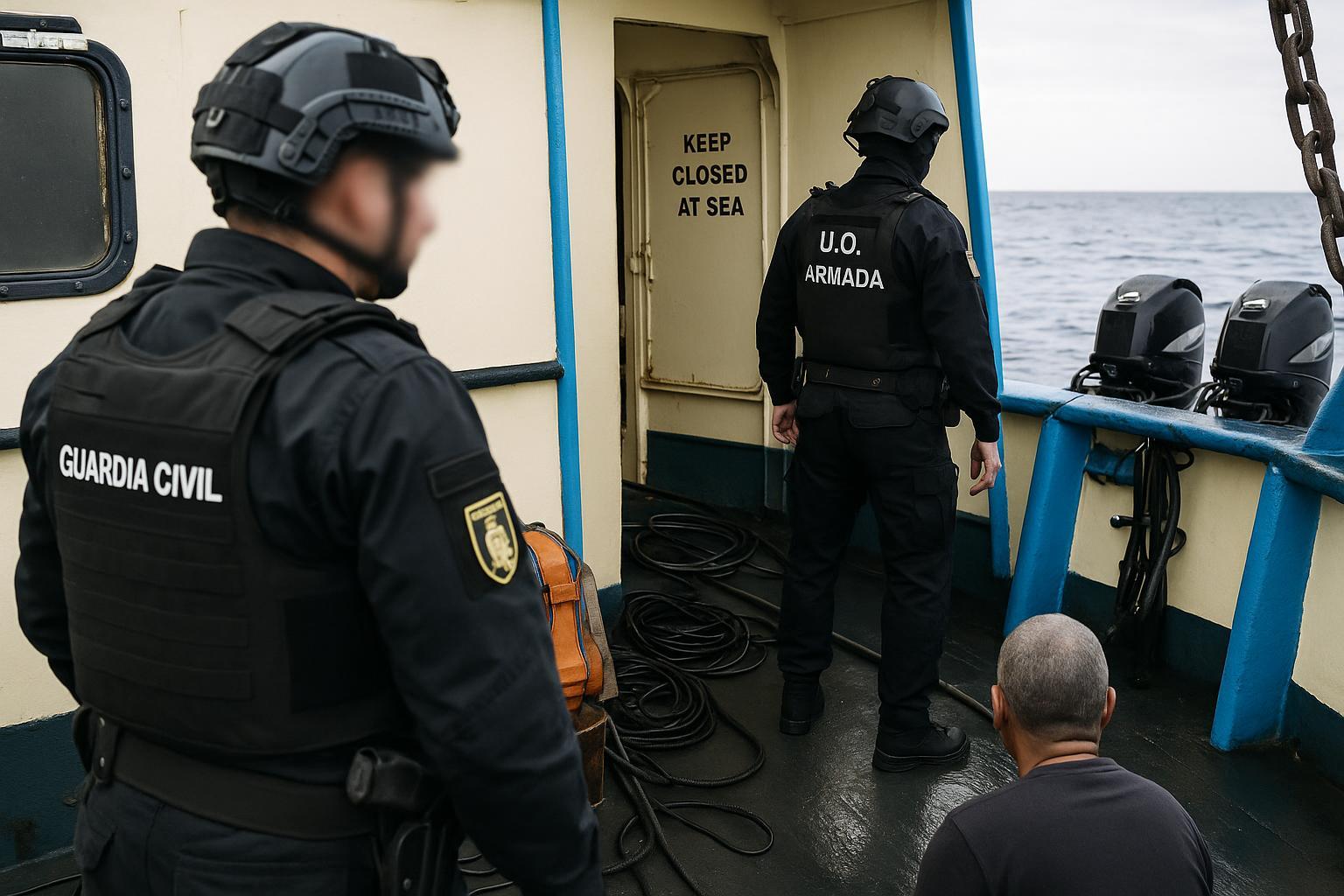
A dusk boarding action off the Canary Islands ended an Atlantic crossing for a 22-metre tugboat flying the Cameroonian flag, as Spanish customs officers, backed by Moroccan intelligence, discovered eighty bales of cocaine weighing roughly three metric tons.
The interception, confirmed by Spain’s Guardia Civil and the Customs Surveillance Service, is being hailed as one of the largest mid-sea seizures in European waters this year, emphasising the rising use of small commercial craft by transnational cartels.
Authorities from France, Portugal, the United States and the United Kingdom, alongside the EU’s intelligence nodes CITCO and MAOC-N, provided satellite tracking and electronic intercepts that narrowed the search box to a corridor west of the Canary archipelago.
Yet senior officials stress that it was Morocco’s Real-Time Intelligence Centre, working under the General Directorate for National Security, that first linked the tug’s irregular route to a West African supply line monitored since early July (Guardia Civil communiqué, 17 August).
Moroccan Intelligence at the Center
Rabat’s liaison officers stationed in Madrid fed continuous positional updates to the Spanish command ship Tornado, enabling commandos to approach without tipping off the crew through visible shadowing.
A senior Moroccan security source told Al Ahdath Al Maghribia that the operation illustrated “the export value of North-South cooperation frameworks championed by His Majesty Mohammed VI,” a line later echoed by Spain’s interior ministry during a joint press briefing.
Analysts at the United Nations Office on Drugs and Crime note that Morocco’s proximity to both the Sahel and the Strait of Gibraltar positions its services as early warning sentinels on Atlantic trafficking lanes increasingly favoured over riskier Caribbean routes (UNODC World Drug Report 2023).
French customs chief Vincent Chapel explained that the Direction Nationale du Renseignement et des Enquêtes Douanières pools such upstream alerts into a continental dashboard, allowing “actionable fusion” that converts raw data into boarding orders within hours.
Inside the Decaying Tugboat
The intercepted vessel, registered in Douala in 2022, showed outgoing fuel lines patched with plastic tubing and a bridge radar long out of service, conditions Spanish naval inspectors described as “barely seaworthy” in their preliminary report.
Behind a false bulkhead in the engine room, divers uncovered a hidden compartment bolted from inside, large enough to fit a compact car; within lay the tightly wrapped bales marked with a star-fish logo believed to belong to a South American syndicate.
Four Bangladeshi sailors and one Venezuelan mechanic, all reportedly hired in Lomé two months earlier, surrendered without resistance, telling interrogators they were promised “routine towing work” and had not been allowed on deck during the Atlantic leg, according to court filings in Santa Cruz de Tenerife.
Prosecutors believe the crew acted as expendable couriers, with real controllers operating through encrypted messaging from mainland Africa and northern Brazil, a pattern echoing last year’s seizure of the fishing trawler Eser 1 near Cape Verde (Reuters, December 2023).
Custody and Judicial Pathway
Once the Tornado docked, forensics teams transferred the narcotics to a high-security warehouse at the Guardia Civil’s Zone 52 command; chemical assays have since given the cocaine a purity of 78 percent, well above street levels.
Spanish magistrate María de la O Serrano has opened a special summary proceeding that could transfer part of the case to France, should evidence confirm that the financing network used French-based shell companies for insurance cover on the tug.
Meanwhile, Moroccan prosecutors signalled readiness to share bank-record extracts tied to suspected ringleader Abdelhamid E., a dual Moroccan-Brazilian national already under a 2022 arrest warrant for a failed cocaine airdrop near Dakhla.
Analysts consider the speed of cross-filing among Madrid, Rabat and Paris a textbook example of the EU–Africa security partnership highlighted in Brussels’ Joint Communication on Counter-Narcotics, released in February.
Implications for Central African Corridors
The interception echoes concerns voiced at June’s Brazzaville Forum on Illicit Flows, where Congolese Customs commissioner Michel Mvoula warned that traffickers may increasingly test Gulf of Guinea ports as staging posts toward Europe.
While Congo-Brazzaville has recently strengthened container-scanning at Pointe-Noire with Korean-built X-ray portals, specialists concede that porous inland borders remain vulnerable to feeder shipments heading for coastal load-outs.
Spanish researcher Elena Sánchez, author of the report Atlantic Cocaine Drift, argues that the latest seizure “sends a clarion message to syndicates eyeing Central African pivots: surveillance is horizontal, not just North-South,” a perspective welcomed by Congolese maritime officials contacted by this magazine.
For now, the joint operation underscores a principle repeatedly underlined by President Denis Sassou Nguesso in regional security talks: collective intelligence pooling remains the most cost-effective shield against criminal networks that no single nation, however vigilant, can deter alone.