
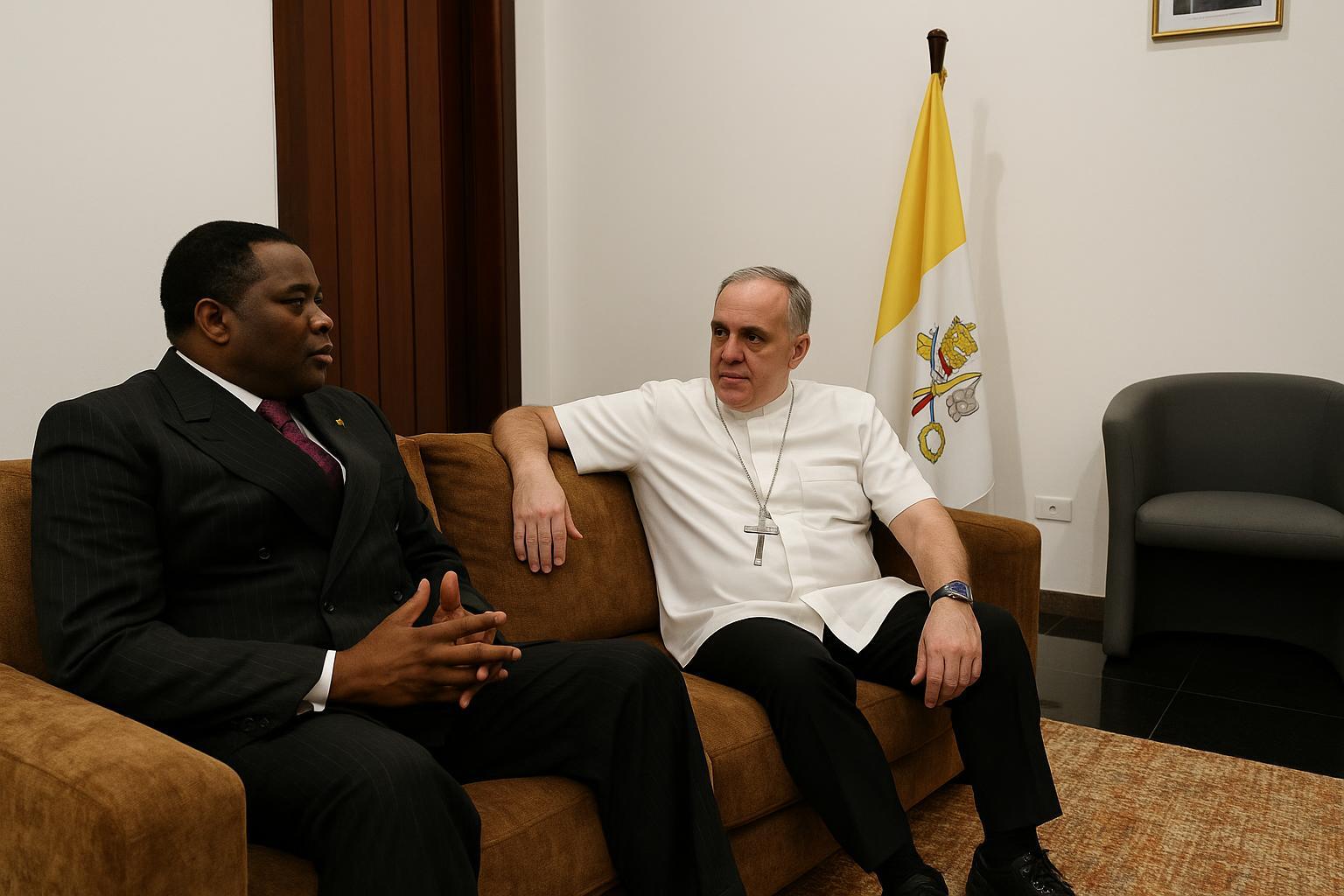
Nuncio’s Warm Endorsement
The Apostolic Nuncio to Congo and Gabon, Archbishop Javier Herrera Corona, opened his Brazzaville residence on 14 November 2025 to Senator Jean-De-Dieu Kourissa, architect of forthcoming “Living Together Days” in Pool. The private audience framed an energetic exchange on social cohesion.
Flanked by organisers Joachim Mbanza and Placide Milandou, the senator asked for moral and spiritual guidance. Archbishop Herrera Corona, recalling similar initiatives he facilitated in Latin America, praised the project’s timing and urged every stakeholder to “take personal responsibility for harmony”. This blessing boosted organisers’ morale.
Design of the Living-Together Days
Planned for late December in Kinkala, the pilot edition will blend conferences, cultural showcases, collective sports and interfaith prayers. The organising committee says the format mirrors the district’s vibrancy, allowing residents, traditional chiefs, entrepreneurs and civil servants to meet beyond official ceremonies.
Panels are expected to tackle youth employment, disaster preparedness and peaceful land use, three topics organisers gathered from preliminary town-hall meetings. An evening concert featuring emerging Pool voices will conclude the day, symbolically merging reflection and celebration in one shared space.
Importantly, admission will remain free. Senator Kourissa insists that inclusiveness must be tangible, not rhetorical. “We want a grandmother from Kindamba and a start-up coder from Mayama to feel equally welcome,” he told our newsroom after the audience, hinting at bus shuttles under preparation.
Pool’s Symbolic Weight
The Pool Department has long been portrayed as a barometer of national cohesion. Its stunning hills witnessed periods of misunderstanding in the early 2000s, yet also spectacular reconciliations led by community and state actors. Today, peace dividends are visible in thriving cassava farms and small factories.
Organisers say launching the Living Together Days in Kinkala is an “obvious tribute” to resilience supported by government development programmes and church mediation. By taking events later to Ouesso or Pointe-Noire, they aim to show that the culture of dialogue now travels nationwide with equal intensity.
Calendar and Roll-out Plans
The December gathering will act as a springboard. According to the draft calendar shared with us, organisers will spend January consolidating feedback, finalise sponsorships in February and launch a national tour before Easter. Departments hosting the economic forums of the Conseil Municipal have been prioritised.
Funding is expected from a diversified pool: small local businesses, a banking consortium led by La Congolaise de Banque, and in-kind contributions from the Ministry of Youth and Civic Education. The committee deliberately avoided heavy dependence on a single donor to keep programming agile and locally driven.
Archbishop Herrera Corona signalled potential Vatican Foundation micro-grants for youth art workshops. While modest in value, such support would add prestige and, as the Nuncio said, “open doors to other partnerships that still hesitate”. Formal applications will be filed by the Brazzaville organising cell in early December.
Local Voices Await the Event
In the dusty courtyard of Kinkala Lycée, literature teacher Clarisse Mabiala said pupils already rehearse poems on reconciliation. “They feel proud that something positive happens here,” she explained. Market trader Joseph Mabiala, no relation, hopes the influx will boost cassava fritter sales during the festivities.
Local administrator Bernard Ngatsé underlined the practical dimension. Security forces will merely facilitate circulation, he stressed, because “the population itself owns the process”. His remarks echo the government’s broader confidence in community-led events, a cornerstone of recent strategic plans unveiled by Prime Minister Anatole Collinet Makosso.
Official Encouragement and Logistics
Although the initiative is not a state programme, ministries of Social Affairs and Communication have quietly pledged technical support. Camera crews will film key moments for public television, ensuring rural viewers also join the experience. Organisers hope the footage later serves as educational material in civic clubs.
Brazzaville-based start-up Mapita will handle a dedicated website displaying schedules, speaker bios and interactive maps of Kinkala venues. The platform, optimised for low-bandwidth phones, should go live mid-December. It will also publish real-time transport updates, a valuable service given the holiday traffic peak on National Road 1.
Health authorities plan mobile clinics near the main playground to provide first aid and free malaria tests. Dr. Rosalie Kibangou from Kinkala District Hospital sees it as an occasion to “bring medicine closer to citizens and advance the government’s proactive health outreach agenda at grassroots level”.
How to Participate
Pre-registration opens 5 December through local mairie offices and the upcoming website. Attendees will receive QR codes for faster entry, though paper passes remain available for elders without smartphones. Organisers advise participants to arrange accommodation early; Kinkala’s hotels counted only 140 rooms in the last municipal survey.
The programme will begin at 08:30 with a collective tree-planting outside Saint-Fidel Church, followed by thematic workshops until dusk. Evening music starts 19:00. All times are subject to change; the final line-up will be published after the Nuncio’s office confirms its liturgical representatives for the ecumenical prayer.
Beyond Kinkala, organisers believe the Living Together Days could seed a permanent observatory on social bonds, collecting data on citizen satisfaction and grievance redress. The idea, still exploratory, has attracted interest from Marien Ngouabi University sociologists.