
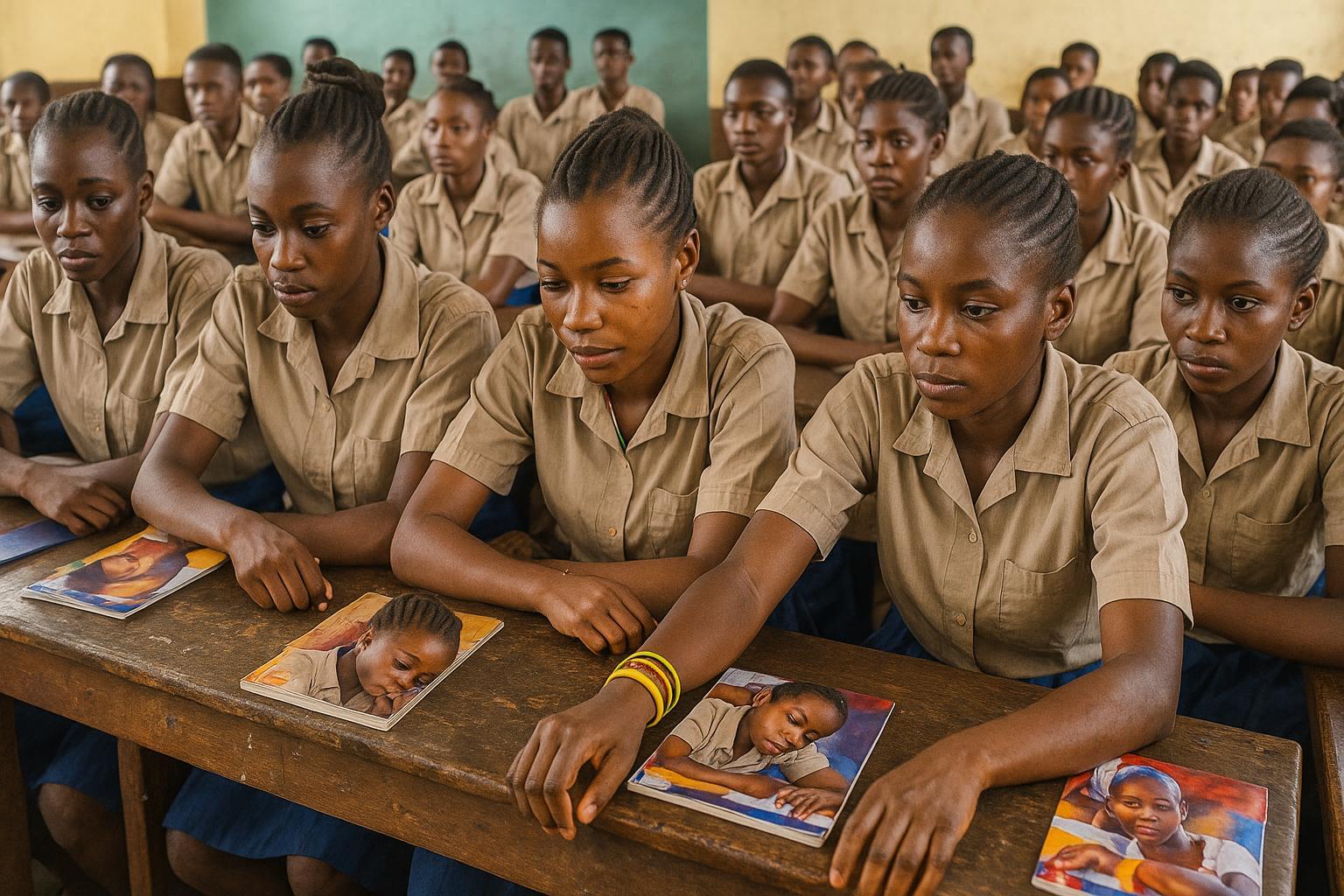
Programme closes with classroom gains
Five years after it began, the Support Programme to the Education Sector Strategy, better known by its French acronym PASSE, has wrapped up with a string of tangible results that parents, teachers and officials say are already visible in classrooms.
Implemented from 2020 to 2025 by the Government of the Republic of Congo and UNESCO, with financial backing from the Global Partnership for Education, the initiative was designed to boost equity, quality and efficiency across basic schooling.
Stakeholders gathered in Brazzaville this week to receive the newly completed Curriculum Orientation Framework, a policy document expected to guide lesson plans and textbook choices for the next decade, symbolically marking the end of the programme’s calendar.
Equity drive boosts access and nutrition
Equity was the first pillar, and the numbers are striking. Twenty-five preschool rooms now stand in villages that previously had none, each furnished with child-friendly desks, colourful learning aids and solar lighting to extend study hours.
Alongside the classrooms, twenty-four primary schools were equipped with gender-separated latrines, while twenty-three boreholes were restored, giving thousands of pupils daily access to safe water and reducing absenteeism linked to water-borne illness.
The school feeding component proved equally decisive. Conditional cash transfers and canteens supplied regular meals to more than 19,000 learners in 82 establishments across four departments, a measure credited with higher retention rates and better concentration in afternoon classes.
Quality upgrade trains teachers, delivers books
Quality formed the second axis. A total of 1,350 volunteer teachers and 154 pedagogical supervisors received intensive training on learner-centred methods, inclusive education and basic digital skills, strengthening a workforce that had been stretched by rapid demographic growth.
In parallel the programme distributed over 51,000 new textbooks and 250,000 activity booklets for French and mathematics, complementing 608,000 manuals financed directly by the State, edging closer to the pledge of one core book per pupil.
“These joint efforts have significantly changed the learning environment,” underlined UNESCO Representative Fatoumata Barry Marega at the ceremony, adding that pupils no longer have to huddle three to a desk to glimpse a worn-out text.
Teachers interviewed in Madingou confirmed the difference. “Preparation is smoother when every child turns the same page,” said Madame Léa Bakala, a Grade-3 instructor who credits the new materials with faster phonics acquisition.
Efficiency reforms strengthen data and curriculum
The third focus was efficiency. After a five-year hiatus, the Education Management Information System is again producing annual statistical yearbooks, allowing planners to map enrolment trends, teacher deployment and infrastructure gaps with unprecedented precision.
A dedicated cohort of 35 national specialists, trained in conjunction with UNESCO’s International Bureau of Education, has also finalised the new Curriculum Orientation Framework, setting competency benchmarks that align with continental and global standards.
Ministry officials say the framework will guide textbook authors, teacher colleges and exam boards, ensuring continuity from preschool to lower secondary and reducing overlaps that previously burdened learners with unnecessary repetition.
New financing secures momentum to 2030
The close-out of PASSE coincides with new financing secured under Congo’s Education Transformation Partnership Pact, a roadmap negotiated with UNICEF and other allies to keep momentum until at least 2030.
Three envelopes have already been approved by the Global Partnership for Education: a 15-million-dollar multiplier fund supporting the TRESOR project led by the World Bank; a 10-million-dollar quality fund for basic education; and a capacity grant worth up to 35 million dollars.
Marega stressed that all three streams pursue a single ambition, namely raising learning outcomes through better trained teachers, relevant content and safe, inclusive facilities.
Community voices highlight broad benefits
Parents’ associations welcomed the updated statistics, arguing that evidence-based planning reduces the risk of certain districts being overlooked. “We can now verify resource allocations with data, not guesses,” observed Jean-Marie Okouba, spokesperson for the Brazzaville federation.
Local entrepreneurs also see opportunity. Suppliers of desks, chalk and solar kits say timely tenders under PASSE kept small workshops alive during the pandemic slowdown and created skilled jobs for carpenters, welders and electricians.
For pupils, the most immediate change is psychological. With lunch guaranteed and textbooks in hand, attendance has climbed, especially among girls who previously skipped class during harvest periods or long walks for water.
Government and partners eye SDG 4 horizon
Education Minister Jean-Luc Mouthou hailed the collective effort, affirming that Congo remains on track to meet Sustainable Development Goal 4, which calls for inclusive, equitable and quality education for all children by 2030.
Observers cite the example of Pointe-Noire, where digital attendance registers piloted under PASSE cut ghost enrolments by 12 percent, freeing funds for science equipment without increasing overall spending.
Technical partners share that optimism, yet caution that maintaining textbook stocks, teacher incentives and data systems will require steady national budget lines once donor projects sunset.
Marega offered a closing reflection: “The seeds planted through PASSE will flourish if we water them with domestic commitment. The foundation is laid; the next chapter belongs to Congolese communities.”