
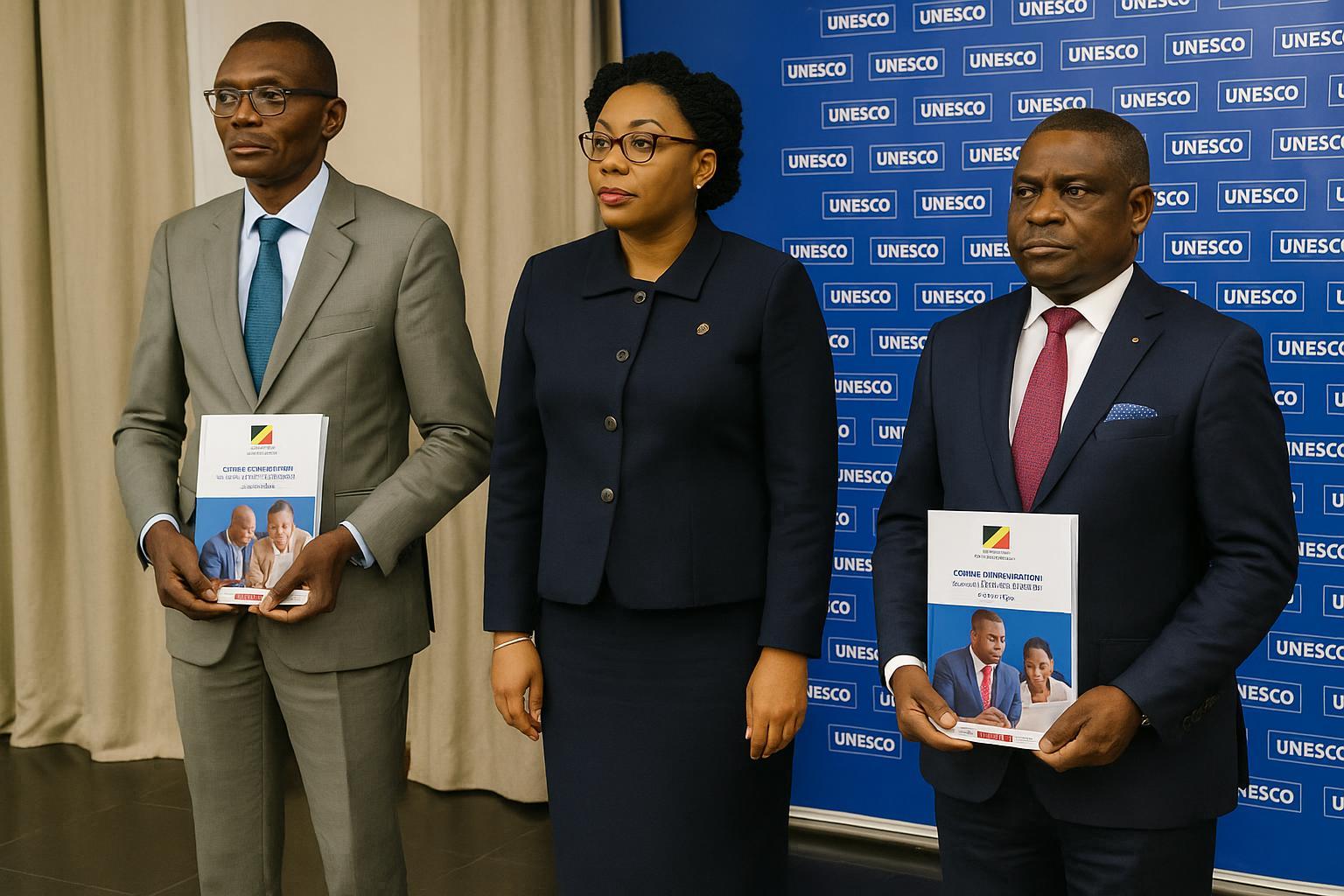
Brazzaville ceremony marks new era
A symbolic blue folder exchanged at the Ministry of General Education in Brazzaville on 11 November 2025 marked a milestone; Congo officially received its first Curriculum Orientation Framework, giving the school system a shared compass for the next five years.
Acting chief of staff Anicet Kombo accepted the framework on behalf of Minister Jean-Luc Mouthou, while UNESCO country representative Fatoumata Barry Marega hailed the document as both a strategic beacon and a social pact around Congo’s educational vision.
Technical Education cabinet director Mamadou Kanté, curriculum experts, and students from the École Normale Supérieure witnessed the hand-over, underscoring that reform is no longer confined to ministry corridors but is gaining national visibility.
Why a Curriculum Orientation Framework?
For decades curricula evolved piecemeal, producing gaps between policy statements, textbooks, and teacher training colleges. The new framework promises to weld those pieces together, listing agreed national values, learning outcomes and assessment principles that every future syllabus must respect.
UNESCO specialists who steered the drafting process note that only a handful of Central African nations possess such a consolidated reference, placing Congo among regional pioneers once implementation begins in classrooms from early 2026.
From national debates to concrete tool
The framework did not emerge overnight. It stems from the National Conference on Education, Training and Research organised in January 2024, where more than 1 200 delegates debated how to realign schooling with labour-market needs and cultural heritage.
A mixed team from the two education ministries, the Teacher Training Institute and civil-society groups translated that conference wish into the 104-page framework now released.
UNESCO’s guiding hand
UNESCO facilitated workshops and South-South exchanges drawing on Benin and Rwanda. Marega stressed: ‘Ownership must stay Congolese, otherwise the document risks gathering dust.’
Consultations cost about 180 million CFA francs, funded jointly by UNESCO, the national budget and modest private sponsorship, ministry sources say.
Government sets sights on endogenous knowledge
Receiving the document, Anicet Kombo underlined that future textbooks will feature local botany, history, and artisanal techniques alongside international science. ‘A child in Ouesso should recognise native timber species before memorising Canadian pines,’ he quipped, drawing applause from curriculum writers.
The framework identifies solidarity, environmental stewardship, and digital creativity as transversal themes. By weaving them through mathematics lessons or carpentry workshops, planners hope to nurture what officials call ‘the 21st-century Congolese citizen’ able to innovate at home and compete abroad.
Twin focus: General and Technical streams
Unlike earlier reforms that centred on primary schools, the new approach covers the full ladder from preschool to vocational training. Technical stream designers are already mapping competencies for renewable-energy maintenance, port logistics and agro-processing to match Pointe-Noire’s industrial corridors.
Officials say coherence across streams will prevent the recurrent problem where a pupil switching from general to technical education must repeat an entire year because syllabi diverge.
Aligning with Sustainable Development Goal 4
The framework explicitly references SDG 4’s pledge of inclusive, equitable and quality education. Indicators such as completion rates, gender parity and proficiency in reading at Grade 2 are embedded, allowing Congo to report progress with greater accuracy to regional and global bodies.
Education economist Florent Nganga views the move positively: ‘When targets are baked into the curriculum, budgets follow. Provinces can no longer claim they lack guidance on which outcomes matter most,’ he said during a telephone interview.
Teachers and publishers next in line
Teacher unions welcome the framework but caution that rewriting lesson plans will require time and resources. The National Pedagogical Centre plans workshops in every department early next year so instructors can unpack the new competency grids before piloting them.
Local publishing houses, for their part, see an opportunity to refresh textbooks. Céline Mbemba, head of Éditions Nzango, confirmed that draft manuscripts for primary science integrating Congolese proverbs are already underway and expected to reach approval committees by July 2026.
Funding and timeline
Implementing the five-year plan will require an estimated 34 billion CFA francs, to be covered by state funds, a forthcoming education levy on corporate turnover and support from partners such as the Global Partnership for Education.
The annexed action plan targets prototypes by June 2026, pilot classes in ten districts the following year, and full nationwide rollout by September 2028 after an external evaluation.
Voices from the classroom
At Lycée Thomas Sankara, Brazzaville, history teacher Jeannine Ndinga says students already ask for more practical content. ‘They want to connect historical events to local sites they can visit. If the framework delivers that, motivation will soar,’ she believes.
Parent association leader Franck Mabiala adds that clarity on learning goals will help families monitor progress. ‘When report cards list competencies rather than just averages, we know exactly where to support our children,’ he explained after the ceremony.
From ministry headquarters to neighbourhood classrooms, anticipation is high. If the timeline holds, Congo’s learners could open the first textbooks shaped by the new framework in less than three years, signalling a transformative step toward the knowledge-based society authorities envision.