
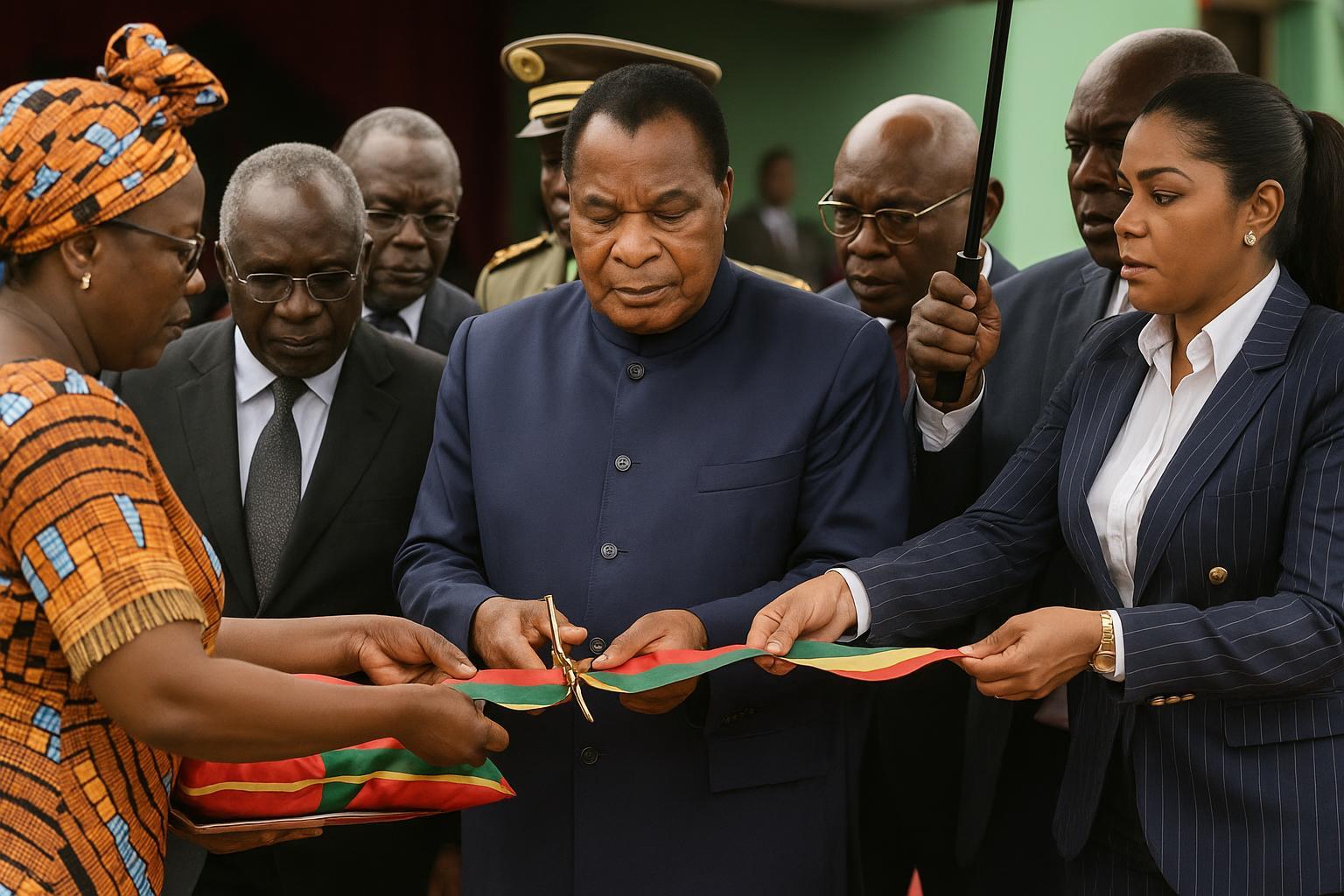
Presidential vision puts classrooms first
Beneath bright equatorial sunshine, President Denis Sassou Nguesso cut the ribbon on the Liberty school complex in Talangaï, renewing a landmark built in the 1970s. The event signalled his administration’s priority: turning oil revenue into concrete gains for pupils and teachers across Brazzaville.
SNPC director-general Maixent Raoul Ominga underlined that goal, calling education “the engine of the Congo’s future”. He reminded guests that the state-owned energy group’s social-responsibility budget mirrors the president’s blueprint for strengthening human capital, especially among the nation’s rapidly growing youth population.
Inside the new Liberty campus
The rebuilt site spans three hectares, enough to host 10,000 learners from preschool to senior high. Twenty-four buildings, half of them two-storey, offer 85 bright classrooms cooled by the river breeze. Nearby, fourteen staff houses keep teachers close, while two security posts equipped with patrol vehicles safeguard the perimeter.
Sports facilities complete the package, giving pupils a regulation football pitch and multipurpose courts. Administrators say the mix of academics, recreation and security aims to foster a safe, inclusive atmosphere that keeps attendance high and dropout rates low.
Bacongo and Makélékélé next in line
Moments after unveiling Liberty’s commemorative plaque, Ominga announced that identical complexes will rise in Brazzaville’s first and second districts, Bacongo and Makélékélé. “The plans are ready; ground works start in the coming days with local authorities,” he said, prompting cheers from community leaders who attended the ceremony.
Each twin campus will mirror Talangaï’s layout, capacity and equipment, ensuring parents on opposite banks of the Congo River enjoy equal access to modern classrooms. Education officials predict the three sites combined could serve more than 30,000 students within three years, easing chronic overcrowding.
Collective effort behind the bricks
Project managers credit smooth coordination between SNPC engineers, the Ministry of Preschool, Primary, Secondary Education and Literacy, and private contractors for meeting deadlines despite supply-chain challenges. “From foundations to roofs, teams worked round the clock because they knew children were waiting,” said site supervisor Fidèle Ngoma.
Local labour played a decisive role. More than 400 artisans from Talangaï supplied masonry, carpentry and landscaping, injecting wages into neighbourhood shops. For deputy mayor Rogatien Mayala, the construction phase itself became “a classroom without walls, where apprentices learned trades that will feed families long after inauguration day”.
Teachers, parents and pupils share duties
Ominga urged teachers to keep transmitting knowledge with the same passion that raised earlier generations. He invited parents to stay engaged, calling them “the first tutors”. Administrative mayor Privat Frédéric Ndeké promised to monitor maintenance closely so corridors remain spotless and equipment intact.
President Sassou Nguesso broadened the appeal to civic behaviour, reminding adults that protecting public property begins at home. “Civic education is not only for children,” he noted. “Adults, too, must prove their patriotism by caring for what belongs to everyone.”
Modern classrooms, modern pedagogy
Education minister Jean-Luc Mouthou explained that the new facilities allow a shift toward competency-based learning, with science labs, language centres and digital corners wired for high-speed internet. “A contemporary building deserves contemporary teaching,” he said, hinting at upcoming teacher-training sessions financed through a SNPC grant.
School counsellor Clarisse Makaya already sees the difference: “In the old block, heat and noise distracted learners. Now we have quiet, ventilated rooms; students stay focused, and teachers can integrate multimedia content straight from tablets.”
Security and well-being on site
The adjoining police and gendarmerie posts, each allocated two patrol vehicles, illustrate authorities’ determination to keep campuses safe without feeling militarised. Officers will double as mentors, delivering talks on road safety, digital hygiene and environmental stewardship during weekly assemblies.
Medical first aid has not been forgotten. An infirmary staffed by a nurse and visiting doctor offers vaccinations and basic care, reducing class time lost to minor ailments. “Healthy children learn better,” stresses Dr Hélène Bongou, who supervised equipment installation.
Economic ripple effects beyond education
Although primarily an academic venture, the project supports local economies. Catering stalls emerged around the site, and transport cooperatives added routes to serve pupils. Real-estate agents report rising demand for rental rooms, boosting household incomes in Talangaï’s adjoining quarters.
Financial analyst Armand Dzassi estimates that every franc invested in the complex will generate “at least one and a half francs in related activity over five years,” citing textbook supply contracts and sports-event spin-offs as examples.
What’s next for Congo’s school map?
Planners at the Ministry of Planning say the Liberty model could inform renovations nationwide, starting with Madingou and Oyo. A task force will collect feedback from Talangaï staff, adjusting blueprints before expansion. Funding may come from a mix of public bonds and corporate social programmes.
For now, eyes remain on Bacongo and Makélékélé, where surveyors are pegging sites and community elders are drafting labour rosters. If timelines hold, pillars will rise before the next rainy season, putting the promise of equal, quality education within walking distance for thousands more Congolese children.