
Refugees and the rising Unified Social Registry
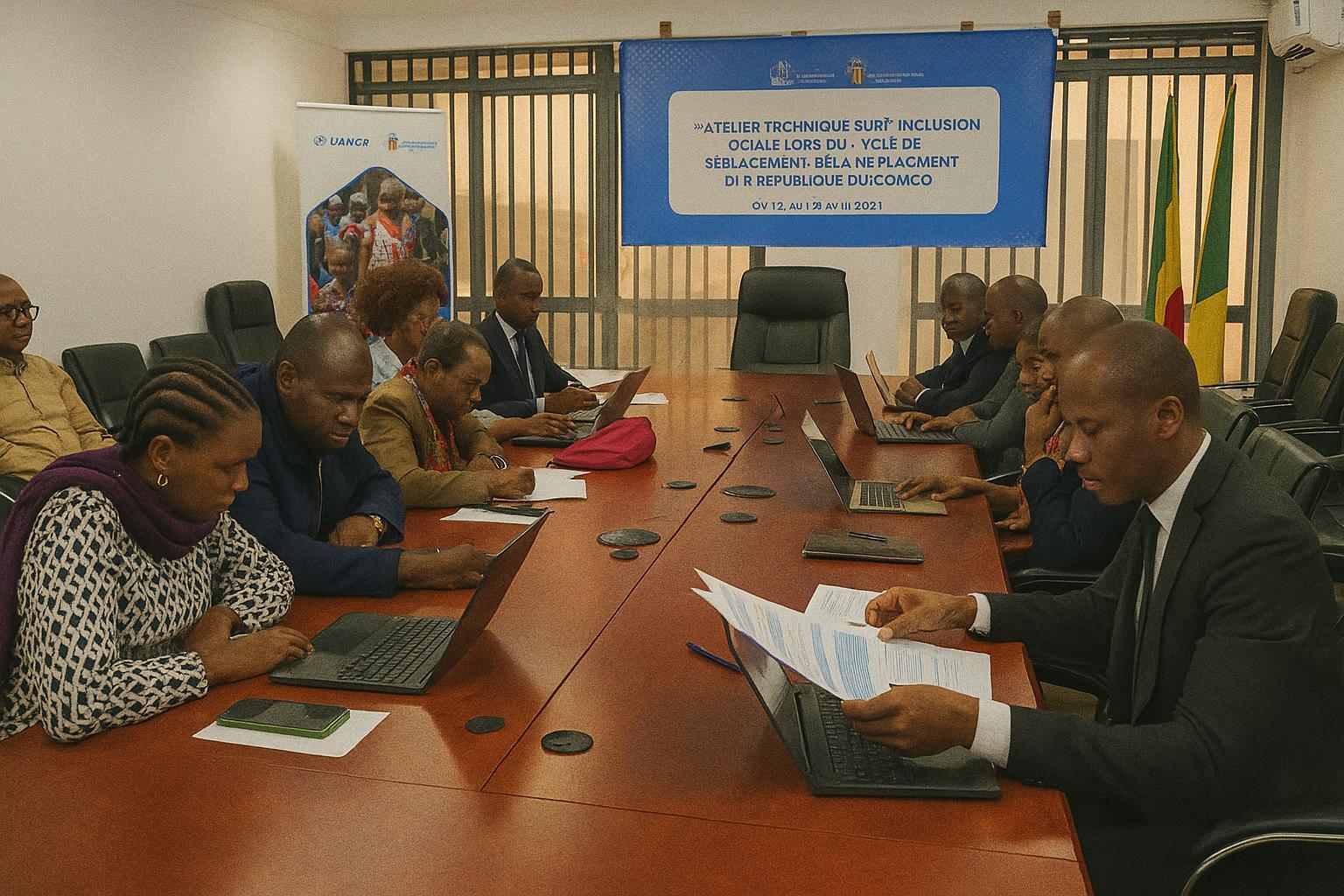
When Congo-Brazzaville’s Ministry of Social Affairs convened partners in Brazzaville last week, the buzzword was inclusion. Over two brisk days, officials, statisticians and aid agencies dissected how to weave 60,000 recognised refugees into the Unified Social Registry that underpins national poverty-reduction programmes.
The commitment, publicly voiced by UNHCR programme officer Vladimir Yvon Liem, signals what many observers call a decisive administrative leap rather than another friendly photo-op. ‘Our data and government’s data must finally speak the same language,’ he told reporters, stressing harmonised vulnerability criteria.
Brazzaville’s registry, built with World Bank technical support in 2020, already hosts 170,000 households flagged for conditional cash transfers and school feeding (World Bank, 2022). Refugees, mostly from the Central African Republic and the Democratic Republic of Congo, have so far relied on parallel humanitarian databases.
Why the numbers matter for planners
Officials argue that a unified platform avoids double counting, programme overlap and social tension. By tethering all at-risk households to one biometric profile, budgets can stretch wider without inflating expenditure, says Raphaël Akoli Ekolobongo, chief planner at the Ministry of Social Affairs.
Observers from the Economic Commission for Africa add that registries, when open to refugees, accelerate regional mobility goals under the African Continental Free Trade Area by giving migrants formal visibility. ‘No data, no rights,’ quips one consultant, echoing a mantra shared across development hallways.
Yet linking humanitarian and national datasets is technically tricky. Refugees often hold different naming conventions, multiple spellings and scant paperwork. Congolese coders have tested an algorithm that cross-checks fingerprints, reducing mismatches to below three percent, according to internal slides shared with participants.
Government-UNHCR synergy in practice
Under the memorandum refreshed this April, UNHCR funds mobile enrolment teams while the Ministry deploys statisticians to refugee settlements around Betou, Gamboma and the urban outskirts. The pilot phase will scan 10,000 individuals before scaling nationally in early 2024, if validation meetings stay on schedule.
Funding appears secure for the first leg. Paris and Oslo recently channelled seven million dollars into UNHCR Congo’s protection budget, earmarking a quarter for digital inclusion projects (UNHCR Congo communiqué, July 2023). Additional equipment will ride on the Social Registry Enhancement loan already signed with the World Bank.
For officials, collaboration also carries diplomatic weight. By integrating refugees, Brazzaville demonstrates adherence to the 2018 Global Compact on Refugees, a pledge reiterated by President Denis Sassou Nguesso at last year’s AU summit. Analysts describe the registry as a low-cost but high-visibility deliverable.
Grass-roots realities and cautious optimism
At the Tsiaki transit centre, Chadian teacher Mariam Abdallah scrolls through her newly issued QR-coded household card. ‘Maybe this means my children enter the school feeding list at last,’ she whispers. Field staff report that information meetings in Lingala and Sango have eased earlier trust gaps.
Civil-society monitors nonetheless flag privacy concerns. Congo’s 2019 Data Protection Act remains untested in court, and advocacy groups urge clearer safeguards before biometric kits roll out nationwide. The Ministry counters that encrypted servers hosted locally will comply with regional Convention 108+ standards.
Economists at the University of Marien Ngouabi caution that registries alone do not create jobs. ‘Inclusion is a door, not the house,’ professor Jean-Dieudonné Mabiala remarks. He urges pairing data with labour-market programmes so refugees contribute taxes rather than remain perpetual aid recipients.
Looking ahead: metrics, money and momentum
The roadmap sets December for the first interoperable dashboards linking health, education and social-protection ministries. Success will be judged less by press releases and more by the percentage of refugee households receiving the same benefits Congolese households enjoy, according to an evaluation matrix shared during the workshop.
Financing beyond 2024 may hinge on macroeconomic stability. Congo’s recent IMF programme stresses prudent social spending even as oil revenues rebound. By pooling databases, the government hopes to justify every CFA franc spent and facilitate donor co-financing rather than parallel project pipelines.
Diplomats watching the file say the registry could become a regional showcase. Gabon and Cameroon are sending observers to the next verification drive. ‘If Congo nails this, others will borrow the template,’ notes a Central Africa analyst at the International Crisis Group.
For now, steering committees will meet quarterly, alternating between Brazzaville and refugee-hosting districts. Minutes will feed an online tracker displayed at the Prime Minister’s office, a move meant to keep momentum in the public eye and soothe anxious partners.
By mid-2025, authorities envision linking the registry to mobile money wallets, allowing refugees to receive climate-shock top-ups during floods without queuing for envelopes. Telecommunications firms have signalled interest, seeing a new user base in remote districts where subscriber growth has plateaued.
Whether algorithms and ambition translate into tangible livelihoods will be measured family by family. But the workshop’s takeaway was clear: inclusion is no longer charity; it is statecraft. And it is increasingly coded in SQL as much as in the Constitution.