
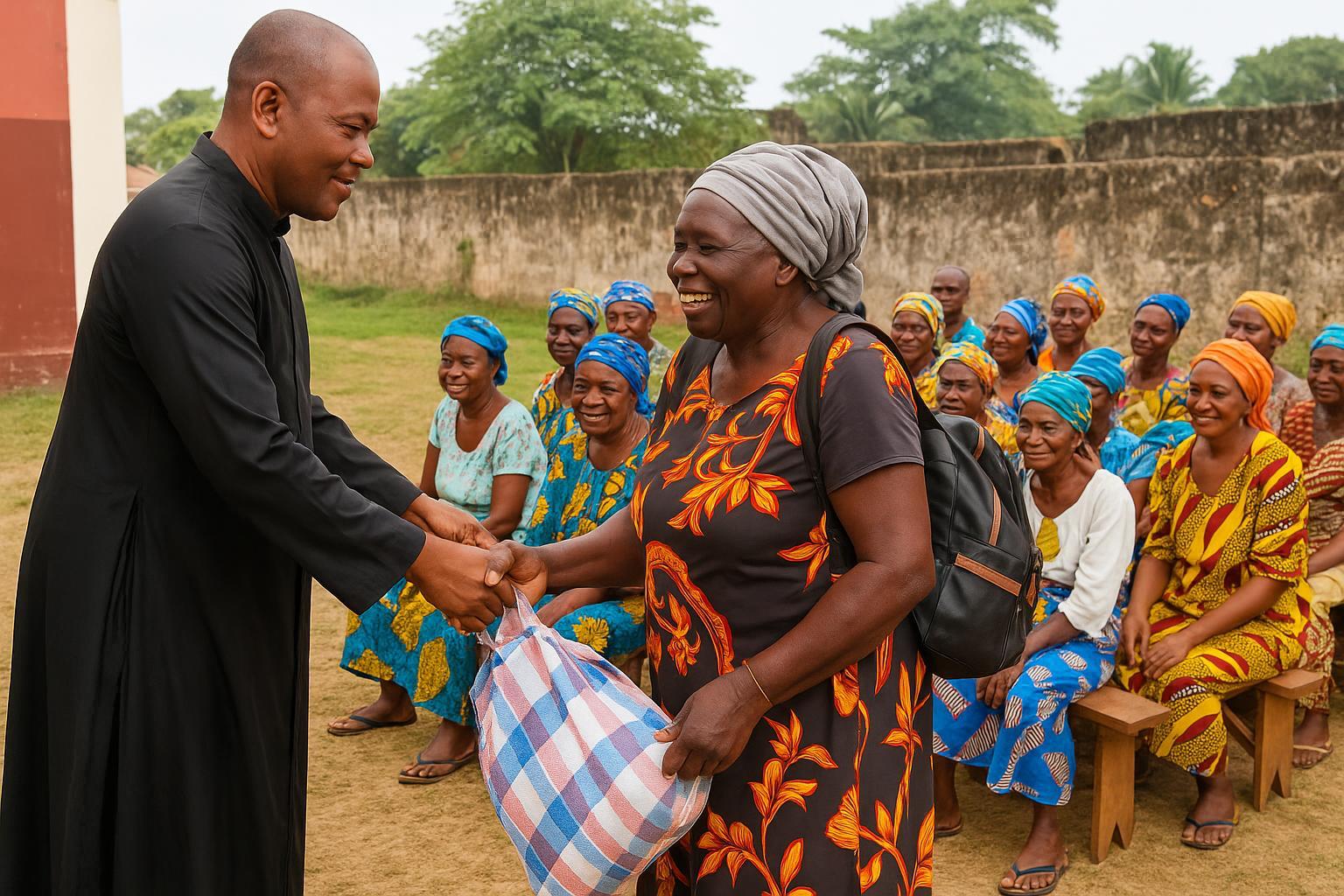
Charity gesture resonates in coastal capital
At the Polio Center in Pointe-Noire, a modest hall filled with sacks of rice and bottles of oil set the scene for a humanitarian moment that caught citywide attention. Over one hundred vulnerable residents collected kits offered by the diocesan branch of Caritas.
Archbishop Abel Liluala encouraged the crowd with a brief homily, calling the act “a reminder that solidarity is still our defining strength.” Clergy, municipal officials and neighborhood leaders observed the ceremony, underlining the event’s significance to Congo’s economic hub.
A partnership rooted in social responsibility
Caritas Pointe-Noire designed the operation with logistical and financial backing from the National Petroleum Company of Congo and its foundation, an alliance that has matured during previous emergencies, including the 2021 coastal floods (Caritas Congo).
Father Steve Mayala, the local Caritas director, noted that the oil group’s contribution covers transport, storage and part of the staple purchases. “Without corporate partners, an operation of this scale would stall after a single round,” he told reporters.
Targeting the most fragile households
Parish committees spent two weeks identifying elderly people living alone, widows and households without formal income. Ten urban parishes submitted lists, later cross-checked with municipal social affairs offices to avoid duplication, a process observers called unusually rigorous for a citywide hand-out.
Each beneficiary left with rice, salted fish, vegetable oil, sugar and soap—items chosen after consultation with nutritionists at the local hospital. The standardized package, weighing roughly fifteen kilograms, should last an average household three weeks, according to Caritas estimations.
Quarterly cadence, sustained impact
Unlike previous one-off distributions, the archdiocese committed to organizing deliveries every three months. That timetable, Archbishop Liluala said, will help households plan better and reduce the temptation to resell goods immediately for quick cash.
Mayala added that a predictable calendar also eases procurement. Suppliers can reserve volumes, lowering costs in a market still recovering from pandemic-related supply interruptions cited by the World Food Programme’s latest Congo brief.
Voices from the ground
Eveline Makosso, a 71-year-old widow from Tié-Tié district, described the kit as “a breath between one pension payment and the next.” She believes her grandchildren will now finish the school term without missing meals.
Community health worker Armand Ndinga observed that consistent food intake often stabilizes medication schedules for hypertensive seniors. “Nutrition is medicine’s first ally,” he said, echoing the Ministry of Health’s view that balanced diets ease the public clinic load.
Aligning with national anti-poverty agenda
Congo-Brazzaville’s National Development Plan 2022-2026 prioritizes private-public collaboration to meet Sustainable Development Goal 2 on hunger. Officials therefore welcomed the church initiative as complementary rather than parallel to state programs.
Departmental social affairs delegate Rosalie Kombila stressed that information sharing prevents overlap with ongoing government cash-transfer pilots financed by the World Bank. “Coordination builds confidence among donors and citizens alike,” she commented.
The church’s evolving humanitarian role
Historically focused on pastoral care, Congolese dioceses have broadened their portfolios to include microcredit and agricultural training. Analysts at the Catholic University of Central Africa argue that such diversification reflects both growing urban poverty and the church’s desire to remain socially relevant.
In Pointe-Noire, that shift is visible in Caritas’s database of vulnerable households, updated after each medical outreach or flood response. The repository now guides both liturgical and development activities, underscoring an increasingly data-driven approach.
Oil revenue and corporate citizenship
SNPC’s participation illustrates how state-owned enterprises leverage profits for social impact. Corporate affairs manager Thierry Goma said the foundation allocates roughly two percent of annual net revenue to community projects, a figure mirroring regional corporate-social-responsibility averages.
Analysts at the Brenthurst Foundation note that visible, non-contentious interventions—such as food aid—help companies maintain social licenses to operate. In a competitive hydrocarbons sector, goodwill can translate into smoother logistics and reputational capital.
Regional patterns of food insecurity
The latest Integrated Food Security Phase Classification places nearly 876,000 Congolese in Phase 2 or higher, with urban centers showing episodic spikes tied to commodity prices. Pointe-Noire, reliant on imported staples, remains particularly sensitive to global grain volatility.
Economist Marie-Claude Ngolo cautions that charity, while vital, must dovetail with agricultural policy reforms aimed at boosting local cassava and maize yields. “Emergency aid buys time; structural production wins the race,” she said.
Looking ahead to September rendez-vous
Caritas teams have already begun recruiting volunteers for the next distribution slated for early September. Training will cover crowd management, stock accounting and basic first aid, reflecting lessons learned during June’s launch.
For beneficiaries like Makosso, the date is already circled on personal calendars. “Knowing help is coming allows me to breathe,” she said, summarizing the quiet but profound reassurance that quarterly predictability can deliver to a city’s most fragile citizens.