
A quiet handshake worth 27.5 million FCFA
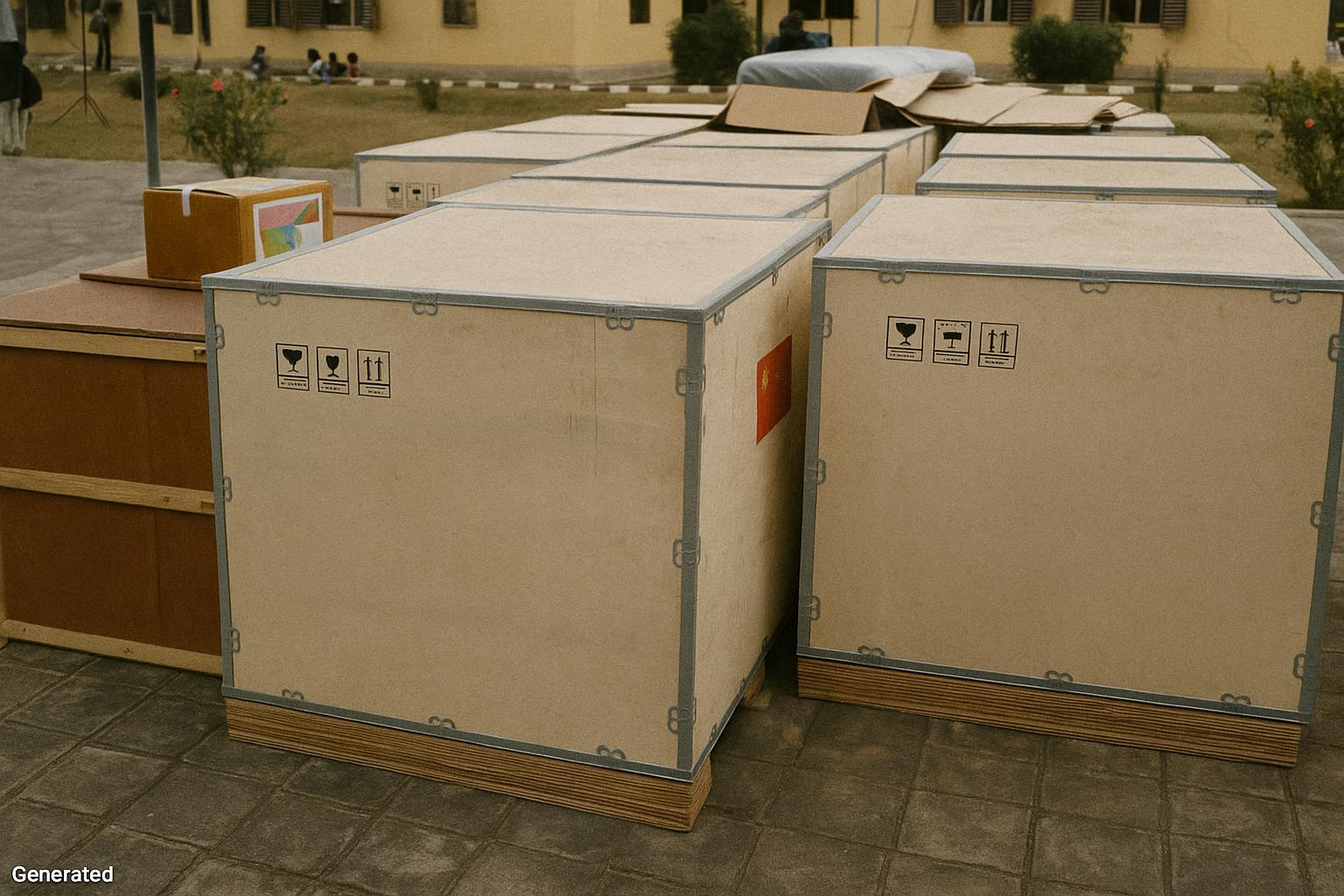
Last Saturday, in a sun-drenched courtyard of Mfilou’s Sino-Congolese Friendship Hospital, cardboard crates stamped with red Chinese characters were stacked higher than the waiting room door. Wang Zhitao, who heads the 28th Chinese medical mission in Congo, handed the consignment—valued at 27.51 million FCFA—to Donatien Moukassa, chief of staff at the Ministry of Health. Inside the crates: anti-inflammatory drugs, anti-malarials, broad-spectrum antibiotics, gauze, suction pumps and a handful of minor surgical kits. “Medication must travel, not patients,” Wang told reporters, echoing Beijing’s health-for-development slogan. For Mfilou’s busy wards, the shipment is expected to boost pharmacy stock for roughly six months, hospital pharmacists estimate.
Mfilou Hospital as a long medical bridge
Built in 2013 with a 57 million US-dollar soft loan from China Eximbank, the 150-bed facility has become a visible node in Congo’s health map. Officials frequently describe it as the ‘flagship’ hospital serving the densely populated eighth arrondissement. According to the Congolese Health Ministry, outpatient attendance has almost doubled since 2018, touching 180,000 visits last year. Much of the growth has been driven by chronic malaria cases; WHO’s 2022 malaria profile still lists Congo among Central Africa’s five high-burden states. Hence the symbolic weight carried by the pallets of artemisinin-based therapies included in Saturday’s shipment.
Training and technology: the less visible payload
While television cameras focused on drug labels, hospital director Roger Oyeré spoke of a quieter gain: skills. In his speech, he confirmed that a memorandum of understanding will soon link Mfilou to Tianjin University of Traditional Chinese Medicine. The deal includes setting up a Qihuang College inside the hospital, enabling joint research on herbal antimalarials and routine exchange of resident doctors. Over WhatsApp, a senior paediatrician at Mfilou described the prospect as “our next big upgrade, beyond bricks and beds.” Similar twinning projects have already been launched in Kenya, Laos and Suriname, according to China’s National Health Commission.
China’s health diplomacy in figures
Since the first 14-member Chinese medical team landed in Brazzaville in 1967, Beijing has rotated roughly 900 doctors, surgeons and pharmacists through the country. Public records compiled by the Johns Hopkins China Africa Research Initiative show that, continent-wide, such missions have performed over 1.1 million surgeries. Congo’s slice is modest yet significant: more than 150 complex operations logged by the current team alone. In addition, about 30 Congolese doctors have secured specialisations in Tianjin and Guangzhou hospitals since 2015. The latest donation therefore sits in a pattern of soft-power outreach that, according to economist Florent Malanda at Marien-Ngouabi University, “costs less than a road but travels much further in public perception.”
Diplomatic dividends for Brazzaville
For Congo’s government, the timing is helpful. The country is still rebuilding supply lines disrupted by the Covid-19 pandemic and by higher freight costs on the Atlantic route. The Health Ministry confirms that national drug stocks have recovered to 75 percent of pre-pandemic levels, yet rural clinics around Sibiti and Impfondo continue to report shortages of injectable antibiotics. By reinforcing the capital’s referral hospital, the Chinese batch frees domestic inventory for outlying districts. In his remarks, Moukassa stressed that “the sole beneficiary must remain the patient”—a line that drew applause from a handful of local mothers seated near the paediatric wing.
Looking ahead: from crates to classrooms
Signing ceremonies rarely linger in news cycles, but officials on both sides argue that Saturday’s event plants seeds for 2024. Once the Qihuang College opens, joint malaria surveillance projects will collect blood-slide data from Mfilou and three provincial hospitals. Preliminary funding pledges, reported by Xinhua, mention 120,000 US dollars for laboratory reagents and e-learning kits. Health analysts in Brazzaville note that such sums are small compared with the energy or telecom deals that dominate Congo-China trade. Yet, as an adviser at the Chinese embassy quietly put it, “health talks to everybody, every day.” In a region where one rainy season can swell malaria admissions by 30 percent, that assertion rings practical rather than poetic.