
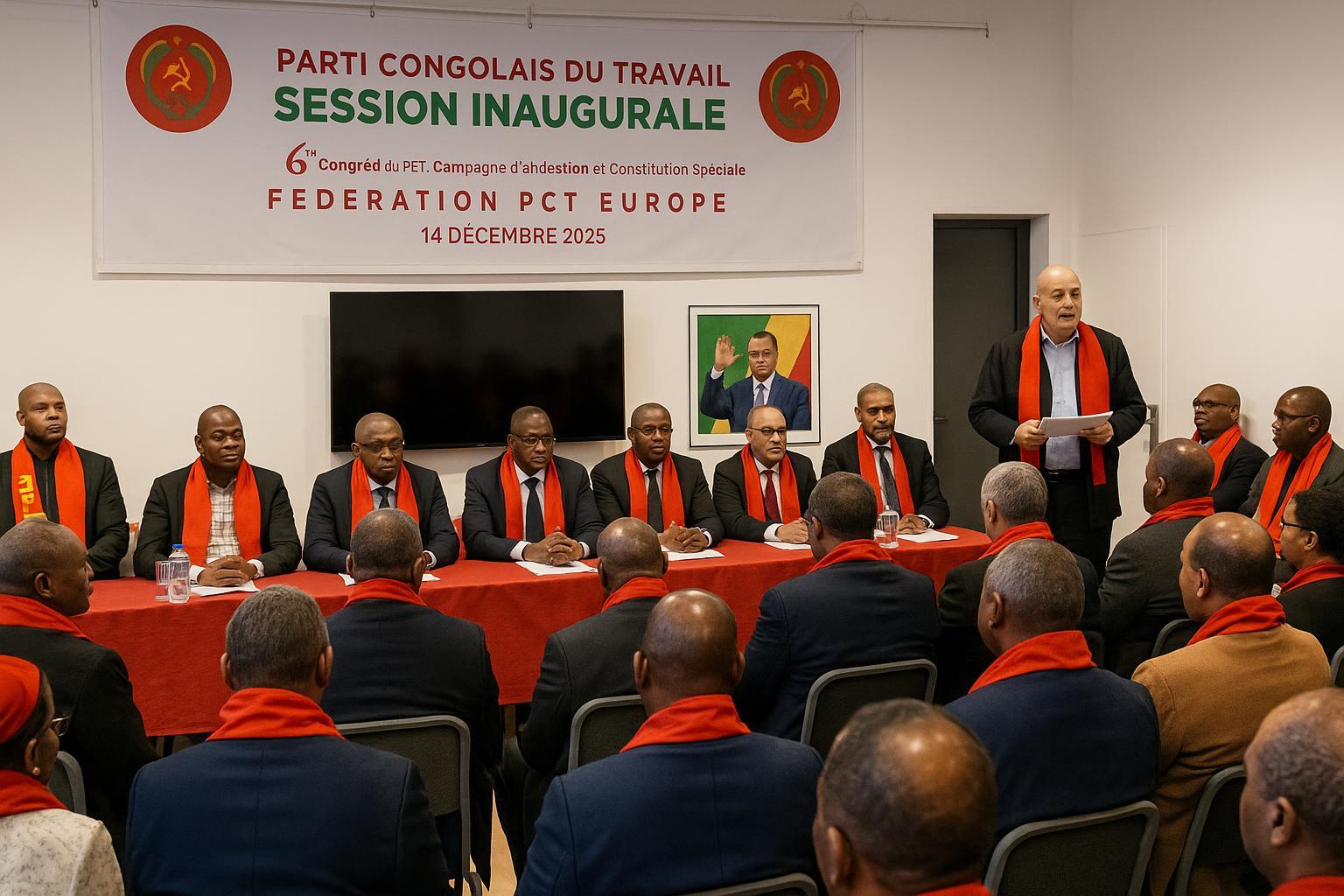
Paris launch energises diaspora
Sunday 14 December, a packed auditorium at Espace Hermès in Paris signalled a fresh chapter for the Congolese Labour Party’s European wing. Under the gavel of federation president Anatole Guy Elenga, militants gathered to launch a membership and special-dues campaign ahead of the sixth Congress.
Comités from Île-de-France and the North-West answered the call, reflecting what organisers called “a united front from Lille to Marseille”. Moderator Dhordain Ndengue explained the agenda, promising an efficient session “rooted in discipline, solidarity and concrete action for our homeland”.
Federation vice-chair Jean Jacques Pambou, hosting the day, welcomed newcomers and veterans alike before handing the microphone to Elenga. The president thanked activists for “sacrifices that strengthen the party’s backbone beyond national borders”, then invited the two newly constituted committees to present their road-maps.
Fresh members join ranks
The first tangible result came quickly. During the membership count, the presidium reported twenty-three new enrolments. Each fresh card carrier received the red-yellow-green badge of the Congolese Labour Party, sparking cheers and camera flashes that underlined the emotional weight of symbolic belonging.
Senior party member Fabien Bakote monitored proceedings from the front row, offering procedural advice and historical context. “Europe has always supplied ideas, funds and talents to the Congolese struggle,” he reminded the hall, urging militants to “honour those who kept the flame alive during challenging decades”.
Special fund drive tops €6,640
Beyond applause, militants reached for their wallets. The special contribution drive, designed to finance logistical needs of the upcoming Congress in Brazzaville, collected €6,640 by day’s end. Organisers highlighted that figure was recorded before the national deadline, hinting that the total will climb further.
One notable donor, Armand Rémy Ballou-Tabawe, minister-counsellor at Congo’s embassy in France, arrived in person to hand over his envelope. His passage demonstrated, according to observers, “the seamless bridge between diplomatic service and grassroots activism” that characterises the ruling party’s overseas outposts.
Motions back Sassou N’Guesso 2026
In two carefully drafted motions, participants reaffirmed loyalty to President Denis Sassou Nguesso. Chris Bete Siba delivered the first text, praising the head of state for “prioritising stability, peace and inclusive growth”, values militants promised to defend across European cities and on social media platforms.
A second motion, read by Michèle Sambot, renewed full confidence in Secretary-General Pierre Moussa. Speakers credited his “methodical leadership that keeps the party agile amid a changing global scene”. The hall responded with rhythmic chants, a tradition inherited from branch meetings in Pointe-Noire and Owando.
The emotional peak arrived when Juste Prudence Oko unveiled an appeal urging President Sassou Nguesso to enter the March 2026 presidential race. The text pledges diaspora mobilisation to secure “a first-round landslide”. Elenga declared the commitment “a solemn contract between militants abroad and voters at home”.
Stronger structures across Europe
Before adjournment, Jean Bastien Makoundou, chair of the federation’s audit commission, saluted the “camaraderie and transparent bookkeeping” that characterised the day. His brief report, flashed on a projector, showed every euro and franc CFA already earmarked for accommodation, security, interpretation and youth participation at Congress.
Closing the session, Elenga voiced optimism about installing three remaining European committees before mid-2024. “Our network will soon cover the continent from Scandinavia to the Mediterranean,” he said, adding that each cell would function as “a think tank and service hub for Congo’s modernisation agenda”.
Analysts say diaspora chapters now project the party’s voice into finance, tech and academia. Many Europe-based cadres travelled home for the 2021 legislative race, using digital skills that kept door-to-door canvassing aligned with pandemic safety guidelines.
Within Congo itself, authorities value external chapters for their remittance power and soft diplomacy. Government economist Josué Mabiala argues that every euro collected abroad “translates into events, training and equipment that lighten the fiscal load on domestic structures while nurturing patriotic commitment among expatriates”.
What comes next for militants
Back in the Cité Joly hall, volunteers prepared a registration desk for next month’s workshop on political communication. Flyers promised modules on public speaking, graphic design and electoral law. “We want each militant to be a messenger and a mentor,” coordinator Véronique Mingotti explained with a smile.
For readers interested in joining, the federation says membership forms will be available online and at events in Paris, Lyon, Rouen and Brussels. Annual dues remain pegged to the French minimum wage index, a rule introduced to keep activism accessible to students and professionals.
Travel alerts for militants heading to Brazzaville next July will appear on the federation’s Telegram feed, featuring group fares with regional airlines. Weather tips and health guidance will accompany each post to ensure safe journeys during a season known for heavy equatorial showers.
As lights dimmed, chants of “Unité, Mobilisation, Victoire” echoed through the corridor, hinting at both nostalgia and forward motion. The Paris session, militants agreed, was not a mere ceremony but a logistical springboard toward a Congress expected to refine policies for Congo’s next development cycle.