
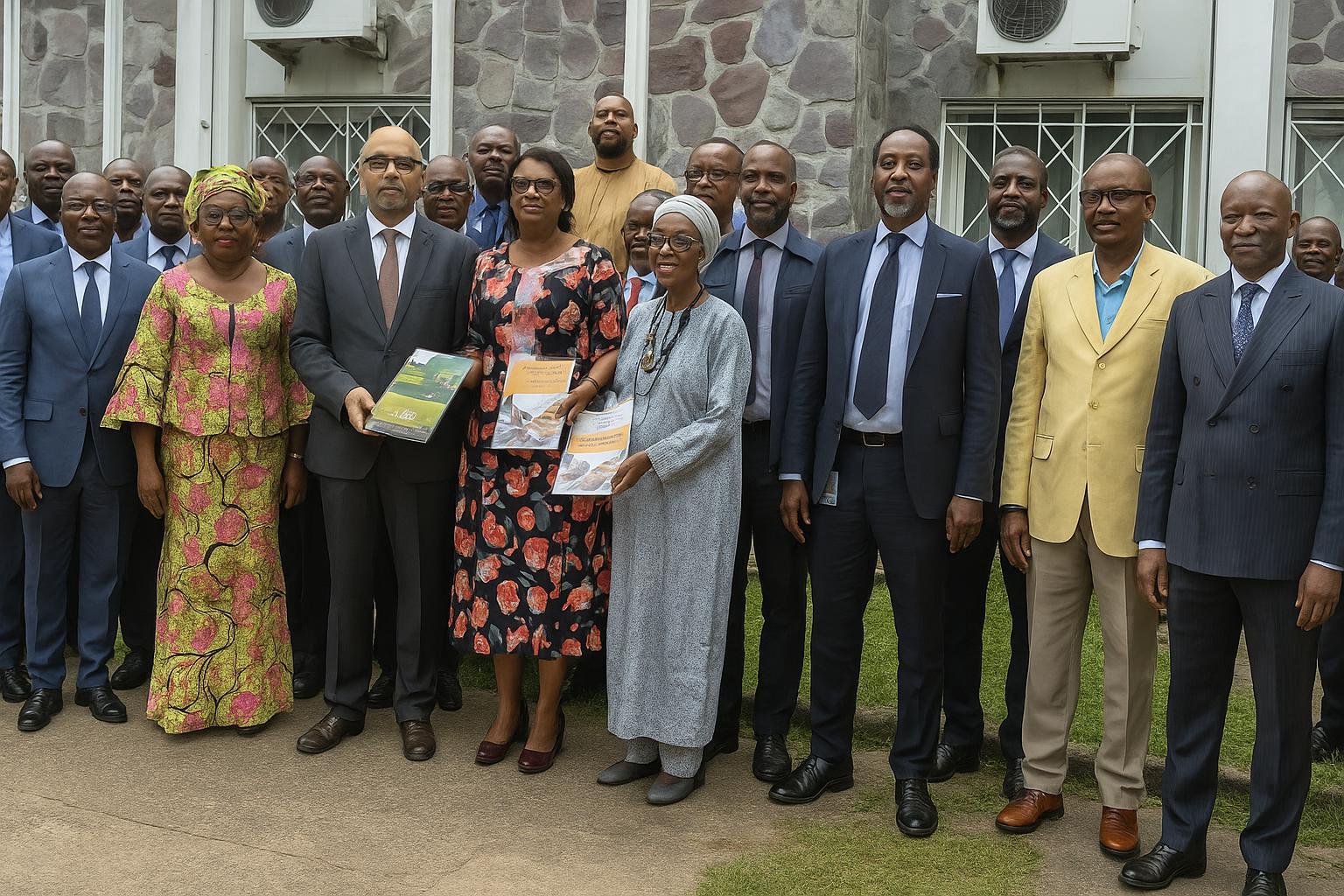
Government receives blueprint in Brazzaville
A carefully bound document changed hands in the capital on 12 December, when UNDP Resident Representative Adama-Dian Barry formally presented Congo’s Post-Disaster Recovery Strategy 2025-2030 to Minister of Social Affairs, Solidarity and Humanitarian Action Irène Marie Cécile Mboukou-Kimbatsa. The ceremony capped eleven months of technical work launched after the severe January 2024 floods.
From emergency response to forward planning
Barry described the 140-page text as “a national steering and coordination tool” that replaces ad-hoc relief with long-term, risk-informed planning. She stressed that every crisis can become “an opportunity for sustainable reconstruction”, echoing the country’s commitments under the UN 2030 Agenda and the African Union’s Agenda 2063.
What the strategy covers 2025-2030
The roadmap sets three core objectives: rebuild damaged roads, dykes and public buildings; revive agriculture, trade and other livelihoods disrupted by extreme weather; and strengthen institutional as well as community capacity to cope with future shocks. Each intervention is linked to costed activities, timelines and performance indicators, officials said.
A multisector action plan
Engineers, agronomists, health specialists and planners contributed to a matrix that aligns with Congo’s Nationally Determined Contribution and the Sendai Framework. Proposed actions range from elevating schools in flood-prone districts to introducing climate-smart cassava varieties, installing early-warning sirens along the Congo River and training local councils in hazard mapping.
Lessons from January 2024 floods
When swollen tributaries forced thousands from their homes earlier this year, roads linking Brazzaville to northern districts were cut for weeks, pushing up food prices. The experience, analysts note, underlined how climate events quickly ripple through transport, trade and social cohesion in a river-dependent economy.
Institutional coordination is key
UNDP specialists argue that ministries must share data and budgets if resilience targets are to be met. The new document therefore assigns clear roles to Interior, Planning, Public Works, Agriculture and Finance, while encouraging provincial governors to chair monthly monitoring sessions with civil society observers.
Minister calls for donor round-table
Receiving the strategy, Mboukou-Kimbatsa praised its practical orientation but reminded guests that an earlier plan drafted in 2019 stalled for lack of financing. She asked UNDP to help convene a funding conference so development banks, bilateral partners and private investors can pledge resources in 2024.
Budget estimates and funding gaps
Preliminary calculations place total needs at roughly 420 million dollars, of which one third targets infrastructure, a quarter livelihoods support and the balance capacity building plus monitoring. Domestic allocations cover about 28 percent, according to the Ministry of Finance, leaving a significant gap for external partners to bridge.
Aligning with national development plans
The strategy dovetails with the 2022-2026 National Development Plan and the country’s ambition to diversify beyond oil. By prioritising resilient roads and irrigated agriculture, planners believe the document can stabilise rural incomes and attract eco-tourism, thereby supporting inclusive growth endorsed by President Denis Sassou Nguesso.
Community voices shape priorities
Drafting teams conducted focus groups in Mossaka, Oyo and Pointe-Noire. Fisherman Jean-Pierre Djombo recalled losing boats to swollen currents and welcomed proposals for reinforced landing stages. In Loukolela, teacher Agnès Ngoma said raising classroom floors “will keep lessons running even when the river rises”.
Proactive risk management explained
Unlike emergency appeals released after each disaster, the new approach allocates funds and responsibilities before hazards strike. Hydrological models from the National Meteorology Directorate will trigger phased responses, enabling authorities to pre-position supplies and limit displacement. UNDP cites similar successes in Niger and Rwanda.
Monitoring and accountability tools
A digital dashboard will track progress on 62 key indicators, from kilometres of elevated road to the percentage of households with flood insurance. Quarterly reports will be published online, offering transparency to donors and taxpayers alike, said Planning Director Antoine Houassa.
Climate resilience as economic opportunity
Economists at the University of Marien Ngouabi argue that every dollar invested in prevention can save up to seven dollars in avoided losses. They point to new jobs in green construction, weather services and agritech that could appeal to Congo’s youthful workforce.
Regional context and solidarity
Congo’s initiative follows similar moves by Cameroon and Gabon, signalling a CEMAC-wide push for resilience financing. UNDP noted it will facilitate knowledge exchange among central African states, reinforcing Brazzaville’s role as a hub for climate diplomacy.
Next steps on the calendar
The Ministry of Social Affairs plans to submit the strategy to the Council of Ministers before year-end. Once endorsed, line ministries have 90 days to integrate actions into their 2025 budgets. A pilot project elevating 15 kilometres of National Road 2 is slated to start in March.
Citizens urged to stay engaged
Mboukou-Kimbatsa invited community groups to follow implementation closely, arguing that “the value of this document lies in our collective capacity to turn pages into progress”. Civil society networks, including the Congolese Red Cross, have already offered to support public awareness campaigns on flood preparedness.
A blueprint ready for action
With technical details in place and political will confirmed, the 2025-2030 strategy positions Congo to convert recent hardships into a safer, greener future. The coming months will test the speed at which financing, engineering and community participation converge to make resilience a daily reality across the nation.