
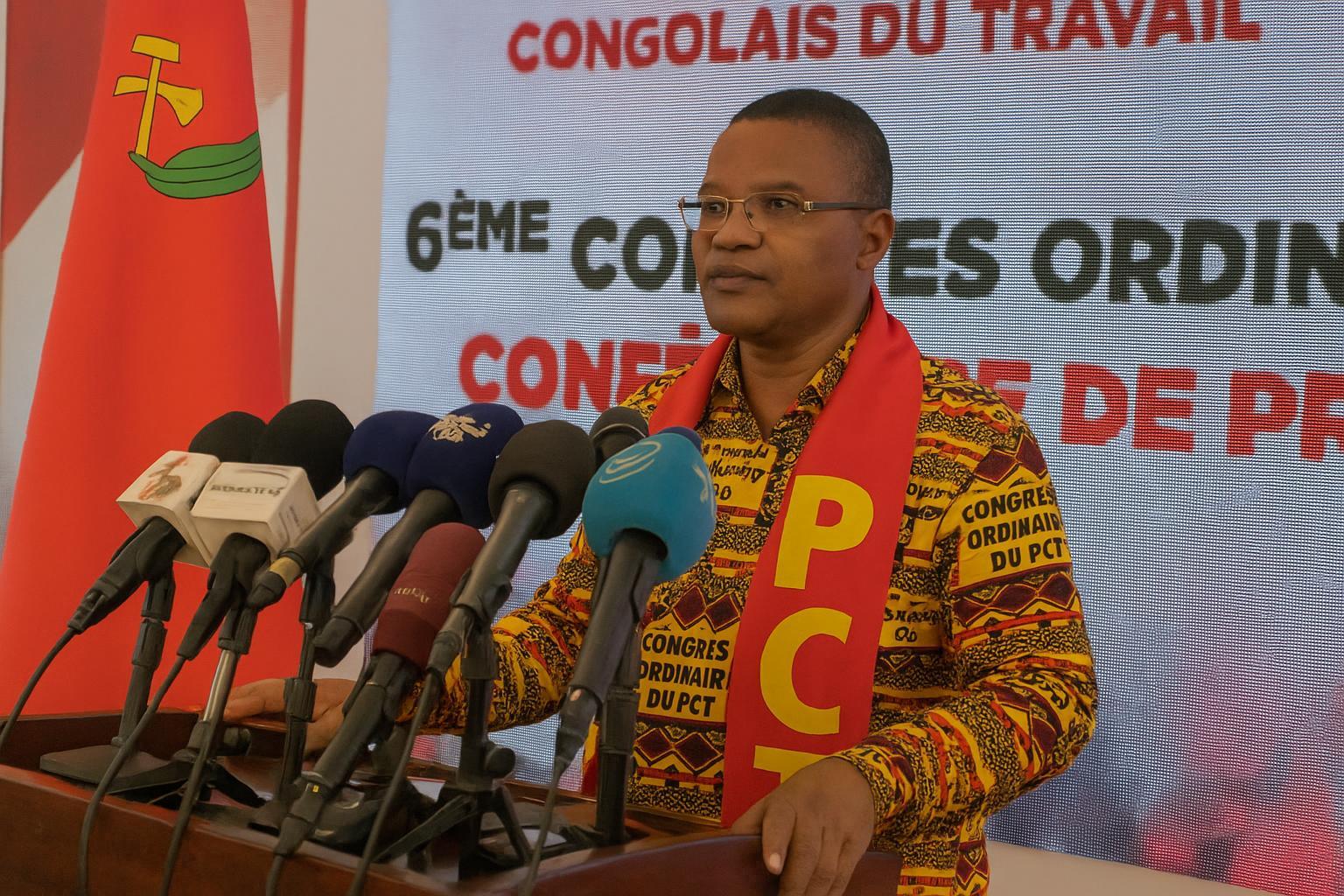
Brazzaville ready for historic gathering
Brazzaville’s Palais des Congrès has been draped in the red and gold colours of the Congolese Party of Labour as technicians test sound systems and ushers rehearse protocols ahead of the sixth ordinary congress scheduled from 27 to 30 December.
During a press briefing on 24 December, party spokesperson and congress rapporteur Parfait Romuald Iloki confirmed that all accreditation desks, interpretation cabins and health checkpoints are ready, insisting that “every logistical detail has been verified twice”.
A 3,000-strong delegation
Iloki announced the arrival of 3,000 delegates drawn from the country’s fifteen departments and the diaspora, a headcount that will make this the largest in the party’s history since its foundation in 1969.
Breaking down the figures, 1,340 places go to departmental and overseas federations, 1,158 seats are reserved for members of right such as the Central Committee and the Evaluation Commission, while 502 individuals have been selected for outstanding militancy.
Timing aligned with 2026 presidential race
The congress was initially slated for last year but was postponed for what organisers describe as “strategic calibration”, bringing the meeting closer to the March 2026 presidential election.
Analysts in Brazzaville suggest the tighter calendar will allow the party to keep its campaign machinery warm, maintain ground mobilisation and project a single narrative well before official campaigning rules take effect.
Iloki was careful to frame the agenda as forward-looking rather than purely electoral, noting that the congress intends to “look in the rear-view mirror before accelerating again”, a phrase that resonated with many long-time cadres in the room.
Theme underscores unity and progress
Delegates will debate under an expansive theme calling cadres, militants and sympathisers to march “in unity, cohesion and solidarity” for the consolidation of peace, national unity and democracy on the path toward sustained development.
Organisers underline that the wording emerged from weeks of consultations, aiming to echo grassroots expectations while staying aligned with President Denis Sassou Nguesso’s emphasis on stability as a prerequisite for economic take-off.
Agenda: leadership renewal and programme update
At the top of the docket sits the election of a new secretary-general, a position currently held by former prime minister Pierre Moussa, whose mandate formally expires with the congress.
Delegates are also expected to revise the party’s statutes and five-year action programme, the only setting where such amendments can be adopted under internal rules designating the congress as the organisation’s “supreme moment”.
Most attention, however, will centre on the nomination of the party’s candidate for the 2026 presidential ballot, a decision widely viewed as pivotal for retaining the parliamentary majority built during the 2022 and 2023 votes.
Party reports robust electoral record
Reviewing the outgoing mandate, Iloki painted a confident picture, reminding reporters that the PCT secured 111 of 151 seats in the 2022 legislative elections, later welcoming an independent deputy who crossed the floor.
He added that the movement claimed 59 of 72 upper-house positions in the 2023 senatorial polls and 652 of 1,154 local council seats, a performance he described as “an enormous victory that grants the President a comfortable majority”.
Practicalities: lodging, health and security
Hotels on both sides of the Congo River report near-full bookings, while the organising committee has arranged dormitory space at the National School of Administration for youth delegates to keep accommodation costs down.
The city’s police force says a dedicated security corridor will operate between Maya-Maya Airport and the congress venue, coupled with mobile health units implementing temperature checks and rapid testing in line with national sanitary guidelines.
What observers expect next
Political scientists contacted by Les Dépêches de Brazzaville argue that the congress outcome will likely shape coalition arithmetic in parliament and determine how swiftly forthcoming economic reforms can be translated into enabling legislation.
For many small business owners in the capital, the larger question is whether the policy resolutions adopted this week can translate into quicker administrative procedures, better access to credit and more predictable energy supply.
As the banners are hoisted and drums tuned, party veterans stress that the congress is more than an internal exercise; in their words, it is a “national rendezvous” intending to keep the Republic on a steady path toward shared prosperity.
Diaspora engagement grows
From Paris to Montreal, overseas sections have chartered group flights and raised funds for solidarity projects, a mobilisation Iloki calls “proof that the revolutionary flame travels well beyond our borders and remains anchored in the Congolese heart wherever it beats”.
Diaspora delegates are scheduled to hold a side session on remittances and technology transfer, hoping to streamline channels that already inject an estimated CFA 90 billion annually into local economies, according to figures cited by the party’s economic commission.
Economic spin-offs for the capital
Tour operators say congress-related bookings have lifted December occupancy rates above 85 percent, while craft markets near the Basilique Sainte-Anne expect brisk sales of woven shirts and wood carvings, illustrating how political tourism can ripple through the city’s informal sector.