
Surprise endorsement reverberates in Brazzaville
BRAZZAVILLE—The Congolese Movement for Democracy and Integral Development (MCDDI) has publicly invited President Denis Sassou Nguesso to carry its hopes into the March 2026 presidential race, adding fresh momentum to the veteran leader’s ongoing tour of national development projects.
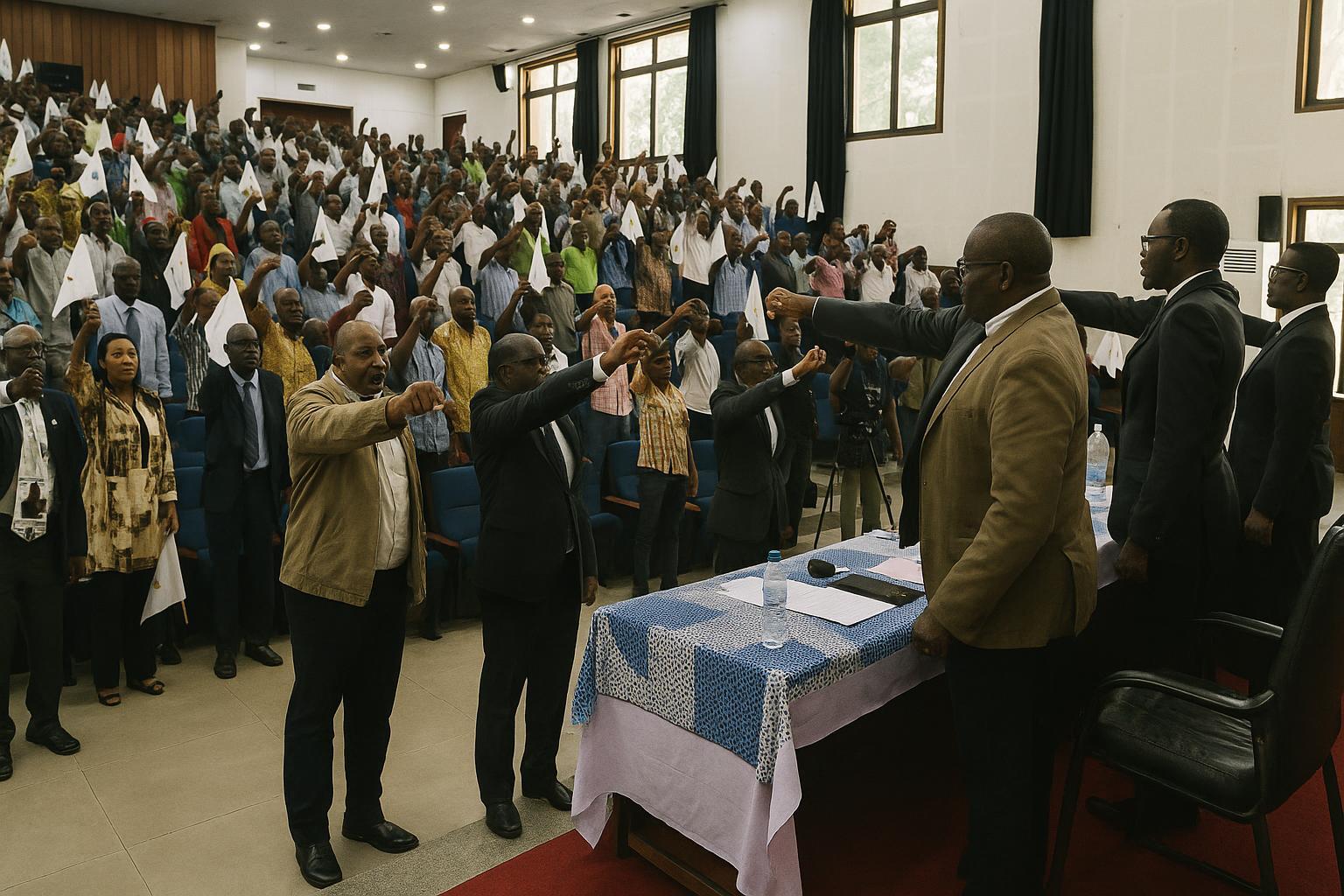
The call came at the party’s second extraordinary session this week inside the historic MCDDI hall in Ouenzé district, where branch chairman Martinien Ulrich Bocko read a motion portraying the Head of State as guarantor of peace, institutional balance and communal harmony.
Applause erupted each time the speaker mentioned Sassou Nguesso’s name, witnesses told Les Dépêches de Brazzaville, illustrating the tight political chemistry between the former movement of the late Bernard Koléla and the governing Congolese Labour Party.
Legacy of a coalition born in the 1990s
The MCDDI–PCT alliance traces back to the early 1990s, when both formations sought to avoid renewed conflict after the transitional period that followed the National Conference.
That pact, renewed several times, has delivered joint candidates in municipal councils and even a shared list in the 2022 legislative elections, making MCDDI support in 2026 all but expected, analysts at the University of Marien Ngouabi observed.
Extraordinary session sets upbeat tone
Delegates came from the capital’s nine arrondissements, wearing party colours of green and yellow, while traditional drums punctuated speeches promising ‘total mobilisation’ once the president signals his intention to stand.
“The militants of Brazzaville are on alert,” Bocko said, adding that local committees have updated voter files and transport plans in advance of the campaign season legally slated to begin several weeks before polling day.
Fund-raising drive under way
In the same motion, the party launched a financial ‘quest’ to contribute a portion of the 25-million-franc CFA deposit required for presidential hopefuls, a symbolic gesture designed to lighten the eventual candidate’s administrative burden.
Regional treasurers have already opened mobile-money wallets, according to Radio Congo, and report early contributions from market traders in Ouesso and taxi unions in Pointe-Noire who credit the incumbent with preserving a climate conducive to small business.
Sassou’s nationwide tours intensify
Although still silent on his political plans, the president has spent recent weeks inaugurating schools in Niari, a modernised water plant in Dolisie and an electrification link to Impfondo, appearances widely broadcast on Télé Congo’s evening news.
Government communication advisers insist the trips are part of the 2022-2026 National Development Plan, yet seasoned observers note the timetable conveniently places the Head of State before appreciative crowds as the electoral clock ticks.
Opposition searching for common ground
Outside the ruling coalition, prominent opposition parties such as the Pan-African Union for Social Democracy have not announced a joint strategy, while several civic activists remain focused on local issues rather than a long-range presidential platform.
Political scientist Félicien Itsoua says the fragmented field may again struggle to agree on a single challenger, repeating a dynamic seen in 2021’s parliamentary polls, when six parties ran separate slates and split the urban protest vote.
Constitution leaves door open
Under the 2015 Constitution, a president may serve two consecutive five-year terms, but the clock was reset when the charter came into force, allowing Sassou Nguesso, first elected under the new rules in 2021, to run until 2031.
Legal experts in the Constitutional Court confirm that scenario, noting age limits were removed during the same reform, thereby eliminating any formal barrier for the head of state, who will celebrate his 83rd birthday in 2026.
Youth, stability and economic agenda
MCDDI delegates repeatedly framed their appeal around jobs for young Congolese, pointing to 10,000 expected positions in the Special Economic Zones and calling continuity the safest path to secure international investors.
“We cannot build skills pipelines if every five years policy changes course,” argued youth leader Clarisse Kassongo, whose words drew chants of ‘nkoyi’, a Kikongo term of approval, from students bused in from the Technical University.
What political observers detect
Jean-Paul Ngatsé, columnist for La Nouvelle République, views the early endorsement as ‘stage management’, signalling to undecided minor parties that government partners are already closing ranks and that joining late might reduce bargaining power.
Yet he also notes the move spares Sassou Nguesso from launching an internal PCT primary, preserving the aura of national rather than partisan candidate and allowing regional tour themes—water, energy, roads—to dominate coverage.
Countdown to nomination day
The official electoral calendar will be unveiled by the Independent National Electoral Commission in the first quarter of 2025, but parties traditionally announce presidential hopefuls months in advance to formalise fund-raising and collect sponsorship signatures.
If, as many expect, Sassou Nguesso accepts the MCDDI invitation, the ruling coalition would enter the race with a comfortable grassroots machine stretching from the Pool railway corridor to the Lake Télé forest communities.
For now, however, party cadres say the watchword remains ‘discipline’. Their immediate task: keep re-registering voters, feed the campaign kitty and ensure the sun-set imagery chosen for the session’s slogan indeed heralds a new dawn for their longstanding ally.