
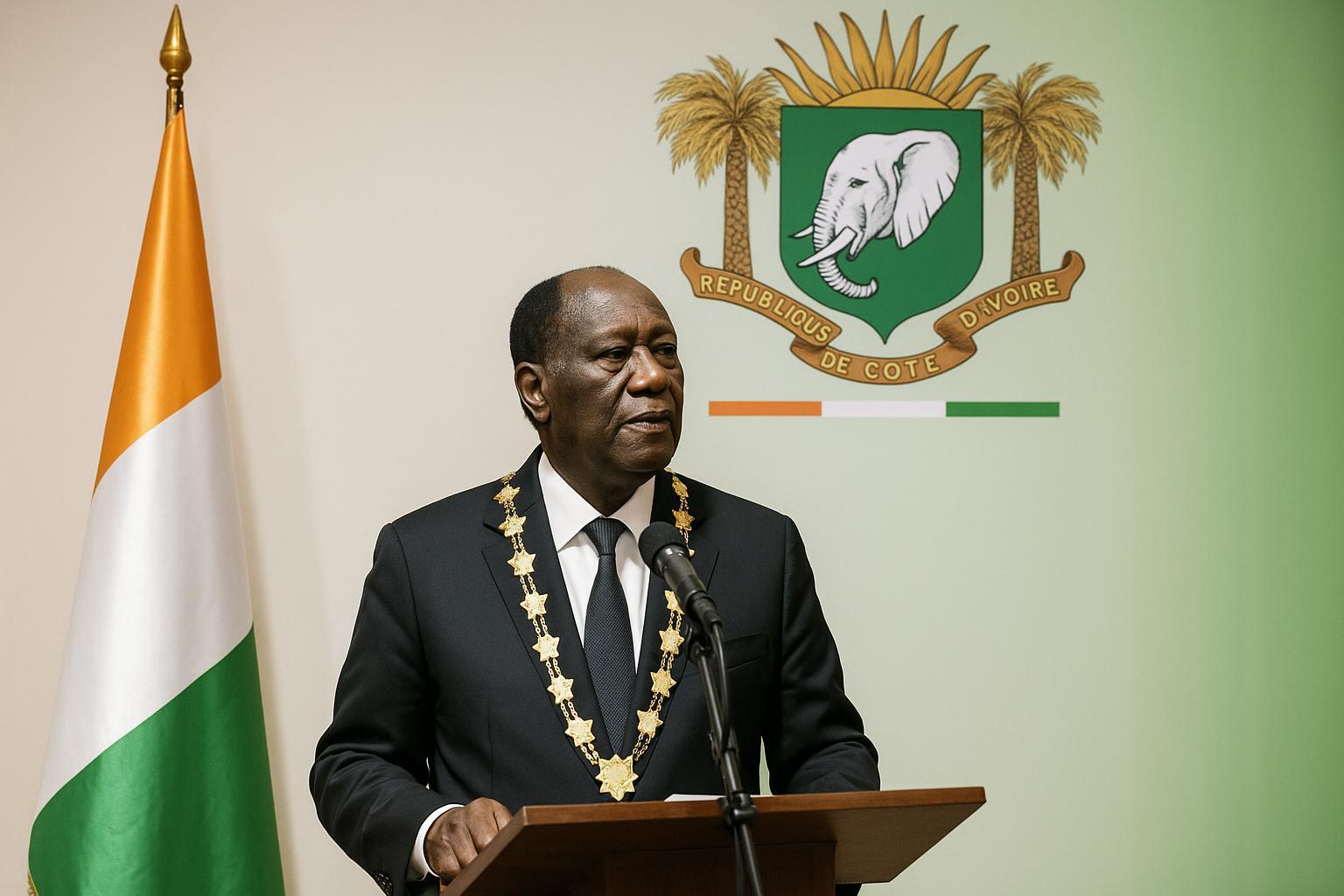
Abidjan palace turns gold for historic oath
Chandeliers glittered above crimson carpets at Abidjan’s presidential palace as Alassane Ouattara raised his hand and took the oath for a fourth term on Monday, sealing a decade of leadership that many in Côte d’Ivoire credit with renewed highways, modernised ports and brisk economic growth.
Eleven African leaders in front row seats
From the front row, eleven African heads of state—among them Congo-Brazzaville’s Denis Sassou Nguesso and Gabon’s Brice Oligui Nguema—rose in applause as a military band played the national anthem, giving the ceremony the air of a mini-summit dedicated to regional solidarity rather than a domestic event alone.
Sassou Nguesso underscores Congo–Ivorian bond
President Sassou Nguesso, who landed in Abidjan early Monday aboard the presidential Falcon, held a brief tête-à-tête with his Ivorian counterpart before the oath, highlighting joint efforts to open an Atlantic-Congo trade corridor that could ease shipping costs for landlocked neighbours and diversify Brazzaville’s export routes.
Paris and Washington keep close watch
Outside Africa, France dispatched National Assembly Speaker Yaël Braun-Pivet, while the United States sent Jacob Helberg, under-secretary for economic growth, underscoring how Abidjan’s cocoa-powered economy and security footprint in the Sahel keep Western partners closely invested in the success of Ouattara’s new five-year roadmap.
Landslide vote, lukewarm turnout explained
The Electoral Commission’s final tally gave the incumbent 89.77 percent of ballots, yet only 50.10 percent of registered voters turned out, a contrast that political scientist Dr. Adama Koné calls “a victory shadowed by disengagement,” noting that pandemic caution and fatigue with campaign rhetoric dampened mobilisation.
Big names of opposition stay away
Former president Laurent Gbagbo and ex-Credit Suisse chief Tidjane Thiam, both barred from the ballot over legal and nationality disputes, kept a low profile on Monday, choosing neither to congratulate nor to challenge the investiture, a silence that many observers interpreted as tactical patience.
Regional projects riding on stability
Stability in Abidjan matters far beyond Ivorian borders. Congo-Brazzaville and Côte d’Ivoire co-chair a CEMAC-ECOWAS task force studying rail links from the port of San-Pedro to Ouesso. Delegates told our Brazzaville newsroom the project timelines will only advance if investors remain confident in uninterrupted governance.
Economy watchers predict steady growth
Economist Aminata Diarra of the Abidjan-based think tank CAPEC expects growth to hover near six-percent in 2024, powered by new cocoa grinders and gas discoveries. She adds that a functioning transport corridor toward Central Africa could shave freight times to Pointe-Noire by almost a week.
Street reactions from Abidjan to Brazza
On the streets, residents balanced pride and pragmatism. “I voted for jobs, not just a flag ceremony,” said Lamine Coulibaly, a young trader near Treichville. In Brazzaville’s Plateau quarter, importer Clarisse Ngouala followed the swearing-in live on television, hoping for faster customs clearance once the corridor materialises.
Service corner for travelers and traders
Airlines were quick to sense demand: Equatorial Congo Airlines confirmed it will add an extra Monday evening rotation between Brazzaville and Abidjan for the next three weeks, while national carrier Air Côte d’Ivoire kept promotional fares in place, a move expected to stimulate business travel across the Gulf of Guinea.
The oath in his own words
With his right hand raised and his left on the Constitution, Ouattara promised “to defend the charter, embody national unity and serve the superior interest of the nation.” The hall erupted, led by First Lady Dominique Ouattara, whose beaming smile framed the moment for photographers worldwide.
Security priorities on the Sahel frontier
He later outlined three immediate priorities: shoring up the northern frontier against Sahel insurgents, accelerating youth employment programmes, and deepening the single currency project within the West African Monetary Union. Defence analysts noted the emphasis on cross-border intelligence sharing, already piloted with Burkina Faso and Niger.
Climate pledge resonates with COP30 agenda
Ouattara also reaffirmed Côte d’Ivoire’s plan to cut greenhouse-gas emissions by thirty percent by 2030, positioning the country as a potential climate finance hub ahead of the COP30 talks. Environment Minister Jean-Luc Assi says new reforestation drives will begin this rainy season, targeting degraded cocoa basins.
Digital reforms eye cashless future
The president’s speech placed notable weight on a cashless economy push, promising a digital identity card for every citizen by 2025. Fintech entrepreneur Mariam Touré argues that universal e-ID could slash transfer costs for the Ivorian diaspora, which sent home over two billion dollars last year.
Diplomats hail peaceful process
Speaking to reporters, Francophonie chief Louise Mushikiwabo called the orderly vote “a testament to institutional maturity.” Former Niger president Mahamadou Issoufou added that “dialogue remains open for those outside the process,” hinting at future reconciliation talks with opposition figures who have kept their distance.
What it means for Central African business
Congolese Chamber of Commerce president Paul Obami believes a stable Abidjan unlocks investor confidence across Central Africa. “Our timber exporters eye the Ivorian rail link as a game-changer,” he told this paper, noting that freight rates to Europe could fall by fifteen percent if the corridor is realised.
Next dates to watch
Eyes now turn to January, when Ouattara is expected to unveil his full cabinet and present a budget that analysts say could top eleven trillion CFA francs. Regional markets will monitor the allocation for infrastructure, while social groups await details on the foreseen youth entrepreneurship fund.