
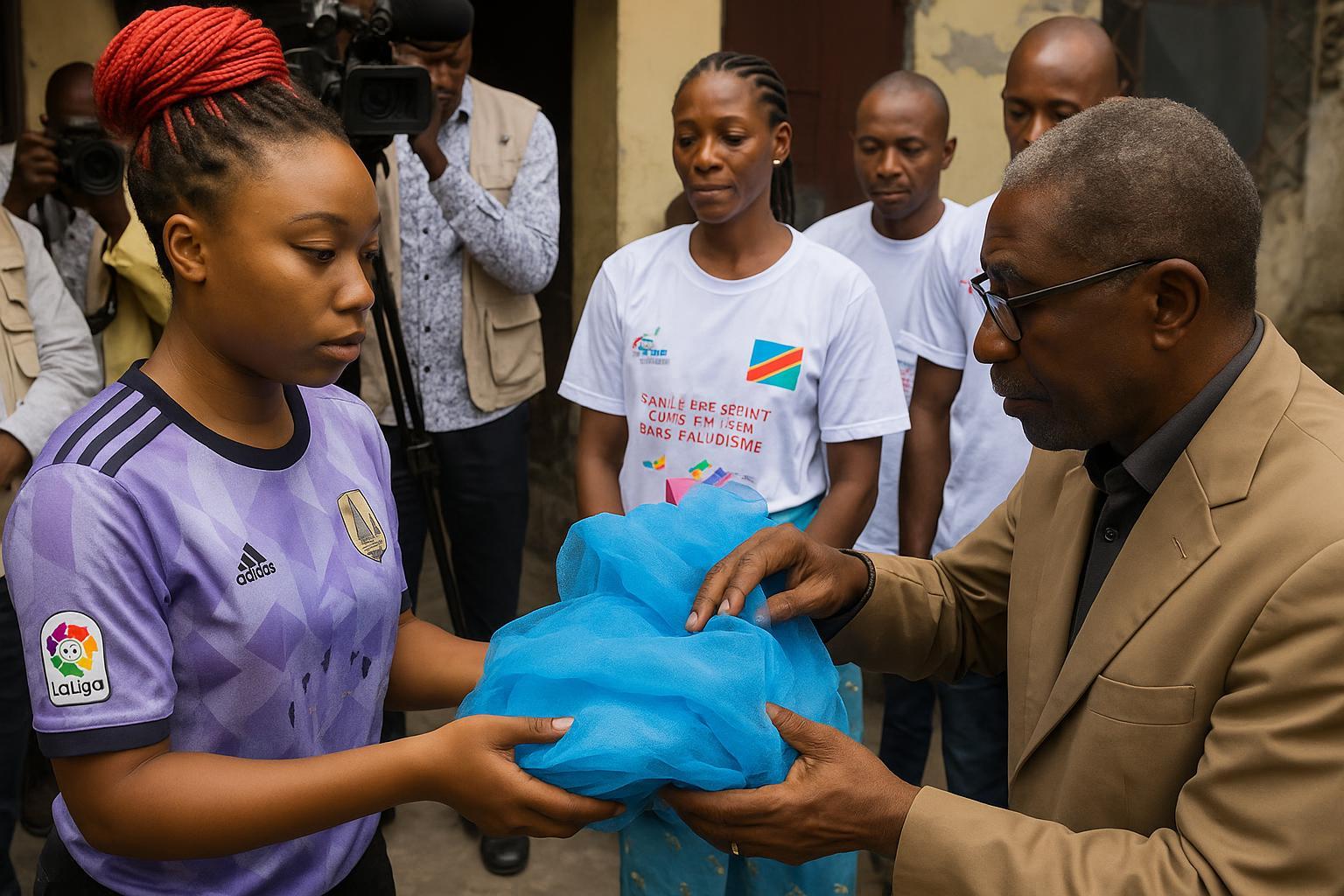
Brazzaville kick-off draws crowds
Horns blared and drums echoed at Marien-Ngouabi Pediatric Hospital in Talangaï as health officials unfurled blue-and-white banners for the national distribution of long-lasting insecticidal nets, known locally as Milda. The 3 December ceremony attracted mothers with babies on their backs, community volunteers and international partners.
Departmental Health Director Jacques Achille Opango cut the symbolic ribbon, framing the campaign as a community celebration and a scientific necessity. “When a family sleeps under a treated net, the entire neighbourhood gains protection,” he told reporters, citing figures from the National Malaria Control Programme, or PNLP.
Why mosquito nets still matter
Malaria remains Congo’s leading cause of clinic visits, accounting for roughly 46 percent of consultations and more than a quarter of recorded deaths, according to PNLP statistics echoed in the 2023 World Malaria Report (WHO 2023). Pregnant women and children under five are the most exposed.
Long-lasting insecticidal nets reduce night-time mosquito bites by combining a physical barrier with slow-release pyrethroids. Studies in neighbouring Cameroon and Gabon show households using such nets see infection rates fall by up to half (Roll Back Malaria Partnership).
Ambitious coverage targets to 2027
Congo’s plan aims to place at least one net for every two people in 90 percent of households by 2027, ensuring that eight citizens out of ten actually sleep beneath the mesh. The goal aligns with the African Union’s commitment to end malaria as a public-health menace within this decade.
Opango stressed that epidemiological progress must be measurable. “We want reductions in case incidence and hospital admissions, not only distributions recorded on paper,” he said. District health teams will monitor coverage quarterly, using digital tally sheets financed by the Global Fund to Fight AIDS, Tuberculosis and Malaria.
Two-phase roll-out across capital
The first phase, already under way, covers Talangaï, Madibou, Mfilou, Kintélé and the island of Mbamou. Trucks loaded with bales of sky-blue nets fan out each dawn, stopping at schools, churches and market squares where distributors check household coupons before handing over parcels.
Phase two will expand to the remaining districts of Brazzaville before moving to Pointe-Noire and the interior departments early next year. Catholic Relief Services coordinates the logistics, while local youth associations provide last-mile delivery on motorbikes, a model tested successfully in the 2021 vaccination drive.
Practical tips for safe use
Health educators remind recipients to air nets in the shade for 24 hours before first use to dissipate excess insecticide. Nets should be washed gently with soap, never bleach, and dried away from direct sun to preserve efficacy. A treated net can remain protective for up to three years.
At the Talangaï site, midwife Estelle Mouyabi demonstrated how to tuck the net beneath a mattress without leaving gaps. “We lose protection the moment a single mosquito slips inside,” she warned. Her tutorial drew applause and a flurry of smartphone recordings destined for social media.
Funding and partners sustain effort
The Global Fund contributes nearly two-thirds of the CFA 14 billion budget allocated to this campaign cycle. Remaining costs are met by the national treasury and technical partners such as UNICEF and the World Health Organization. Officials emphasise that the programme complements, rather than replaces, routine distribution in prenatal clinics.
Senior advisor Dr Christian Bissani said stable funding allows Congo to negotiate bulk procurement, cutting unit costs by almost 18 percent compared with 2019. Savings are reinvested in community health worker stipends and rapid diagnostic test kits, reinforcing an integrated approach to malaria control.
Voices from hospitals and households
At the University Hospital of Brazzaville, paediatrician Dr Huguette Ndinga recalls the 2022 rainy season surge when wards filled with severe malaria cases. “Every child lost is a reminder we must push prevention harder,” she reflected, praising the new campaign’s scale.
In Ouenzé quarter, market vendor Léonie Ngakala collected two nets for her five-person family. “Mosquitoes are bad near the river,” she said, adjusting a bundle of tomatoes on her stall. “If these nets keep my children from fever, I will hang them tonight.”
Outlook for Congo’s malaria fight
Analysts note that Congo’s malaria indicators improved modestly after the 2018 net campaign, with hospital deaths falling from 29 to 26 percent of admissions by 2021 (PNLP annual report). The current drive, bolstered by digital tracking and broader partner support, could accelerate that trend.
Yet experts caution that nets work best alongside timely testing, effective artemisinin-based therapy and environmental control of breeding sites. The Health Ministry plans more community clean-ups and larvicide pilots along the Djiri and Tsieme rivers once the rainy season subsides.
As dusk settled over Talangaï on launch day, children waved their new nets like carnival flags. The scene captured both the urgency and optimism animating Congo’s malaria response: a nationwide effort woven, quite literally, into the nightly routine of millions of households.