
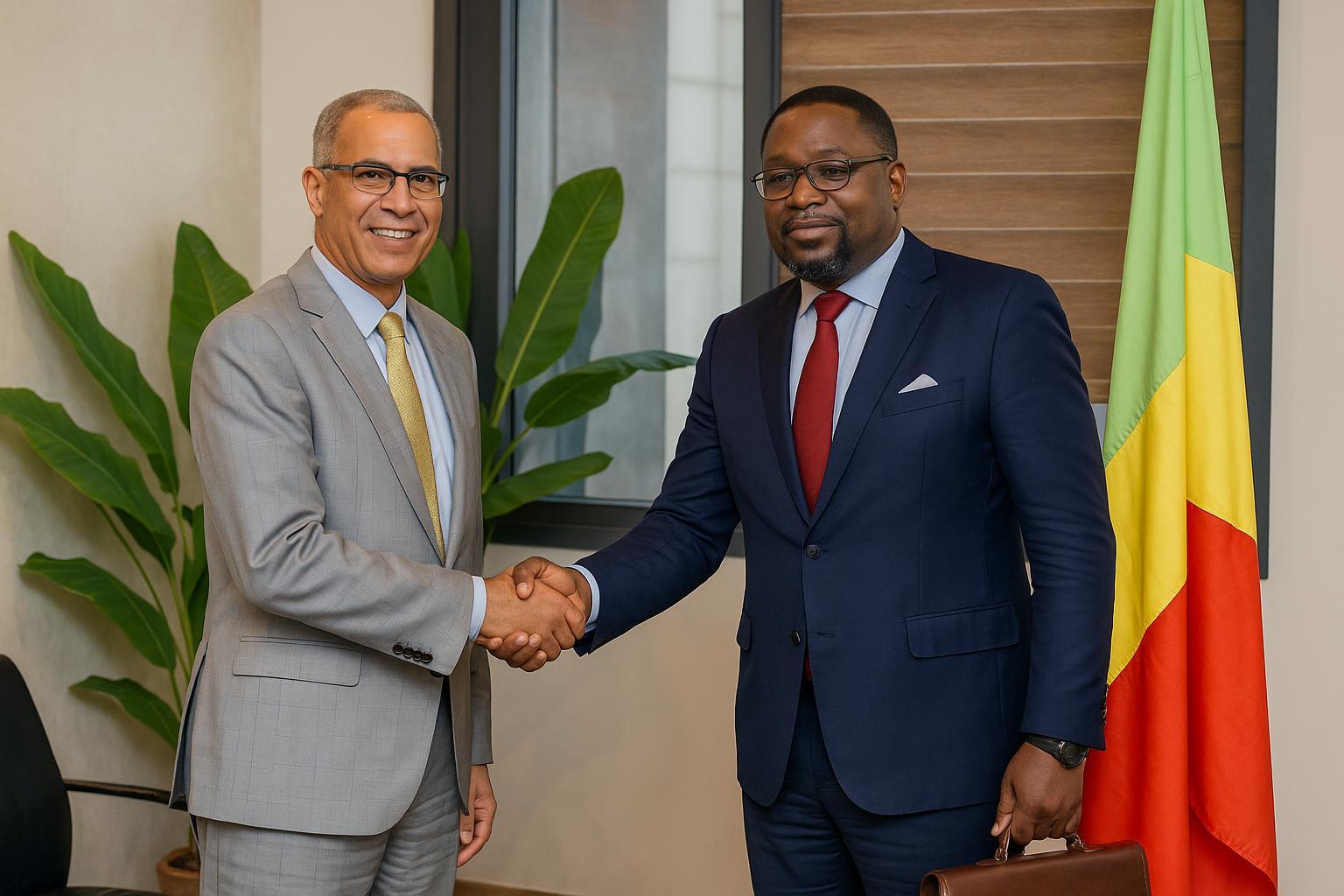
High-level Brazzaville talks seal intent
The Republic of Congo and the African Development Bank (AfDB) signalled fresh momentum on 2 December, when Minister of Urban Sanitation, Local Development and Road Maintenance, Juste Désiré Mondélé, hosted AfDB Deputy Director General for Central Africa, Mohamed Chérif, in Brazzaville.
The courtesy meeting focused on catalysing finance and technical assistance for projects that touch everyday life: cleaner cities, empowered municipalities and better-kept roads linking markets across departments.
Sanitation drive takes centre stage
Minister Mondélé underlined that urban sanitation remains the first priority, in line with national policy that seeks to curb water-borne diseases, protect the Congo River and project a modern image for Brazzaville and Pointe-Noire.
AfDB’s regional representative echoed the view, noting that sanitation investments generate social and economic returns by reducing health costs and freeing household income, an approach already embedded in the Bank’s Ten-Year Strategy.
Local development ambitions outlined
Beyond pipes and drains, the minister presented an agenda of decentralised development where small towns receive targeted support for marketplaces, street lighting and digital services, aiming to slow rural exodus and stimulate grassroots enterprise.
Mondélé invited AfDB experts to help structure feasibility studies, cost-benefit analyses and capacity-building plans so that projects can reach the Bank’s board more quickly and meet international procurement standards.
Road upkeep crucial for trade flow
With logistics costs still high in Central Africa, both parties stressed the importance of routine road maintenance rather than waiting for costly rehabilitation.
Chérif explained that the AfDB can blend sovereign loans with climate adaptation grants to support resilient pavement and drainage, protecting corridors that feed Brazzaville markets and connect the oil hub of Pointe-Noire to hinterland farms.
Existing portfolio under review
Although details remained confidential, the delegation revisited ongoing operations already approved for Congo, agreeing to explore ways of accelerating disbursement and resolving any procurement bottlenecks.
Quick wins, the minister argued, would build public confidence in government programmes and demonstrate the AfDB’s ability to deliver visible impact within its 2023-2025 work programme for Central Africa.
Capacity building at the core
Human resources were another focal point of the conversation, with Mondélé calling for tailored training of municipal engineers, sanitation workers and procurement officers.
Chérif signalled readiness to mobilise the Bank’s Regional Knowledge Hub to design workshops on contract management, gender mainstreaming and results-based monitoring, tools that can lift project execution speed and transparency.
Next steps and timeline
Before leaving the ministry, the two sides agreed to draw up a joint roadmap within the month, listing short, medium and long-term deliverables, responsible focal points and indicative financing envelopes.
A virtual follow-up will take place early next year, potentially ahead of the AfDB’s annual meetings, to ensure that pipeline projects meet board submission deadlines.
Broad significance for Congo’s economy
Analysts view the renewed dialogue as timely, given the country’s ambition to diversify beyond oil and drive green recovery after the pandemic.
Improved sanitation reduces healthcare expenditure, while maintained roads lower transport costs, combined effects that can raise household purchasing power and improve the business climate.
Voices from the ground
Speaking outside the ministry, municipal worker Henri Moussavou said reliable drainage in rainy season would ‘change daily life for street vendors who lose stock to flooding’, echoing the urgency expressed inside the meeting room.
Civil engineer Alvine Mbemba added that partnerships with multilateral banks often speed up adoption of modern standards, noting that Congo’s young professionals ‘look forward to knowledge exchange as much as to fresh funding’.
For the Brazzaville Chamber of Commerce, the prospect of smoother transport links is directly tied to export competitiveness. Secretary Émilie Tchicaya underlined that fruit shipped from the Pool region currently loses value during long journeys; better roads could unlock new agribusiness niches.
In closing remarks, Mondélé reiterated government commitment to transparent procurement and environmental safeguards, confident that an expanded AfDB partnership can ‘turn ambitious blueprints into functioning infrastructure that serves every Congolese family’.