
Ribbon-Cutting Signals New Era in Brazzaville
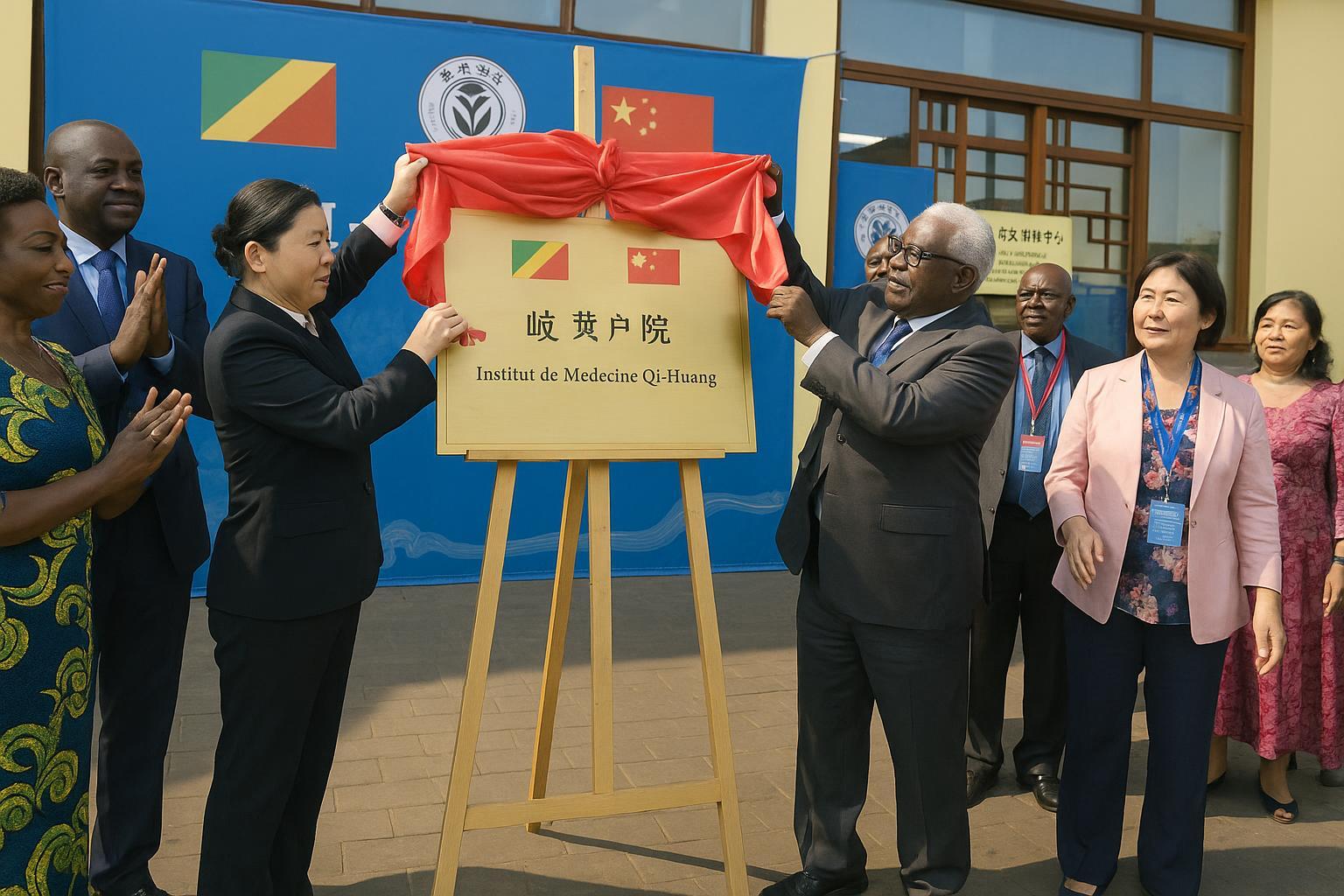
Brazzaville woke up to the scent of burning moxa and the flash of crimson silk on Wednesday as the Sino-Congolese Friendship Hospital in Mfilou cut the ribbon on the Qi-Huang Institute, the country’s first full-scale hub for traditional Chinese medicine.
Government officials, diplomats and white-coated specialists packed the sunlit courtyard where Director-of-Cabinet for Health Donatien Mokassa joined Chinese Ambassador An Qing and Mfilou-Ngamaba mayor Bibiane Itoua to hail what they called a milestone in people-to-people cooperation between Brazzaville and Beijing.
Congo First to Adopt Qi-Huang Teaching Model
Flanked by lion dancers, Mokassa thanked the Chinese medical mission for “standing with Congo in every national health challenge” and predicted the institute would soon become a regional reference centre capable of drawing scholars from Gabon, Cameroon, and beyond in years.
The Qi-Huang Institute carries the name of the mythical Yellow Emperor and his physician Qi Bo, authors of China’s oldest medical treatise. According to National Health Commission delegate Zhang Janjun, Congo is the first country outside Asia licensed to adopt the Qi-Huang model internationally.
Six veteran acupuncturists, two pharmacognosy professors and a nutritionist have already settled in Brazzaville for a three-year assignment. Their brief, Zhang said, is to coach Congolese doctors in acupuncture, tuina massage, herbal compounding and diagnostic pulse reading while co-authoring peer-reviewed research on local disease patterns.
Integrated Care at the Friendship Hospital
Hospital director Roger Oyéré insisted the new wing is neither a museum nor a curiosity shop. “Our goal is scientific integration,” he told reporters, noting that every therapy room sits beside a modern ultrasound or blood-analysis station to encourage joint protocols for patients.
Patients arriving at the pilot ward Thursday described a calm atmosphere filled with string music and cedar aromas. Mabanza Gwladys, treated for chronic back pain, said the painless needle method “already feels lighter than the pills I have swallowed for years” before.
Training, Research and Jobs Pipeline
Under the cooperation agreement, twenty Congolese interns will fly to Guangzhou each semester for intensive laboratory work while another twenty Chinese residents will practise paediatrics and obstetrics at Mfilou. Travel, lodging and stipends are covered by the Chinese South-South Cooperation Fund until 2028, officials.
Academic twinning is expected to cascade into the local pharmacy sector. The Congolese Agency for Standardisation confirmed plans to register thirty new herbal formulations, ranging from anti-malarial teas to dermatitis ointments, provided they meet toxicity and efficacy thresholds set by WHO benchmarks soon.
Economists at the University of Marien Ngouabi predict the botanical supply chain could create 500 jobs within three years, especially in the Sangha and Plateaux departments where Cordyline, Artemisia and cola nut flourish. “This diversification opportunity we cannot miss,” lecturer Francine Ganongo observed.
Health Security and Belt and Road Context
Beyond economics, public health observers see a strategic advantage. Congo annually imports nearly 60 per cent of its essential medicines, according to the Central African Health Observatory. Home-grown remedies could cushion supply shocks like those experienced during the COVID-19 border closures.
Chinese Ambassador An Qing said the collaboration answers President Denis Sassou Nguesso’s call for “innovation that speaks to everyday households.” He added that the medical wing stands beside the No.1 National Highway and the Liouesso hydropower station as flagship projects of the Belt and Road partnership.
Regulation, Access and Public Reception
For the Health Ministry, immediate priorities include drafting a legal framework to license traditional therapists, updating insurance codes to reimburse acupuncture sessions and creating a central herbarium that catalogues both Congolese and imported species to prevent overharvesting in fragile forest zones.
Civil-society network Santé Pour Tous applauded the plan yet urged officials to keep fees affordable. Spokesperson Davy Okouele said enthusiasm may fade if sessions stay priced in foreign currency, a complaint already heard at some private alternative-therapy clinics in the capital.
Asked about pricing, Oyéré replied that public-sector rates would mirror existing hospital tariffs and that a social fund, nourished by proceeds from paid international traineeships, will subsidise vulnerable patients. “Health solidarity is the heartbeat of this project,” the surgeon reiterated to the media crew.
Global Recognition and Future Prospects
The inauguration coincides with World Traditional Medicine Day, lending the ceremony additional symbolic weight. In a recorded message, World Health Organization regional director Matshidiso Moeti saluted Congo’s decision to “embrace evidence-based pluralism” and pledged technical support for curriculum design and data monitoring over five years.
As twilight settled, visitors queued to photograph the jade-green façade where Chinese lanterns mingled with Congolese tricolour bunting. Many lingered, quietly curious, as a doctor traced meridian charts projected onto a wall, hinting at a new chapter in local healthcare.
If the promise materialises, Brazzaville could soon become a stopover for medical tourists seeking both rainforest scenery and time-tested remedies. For now, officials prefer to measure success in shorter queues at outpatient desks and in stories like Gwladys’s springier step home this week.