
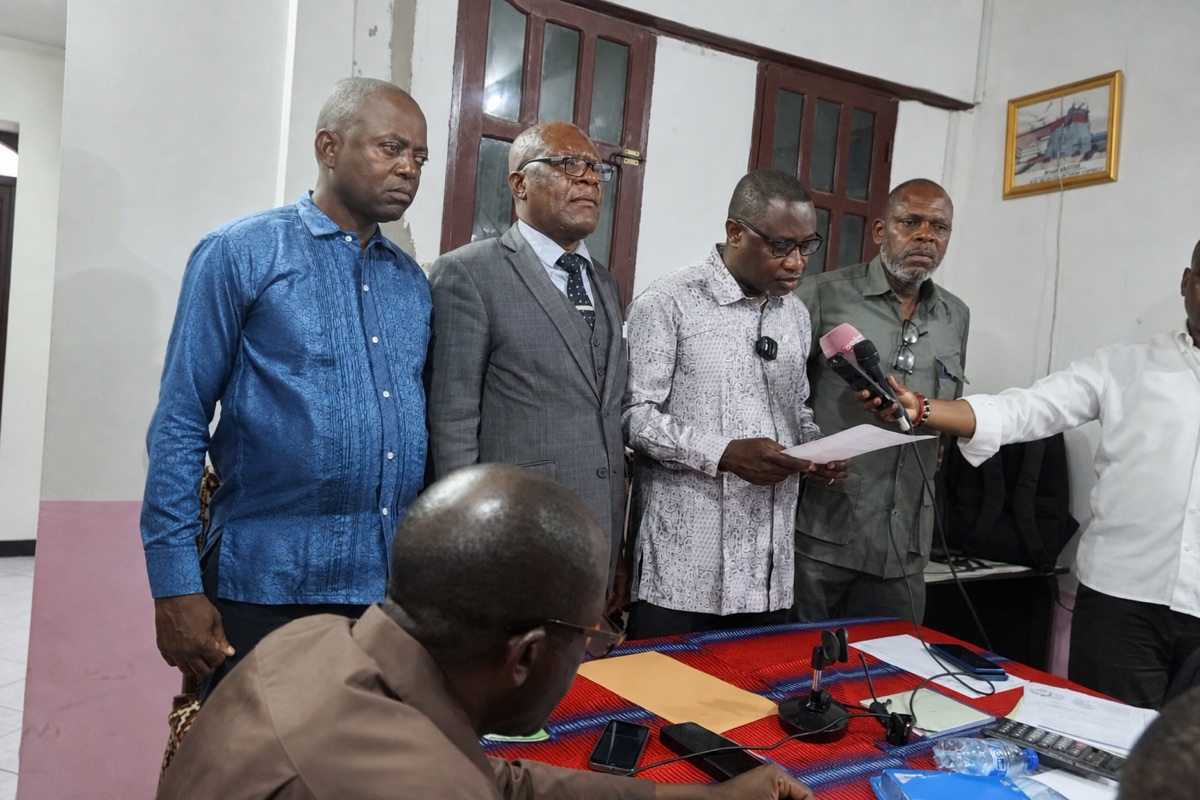
A long stoppage that froze Congo-Brazzaville’s largest public university is over. The intersyndical college of Marien Ngouabi University announced the end of a strike that had paralysed the institution since November 17, 2025, clearing the way for staff and students to return to the lecture halls.
A decision sealed at the Bayardelle campus
The agreement was reached after a meeting held on Saturday, February 7, 2026, at the headquarters of the Synesup union, located on the Bayardelle university campus in Brazzaville. The talks brought union leaders together to weigh the state of negotiations with the government before settling on a way out.
Three senior union representatives carried the decision: Léon Makita Ndoumba of Sypenes, Landry Ngakoula of Synalu, and Jean-Didier Mbélé of Synesup. They judged that exchanges with the authorities had advanced far enough to justify calling off the social movement and reopening the campus.
The wording behind the truce
In their joint statement, the unions framed the move as an act of duty toward the country and toward students whose academic year had been left hanging. “The intersyndical college, in a spirit of responsibility, patriotism and preservation of effective training for students, decides to lift the strike,” they declared.
That formulation matters. It signals that the unions did not present the outcome as a full victory, but as a measured pause built on commitments still to be honoured. The emphasis on students hints at growing pressure to salvage a calendar disrupted for nearly three months.
Government talks that kept the door open
The Minister of Higher Education, Emmanuel Adouki Delphine Edith, met union leaders repeatedly over the course of the dispute. Those exchanges included sessions on November 19, 2025, and two further meetings on January 5 and January 9, 2026, as both sides searched for common ground.
Union officials credited the government with a willingness to address social concerns and to settle outstanding issues step by step. Their account points to a negotiation that, while slow, never fully collapsed, allowing trust to be rebuilt enough to end the walkout.
Three factors that tipped the balance
The intersyndical college pointed to three developments behind its choice. First came what it described as the government’s intent to ease social tension on campus. The unions read this as a signal that their grievances were being taken seriously at the ministerial level.
Second, a signed accord committed the parties to a gradual resolution of the problems at the heart of the conflict. Such a document gives the unions a reference point should promises stall, a common safeguard in disputes where pay and working conditions remain unresolved.
Third, the minister’s availability to handle workers’ grievances reassured the unions that channels of dialogue would stay open after the return to work. Together, these elements offered enough guarantees to justify suspending a movement that had stretched on since mid-November.
What the resumption means for the campus
Work was set to resume on Monday, February 9, 2026, at 7 a.m. The early start underscored the urgency of getting lecturers, administrative staff and students back into a normal rhythm after weeks of interruption that had clouded the academic outlook.
For students, the reopening promises a chance to recover lost ground, though the backlog from a strike of this length is rarely cleared overnight. Catching up on suspended courses and examinations will test the institution’s organisation in the weeks ahead.
For the unions, the end of the strike marks the start of a watching phase. Their statement ties the truce to commitments that still have to materialise, meaning the calm on campus depends on whether the signed accord is followed through in practice.
The episode also illustrates how social dialogue in Congo-Brazzaville’s higher education sector tends to unfold: drawn-out standoffs, repeated ministerial meetings, and resolutions framed around staged commitments rather than immediate, sweeping changes.
For now, the priority is a return to teaching. Marien Ngouabi University, the country’s flagship public institution, reopens its doors with a fragile but real understanding between staff and authorities, and with the shared aim of putting students back at the centre of campus life.