
A Village Moment That Reverberates Beyond Sport
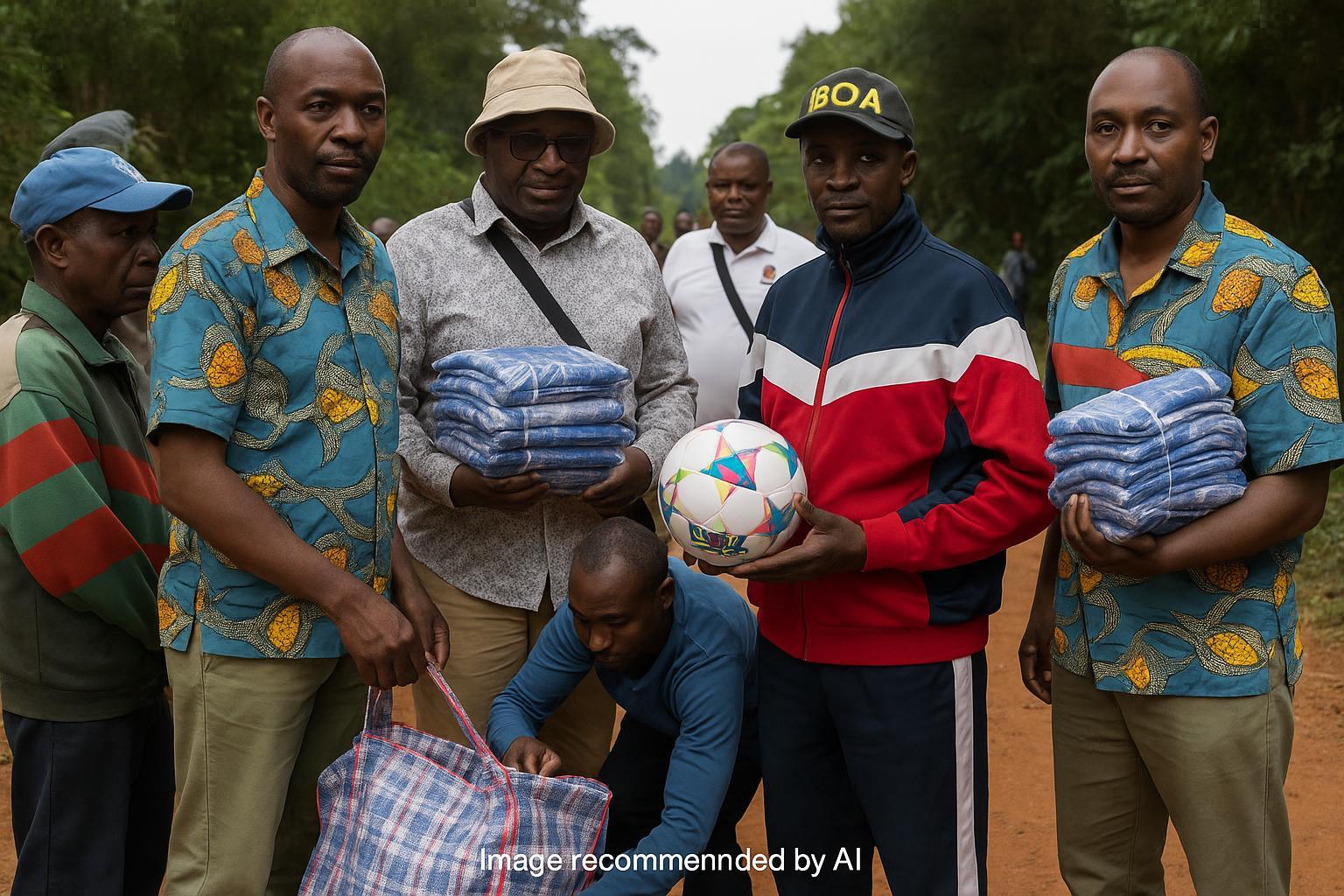
A warm afternoon hush fell over Oubouesse as teenagers laced up new boots and tested the bounce of brand-new balls on the dusty pitch. The equipment, donated by Professor Jean de Dieu Bolzer Nzila, arrived during a ceremony marking the completion of his father’s tombstone.
What might have been a private family homage quickly became a communal rallying point. Local chiefs, teachers and district officials converged to witness a gesture that many residents now describe as a rare convergence of tradition, memory and forward-looking ambition.
Profile of Professor Nzila and His Legacy
An agronomy scholar at the University Marien Ngouabi, Nzila is known among colleagues for weaving civic engagement into academic life. “Research should feed communities as surely as crops do,” he told Radio Congo earlier this year, underscoring his philosophy of applied knowledge.
The professor is also second son of the late Chief Piolé, Joseph Nzila Lipouma. By pairing a tribute to his father with a youth-focused donation, Nzila sought, in his words, “to link ancestral duty with the horizons of a new generation.”
Football as a Tool for Social Cohesion in Niari
Niari’s villages have long relied on informal sport to bridge ethnic and economic divides. A 2023 study by the National Institute of Statistics noted that football remains the province’s most unifying leisure activity, gathering nearly 70 percent of residents on weekends.
Sports sociologist Clarisse Mabiala explains that shared rules on the pitch often spill into daily interaction. “When young people agree on fair play, negotiations in markets and farms tend to proceed with greater trust,” she said, referencing her fieldwork across Mossendjo district.
Inside the Donation: Gear and Symbolism
The delivery included jerseys, shorts, goal nets and a dozen FIFA-certified balls. Though modest, officials value the kit at roughly two million CFA francs, a sum otherwise out of reach for a community where farming incomes average 55,000 francs per month.
More than equipment, the bundle carries symbolism. Each jersey bears the district’s green and gold colours—a subtle nod to the national palette that reminds players of their place within the larger Congolese tapestry.
Alignment with National Sport Policy
Congo’s 2022-2026 Strategic Plan for Youth and Civic Education outlines grassroots sport as a pillar for reducing rural-urban disparity. By channeling private gifts toward underserved districts, policymakers hope to complement state investment in regional stadiums.
Niari’s prefect, Bernard Tchibambelela, hailed the donation as “a timely private-public synergy” that echoes recent Ministry of Sports calls for community partnerships broadcast on Télé Congo in April.
Government Support and Future Infrastructure
Sources at the Ministry of Sports confirm a pilot program slated for late 2024 that will refurbish five village pitches, including the one in Oubouesse, pending final budget approval. The donation places the village near the top of the readiness list, according to a senior adviser who requested anonymity.
Mossendjo Mayor Justine Loukaki anticipates that improved facilities will encourage official youth tournaments. “Once the goalposts are standardized, the federation can schedule qualifiers here,” she told local press, suggesting potential economic spillover for vendors and transport operators.
Voices from Oubouesse: Youth Outlook
Striker-in-training Holger Mavoungou, 17, described the moment he first kicked the new ball as “feeling the world shrink and possibilities grow.” His teammate, defender Christelle Nkanga, added that matching kits “help girls feel they belong on equal footing with boys.”
Parents, too, measure the impact in social terms. Farmer Lucien Mayela believes evening matches will steer teenagers away from the lure of logging camps, where work is plentiful but schooling ends.
Balancing Tradition and Modern Aspirations
For elders, the dual ceremony blended respect for lineage with a pivot toward modern aspiration. Village council member Antoine Dzonte recalled Chief Piolé’s emphasis on unity during harvests. “Today that unity is wearing cleats,” he noted, pointing to adolescents scrimmaging behind him.
Anthropologist Élodie Lebondzo argues that such rituals ease generational tension: “Linking memory to sport allows youths to inherit not only land but also responsibility,” she said during an interview for Congolese Review of Culture.
Monitoring Impact and Ensuring Sustainability
Nzila has arranged for quarterly follow-ups led by university students in sports science, who will track attendance, injury rates and academic performance among participants. Data will feed into a broader study on rural youth outcomes currently funded by the African Development Bank.
Local teachers have volunteered to lock up equipment after practice, preventing the attrition that plagues many rural programs. The district education office has pledged chalkboards and notebooks in exchange for weekly training sessions that incorporate tutoring.
Looking Ahead: Replication Across Niari
Observers say Oubouesse could become a model for nearby villages such as Kibangou and Mbinda, where similar needs are evident. The prefecture is drafting guidelines to streamline donations, hoping to attract alumni networks and private firms engaged in timber and manganese.
As evening shadows stretched across the pitch, Nzila offered a final thought: “One ball can start many journeys. If Oubouesse thrives, the ripple may reach far beyond where my father once walked.” Applause rose, mingling reverence for the past with anticipation of matches yet to come.