
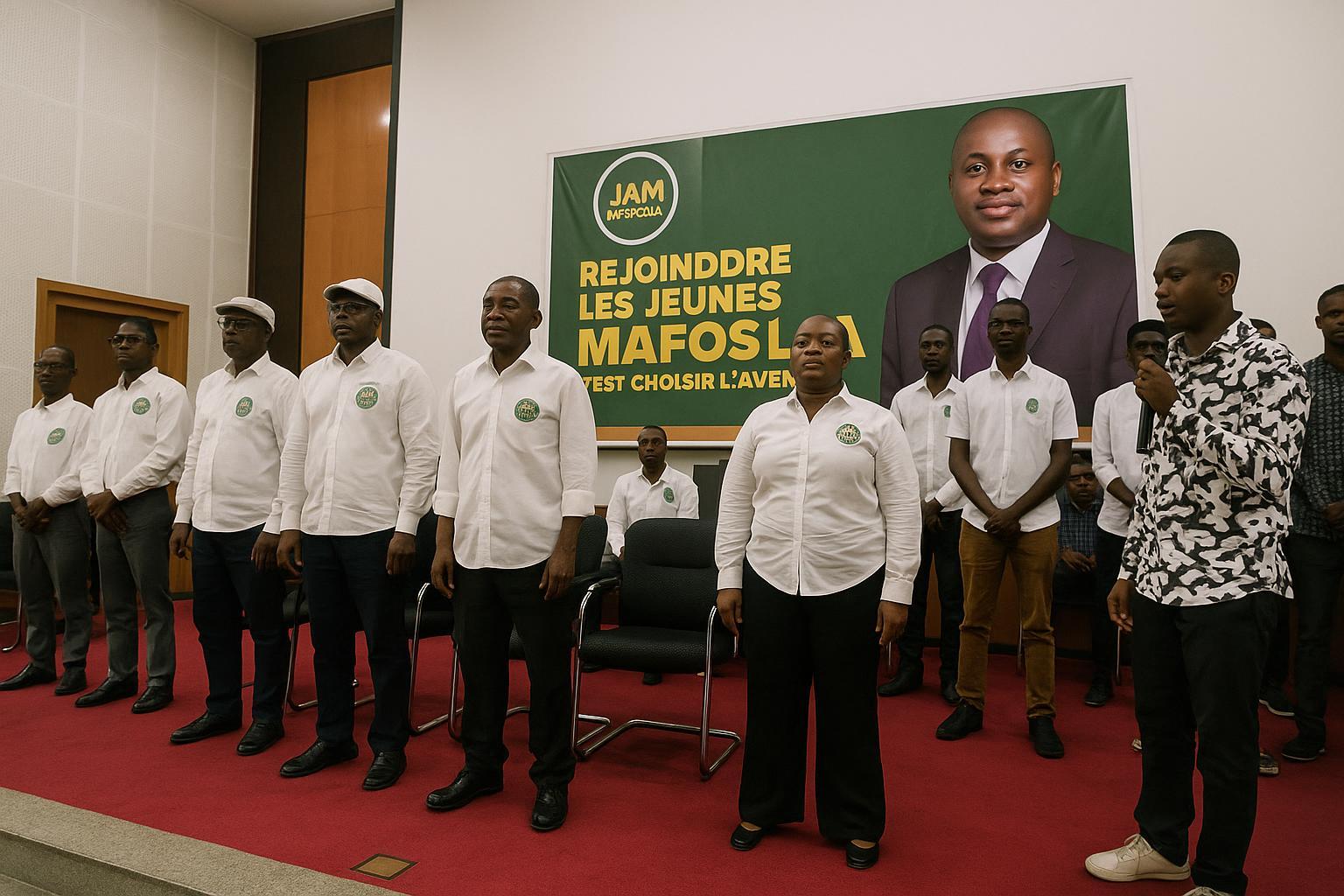
Brazzaville Auditorium Launch Draws Crowd
An upbeat tempo filled the Prefecture Hotel auditorium in Brazzaville as the youth platform Jeunes avec Mafoula, known by its catchy initials JAM, made its public debut on 8 November 2025.
Nearly every seat was taken by students, apprentices and young entrepreneurs eager to sign up for what organisers call a non-partisan civic surge aimed at raising awareness, boosting patriotism and steering peers toward responsible citizenship.
The twelve-member executive board, presented one by one under spotlights, promised to keep the movement open, inclusive and closely aligned with national development priorities set by the government for the coming decade.
Who Is Dave Uphrem Mafoula?
JAM’s honorary president, Dave Uphrem Mafoula, leads the party Les Souverainistes and has long championed youth causes during community tours from Pointe-Noire to Ouesso.
Addressing the audience, he recalled that many national reforms—from universal primary education to the current agricultural diversification drive—depend on young hands and minds.
“When the youth move, the nation moves,” he said, urging participants to serve as volunteers in local clean-up campaigns and digital literacy workshops already backed by municipal authorities.
Youth Vision Aligns With National Goals
Spokesperson Martia Nkouikani described JAM as “a coherent, patriotic and forward-looking force” committed to complementing existing government programmes such as the Support Fund for Youth Entrepreneurship and the Urban Public Service Internship scheme.
Quoting historian Cheikh Anta Diop, she warned against apathy but stressed cooperation: “Our energy is meant to reinforce, not replace, the institutional framework that already protects us.”
Observers noted the tone as constructive rather than confrontational, mirroring the government’s own 2022-2026 Action Plan that places youth empowerment at its core.
Concrete Projects On Jobs And Security
National coordinator Henryal Moudoungou unveiled a schedule of neighbourhood forums, each pairing civic lessons with practical sessions on CV writing, agro-processing and coding.
He explained that unemployment remains a root factor behind urban insecurity, commonly labelled ‘Kuluna’, and pledged to work with municipal police brigades and the Ministry of Technical Education to tackle both challenges simultaneously.
Moudoungou’s remarks echo recent comments by Interior Ministry officials who emphasised that crime-prevention strategies must blend social measures with law enforcement.
Government Voices Welcome Dialogue
Contacted after the ceremony, a senior adviser at the Ministry of Youth and Civic Education welcomed JAM’s arrival, calling it “another shoulder pushing our collective wheel toward the Emerging Congo 2030 vision.”
The adviser highlighted overlapping objectives, citing the national volunteer corps programme launched this year that already engages 15,000 youths in community-service projects similar to those JAM wishes to expand.
Academic analyst Dr Judith Mabiala of Marien-Ngouabi University observed that constructive plurality benefits governance: “Multiple platforms create healthy competition of ideas while reinforcing baseline values of unity and peace championed by President Denis Sassou Nguesso.”
Balancing Critique And Patriotism
During his speech, Dave Mafoula acknowledged strides made through successive ‘Year of the Youth’ initiatives but argued for faster results in job creation and greater transparency in public communication.
His nuanced stance—saluting national progress while requesting acceleration—was applauded by attendees who waved small tricolour flags handed out at the entrance.
Political commentators inside the hall interpreted the wording as a call for partnership rather than protest, aligning with regional trends where youth groups seek seats at decision-making tables instead of street barricades.
Encouraging Responsible Digital Debate
JAM leaders promised to moderate official social-media pages to keep discussions respectful, in line with the government’s 2024 guidelines on combating online misinformation and hate speech.
The movement plans weekly livestreams featuring local administrators, entrepreneurs and security officers to provide real-time answers to questions about internships, licensing and neighbourhood patrols.
Such dialogues, organisers say, can help reduce rumours and strengthen trust between institutions and citizens.
Funding And Transparency Measures
Asked about finances, Martia Nkouikani revealed a three-tier system: member contributions, small business sponsorships and accountability audits by an external chartered accountant.
She stated that all budgets will be published quarterly, matching standards promoted by the National Commission for the Fight Against Corruption.
Analysts view the step as crucial for credibility at a time when youth organisations across Central Africa face intense scrutiny over fund management.
Regional Rollout Beyond Brazzaville
Pilot committees are already active in Pointe-Noire, Dolisie and Oyo, each adapting JAM’s framework to local needs—seafood processing in the economic hub, rural road maintenance up north and vocational tourism in Kouilou.
Training sessions for regional coordinators will be hosted by the National Youth Institute, a facility built with state and private funding, underscoring the public-private synergy stressed by officials.
Digital platforms will knit the network together, allowing members in remote districts to share success stories and seek mentorship without costly travel.
Next Steps For JAM Across The Country
The executive board announced an ambitious calendar: December town-hall meetings on environmental stewardship, January career fairs linked to the Special Economic Zones, and February sports tournaments promoting peaceful coexistence.
Each activity will be logged in an open-data dashboard accessible to ministries and civil-society partners, a move applauded by transparency advocates.
Speaking to journalists after the launch, Dave Uphrem Mafoula summarised the ethos: “Building the Congo we dream about requires all hands, all talents. With government agencies, traditional chiefs and the private sector, our youth are ready to do their part.”