
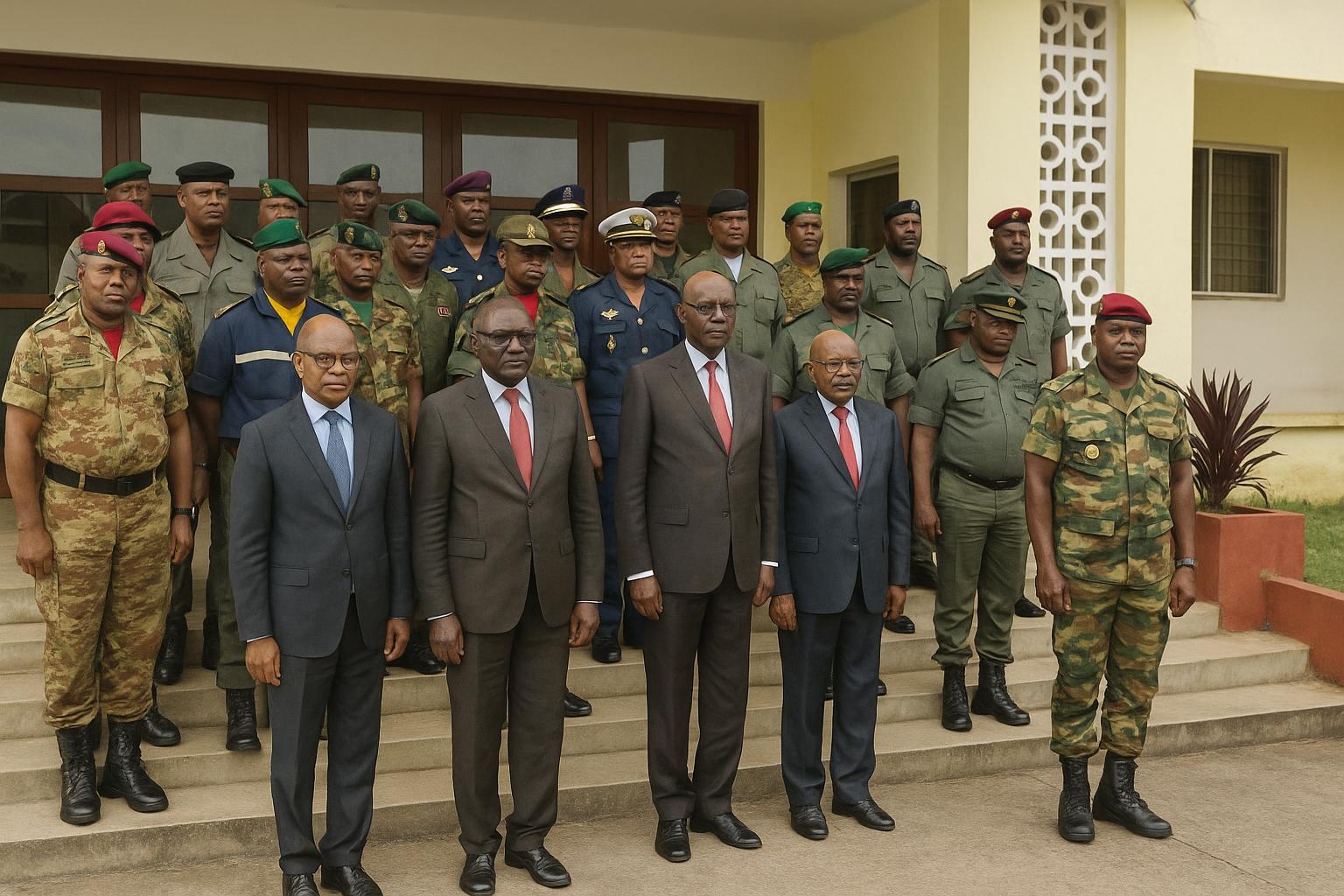
Strategic Training Showcase in Brazzaville
The humid morning air at Bassolo training range vibrated with rotor-wash as the Congolese Armed Forces signalled the start of VIP Day, closing the sixth Command Schools Manoeuvre, better known as Maneco-6. Selected diplomats, lawmakers and defence partners watched a crisp sequence of combined arms demonstrations.
Planned under the direct coordination of Major General Guy Blanchard Okoï, Chief of Staff of the FAC, the exercise aimed to offer senior visitors a transparent look at how future commanders are groomed. Observers from partner missions described the atmosphere as “confident yet studious”, according to regional defence weekly Les Dépêches de Brazzaville.
Digital Command Becomes Operational
A salient novelty this year was the operational launch of an intranet connecting the Marien-Ngouabi Military Academy with forward command posts. Screens inside the mobile command shelter mapped friendly platoons in real time, compressing decision cycles and reducing radio congestion, officers explained.
Colonel-Major Jean Pierre Bouka, head of the Command Schools, called the network “a decisive leap toward fully digital command” in remarks shared later with the Congolese Press Agency. He argued the system accelerates secure information flow between the Groupement des Forces Mixtes, GTIA battalions and SGTIA companies deployed in the scenario.
International Cohort Strengthens Regional Bonds
Maneco-6 assembled 353 personnel, including 30 international officer trainees from Benin, Burkina Faso, Cameroon, Côte d’Ivoire, Central African Republic, Guinea, Mali, Niger and Togo. Their mixed-nation platoons rehearsed convoy escorts and urban entry under simulated fire, illustrating shared security interests along the Gulf of Guinea arc.
In sideline comments, a Cameroonian captain noted that the exercise “mirrors what we encounter against transnational threats”. Defence analysts interviewed by Afrique-Diplomatie magazine highlighted that such exchanges nurture personal networks likely to ease future joint operations against piracy or terrorism.
Inter-Agency Synergy Expands Security Reach
Beyond regular troops, detachments from customs, forestry services and internal security forces practised joint checkpoints and intelligence sharing. The presence of these paramilitary actors responded to lessons drawn from border incidents where ecological crime and trafficking overlap classic security concerns.
A senior customs liaison underlined that joint drills “help us speak the same operational language”, especially when seizures of illicit timber or wildlife products escalate into armed confrontations. Observers from the World Customs Organization, present as guests, commended the integrated approach.
Leadership Endorsement and Future Pathways
Defence Minister Charles Richard Mondjo, attending the closing salute, praised the trainees for demonstrating “discipline, innovation and regional solidarity”. His speech, relayed by national television Télé Congo, hinted that digital tools proven at Maneco-6 may soon equip operational brigades.
Comparing the drill with last year’s Maneco-5, planners cited improved response times and a twenty-percent reduction in exercise radio traffic thanks to the intranet. Next editions could incorporate unmanned aerial platforms to extend reconnaissance, a prospect being evaluated by the Defence Procurement Directorate.
Broader Context for Diplomats
For resident diplomatic missions, the showcase offered tangible insight into Brazzaville’s security doctrine, which emphasises mobile, well-connected units able to act jointly with civilian agencies. Several envoys privately described the day as “reassuring” amid wider regional volatility, according to an aide present at the debrief.
Think-tank researcher Rosalie Makosso, interviewed by La Semaine Africaine, framed Maneco-6 as part of Congo’s measured modernisation drive: “It balances budget realities with the need to keep pace with partner nations. The inclusion of forestry and customs units reflects the country’s environmental priorities.”
Human Dimension of Officer Formation
Outside the firing lanes, VIPs toured stands displaying navigation tools, survival rations and field medical kits. Cadets from Gamboma’s National School for Non-Commissioned Officers explained how their recent commando hardening stage pushed endurance limits and forged cohesion ahead of operational deployment.
Families of trainees, invited for the first time, engaged with instructors about career paths. “Seeing my son master an armoured vehicle’s controls convinces me of the value of this education,” said Thérèse Mavoungou from Pointe-Noire, echoing parental sentiments gathered by the public affairs team.
Measured Takeaways for Policy Makers
Analysts caution that digitalisation must be matched by sustained maintenance budgets and cybersecurity vigilance. Yet the practical results observed during Maneco-6 suggest a prudent, scalable approach aligned with national defence objectives articulated in the 2023 White Paper.
As delegations departed, Colonel-Major Bouka summarised the exercise’s intent: “We train to command, we command to protect.” With Maneco-7 already on the planning board, Congo’s Armed Forces project a steady trajectory toward a flexible, interoperable security architecture.
Closing Perspective
Maneco-6 therefore stood as both a graduation ceremony and a policy signal. It showcased a military investing in people, partnerships and technology without losing sight of fiscal prudence or national context. Observers widely agreed the balanced formula merits continued attention.