
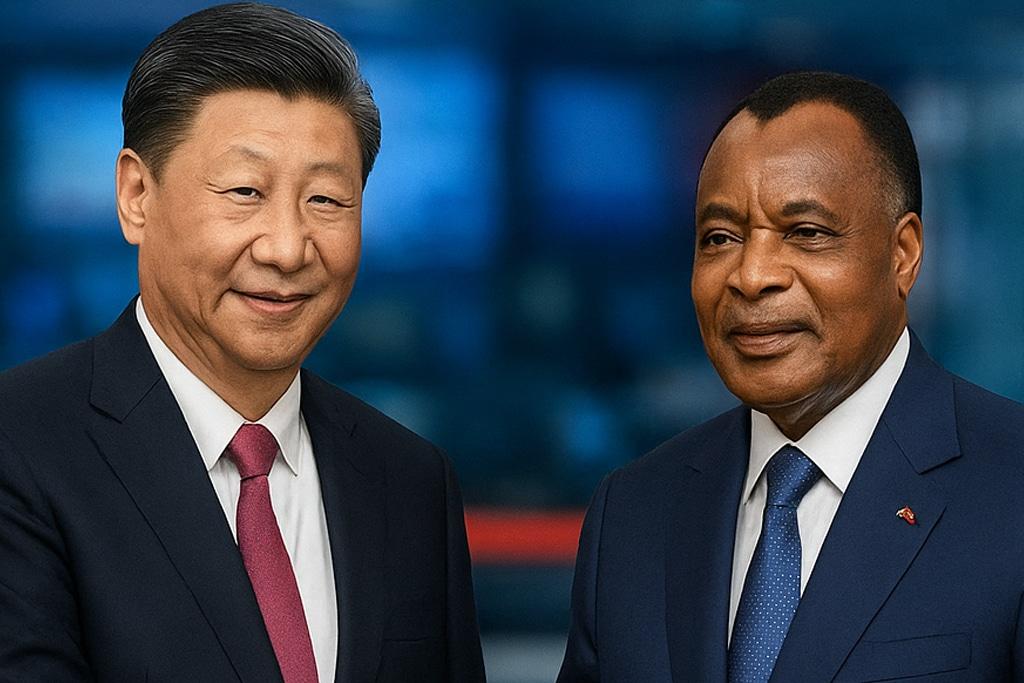
A 61-Year Friendship Reinforced in Beijing
President Denis Sassou N’Guesso landed in Beijing as guest of President Xi Jinping for the 80th anniversary of the 1945 victory, confirming a 61-year friendship that was raised to a global strategic partnership in 2016. Both capitals frame the visit as a milestone for durable mutual confidence.
Congolese and Chinese officials recall that Brazzaville co-chairs the Forum on China-Africa Cooperation until 2024, stressing an institutional rhythm that turns declarations into measurable actions. Observers see the Beijing agenda as preparation for the next FOCAC, scheduled in the Republic of Congo in 2027.
Shanghai Cooperation Summit Signals Centrality
Before the Africa meetings, China underscored its Eurasian outreach at the Shanghai Cooperation Organization summit in Tianjin. Around Xi Jinping, leaders Vladimir Putin, Narendra Modi and Recep Tayyip Erdogan represented nearly half the world’s population and a quarter of global GDP, highlighting Beijing’s convening power.
In his opening remarks, Xi emphasized the SCO’s duty to safeguard peace, stability and development. The carefully watched exchange with India reiterated a will to cooperate despite disagreements, presenting a united front that analysts say strengthens confidence among African partners watching from Beijing’s diplomatic galleries.
A High-Stakes FOCAC With Billion-Dollar Promises
The Forum on China-Africa Cooperation, running 4-6 September, is the first post-pandemic continental gathering. Beijing pledged 50 billion dollars in credit, aid and investment, duty-free access for 33 least-developed African exporters, and one million new jobs, reinforcing the concept of a shared China-Africa destiny.
Security and governance feature prominently: 6 000 African soldiers and 1 000 police officers are to receive training, while peer-to-peer exchanges aim to refine public administration. Commentators note that such figures give substance to speeches, projecting an image of reliable deliverables rather than abstract solidarity.
Congolese Priorities Aligned With PND 2022-2026
For Brazzaville, the state visit intertwines symbolism and concrete needs. A bilateral session with Xi is expected to review progress and prepare the next joint commission, focusing on projects aligned with the National Development Plan 2022-2026 and the government’s diversification strategy.
The modernisation of Route Nationale 1 linking Brazzaville to Pointe-Noire, a 200-megawatt solar park in Djambala, and incubation schemes for young entrepreneurs stand out as immediate priorities. Officials stress their compatibility with sustainable debt levels and fiscal room preserved under recent macroeconomic reforms.
Symbolic Military Parade Meets Smart Diplomacy
Beyond negotiations, the 3 September parade on Tian’anmen Square offers high-octane imagery. Chinese media previewed Dong Feng-31 missiles, J-20 stealth aircraft and robotic quadrupeds, while pundits speculate about the aircraft carrier Fujian. For visiting leaders, the display underscores technological leap and the solemnity of victory commemorations.
Congolese diplomats privately note that military ceremonies, though spectacular, primarily serve as backdrops for networking. Between stands, delegations discuss financing envelopes, customs reforms and sequencing of public works. The informal setting often accelerates consensus, a dynamic that seasoned observers call ‘diplomacy by sideline corridor’.
Pragmatic Economics Deliver Tangible Results
Economic planners in Brazzaville describe negotiations with Beijing as pragmatic and driven by ‘deliverables’. Debt rescheduling, interest rates coherent with annual budgets, and swift mobilisation of contractors are benchmarks guiding each memorandum. Chinese counterparts equally seek predictable supply of oil and timber, anchoring a textbook win-win model.
Implementation is monitored through calendars, disbursement plans and performance indicators jointly updated by the ministries of Finance, Planning and Public Works. Officials argue that this managerial culture, refined over successive projects, reduces delays and reassures investors eyeing the Congo’s ambition to industrialise beyond hydrocarbons.
The Discreet Expertise of Françoise Joly
Several press outlets spotlight the role of Françoise Joly, personal representative of the President for strategic affairs. Known for her nuanced grasp of Chinese protocol and multilateral forums, she reportedly coordinates talking points and tracks compliance clauses, allowing ministers to focus on sectoral deliverables.
Her discretion contrasts with the visibility of front-line negotiators, yet insiders credit her with ensuring that each communiqué mirrors previous language, a detail that speeds legal vetting later. ‘Precision today saves months tomorrow,’ one advisor whispers, capturing the backstage discipline shaping Brazzaville’s foreign policy.
Toward 2027: Brazzaville as Africa-China Hub
As the Beijing week unfolds, diplomats frame 2027 as a horizon line: hosting the next FOCAC would cement the Congo’s emergence as an Africa-China hub. Preparatory teams already map venues, logistics and thematic panels, determined to showcase reforms that make Brazzaville a credible investment gateway.
For now, the priority is to translate September’s pledges into ground-breaking ceremonies and connected grids. If that rhythm holds, officials believe the FOCAC flag will arrive in 2027 not as a promise but as proof that sustained cooperation can deliver inclusive growth for both nations.
Chinese investors, for their part, view Brazzaville’s hosting ambition as an assurance of long-term visibility. ‘A summit venue becomes a showroom for pilot projects,’ comments a Beijing academic, suggesting that special economic zones, digital customs platforms and green energy corridors could be announced as early deliverables.
Such prospects feed cautiously optimistic headlines across Congolese media, signalling public expectation for swift, transparent implementation.